2026 – The year you will be lied to on an epic scale, so we start with the truth
Those who talk the UK down, blaming Brexit for non-existent falls, must explain themselves
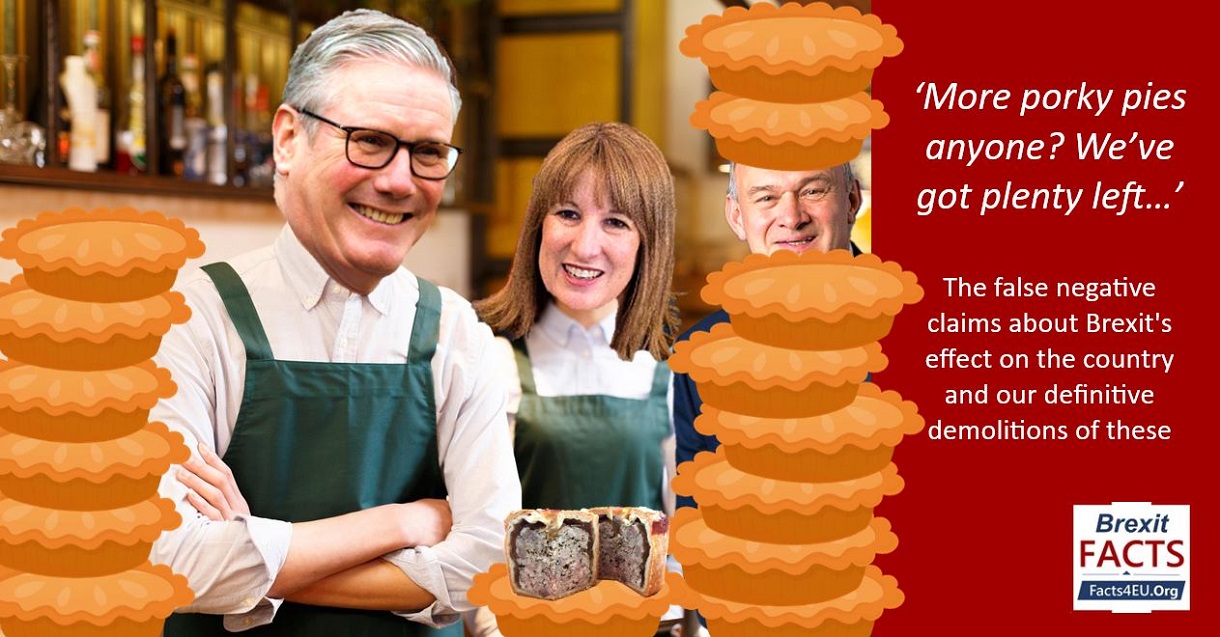
Montage © Facts4EU.Org 2025
Sir Keir and all Rejoiner MPs are proved wrong, with the definitive evidence the UK has done better since Brexit
2025 came towards a close with the public being told an increasing number of lies. These have been told in so many ways, at such repetitive frequency, many people are starting to believe them.
Facts4EU starts the year, in collaboration with the Rt Hon Sir John Redwood and in association with GB News, by correcting the record with the definitive take-down of the lies we are all being told. If Sir Keir is going to drag us further back into the EU in 2026, he will not be able to do so built on a foundation of pure fabrication.
In this first report of 2026, we present the facts, based on the official data from the Office for National Statistics, which show conclusively that if Sir Keir is determined to take the United Kingdom back under EU laws and regulations again, he will not be able to do so by using one pretence after another. The public deserve to know the truth, and that is what this two-part report delivers.
After reading this report, and Part II, based purely on official facts, there will no longer be any excuse for Sir Keir Starmer and all Rejoiner parties and their MPs to mislead the public so egregiously.
A Brexit Facts4EU.Org 2-parter with good news about Brexit
Part I (This report) - The definitive demolition of the claim Brexit has damaged economic growth
Part II - Definitive demolitions of the other negative claims about Brexit's effect on the country
What they have been telling the public, day in, day out
Everyone in Government from Sir Keir Starmer and Rachel Reeves, to pretenders for the crown such as Andy Burnham, to almost all Labour, LibDem and SNP MPs, have been enthusiastically talking the country down.
They are saying that the UK is worse off due to Brexit, and the set-back is quoted as being between 4% and 8% of GDP, depending on who is speaking and which academic forecast they are referring to.

We will cover the oft-heard "Brexit has reduced our economy by 4% of GBP", plus a number of generic comments, but we will start with the latest claim of "6-8% smaller" which surfaced in a LibDems motion in the Commons in December.
Then Sir John Redwood will take us through the one we've all heard so many times, about us being 4% worse off.
On 09 December, the LibDems were given time for a 10-minute bill in the Commons and chose to propose a motion demanding the Government start negotiating with the EU to rejoin the Customs Union.
Talking the country down, for a gloomy 2026 - who wants that?
The latest debate was led by Dr Al Pinkerton MP, a long-time Scottish academic who won the seat of Surrey Heath in 2024 and is now the LibDem Spokesman for Europe. Dr Pinkerton began the motion in the Commons by saying the following.
“Up and down the country, businesses know it, the public feel it and it is time that this House found the courage to lift our whispered voices and admit it: Brexit has been an abject economic failure.
It has choked business investment, shattered economic resilience, strangled trade, shrunk the economy and left every single one of us poorer.”
- Dr Al Pinkerton MP, House of Commons, 09 Dec 2025

This description, of Brexit having shrunk the economy, is typical, regardless of the facts that prove the opposite. Al Pinkerton even quotes the PM the previous week as saying:
‘“The Brexit deal significantly hurt our economy. So for economic renewal we must keep reducing frictions and move towards a closer relationship with the EU.”’
- Sir Keir Starmer, quoted by Dr Pinkerton
He then adds David Lammy by saying: ‘That view was echoed by the Deputy Prime Minister, who described a customs union as an inevitable “journey of travel”.’

The strange, unendorsed, academic forecast paper on which the LibDems base their claims
The LibDem’s motion was then justified with an academic paper, which was referenced by Dr Pinkerton.
“Just last month, the National Bureau of Economic Research, a leading US think-tank, published a decade-long analysis concluding that Brexit has reduced UK GDP by between 6% and 8%.”
- Dr Al Pinkerton MP, House of Commons, 09 Dec 2025
The ‘killer’ charts which destroy the Rejoiners’ case
The important point to make is that the paper does not claim that Brexit has “shrunk the economy”. It forecasts, in effect, that the economy is 6-8% smaller than if there had been no Brexit.
Our own charts are simple and straightforward. Below we present the two ‘killer’ charts which make the LibDems and all the other Rejoiner parties – Labour, the SNP, the Greens, and various independents and very small parties - look somewhat misinformed, to say the least.
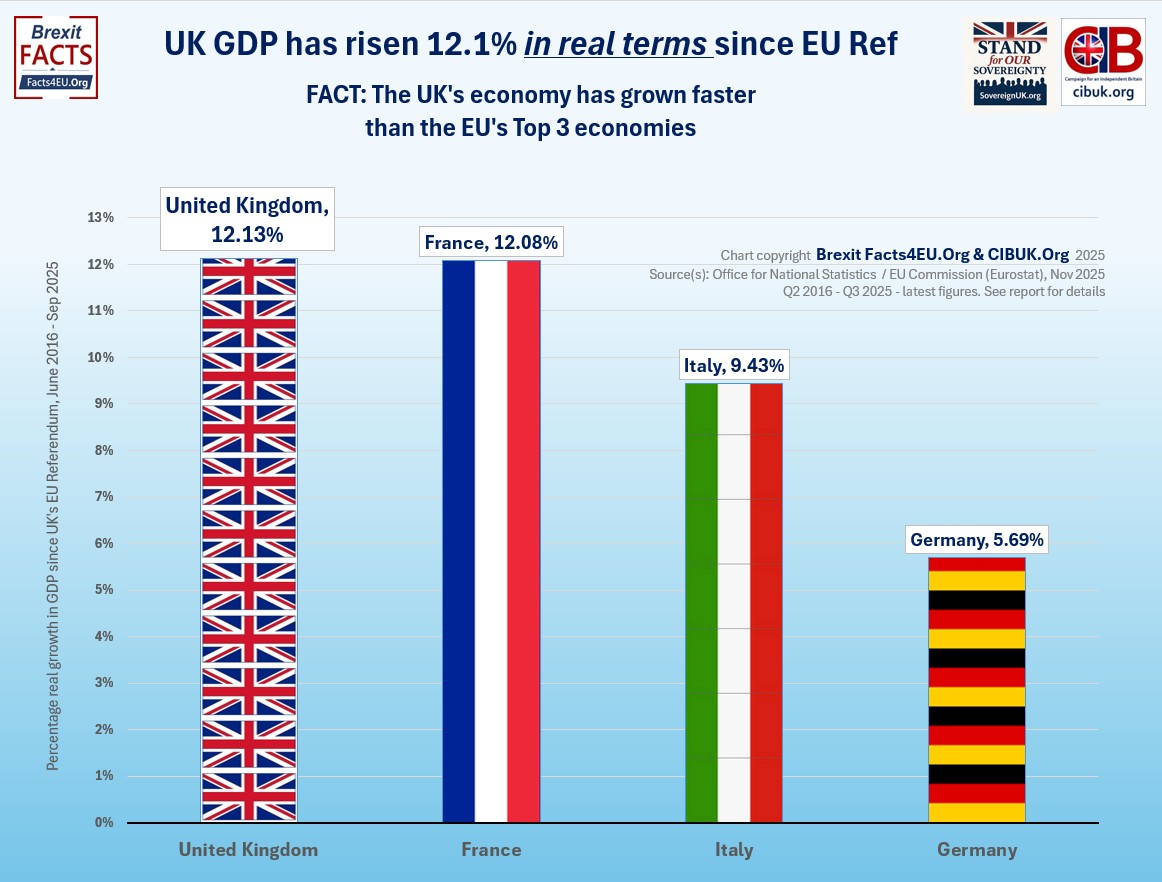
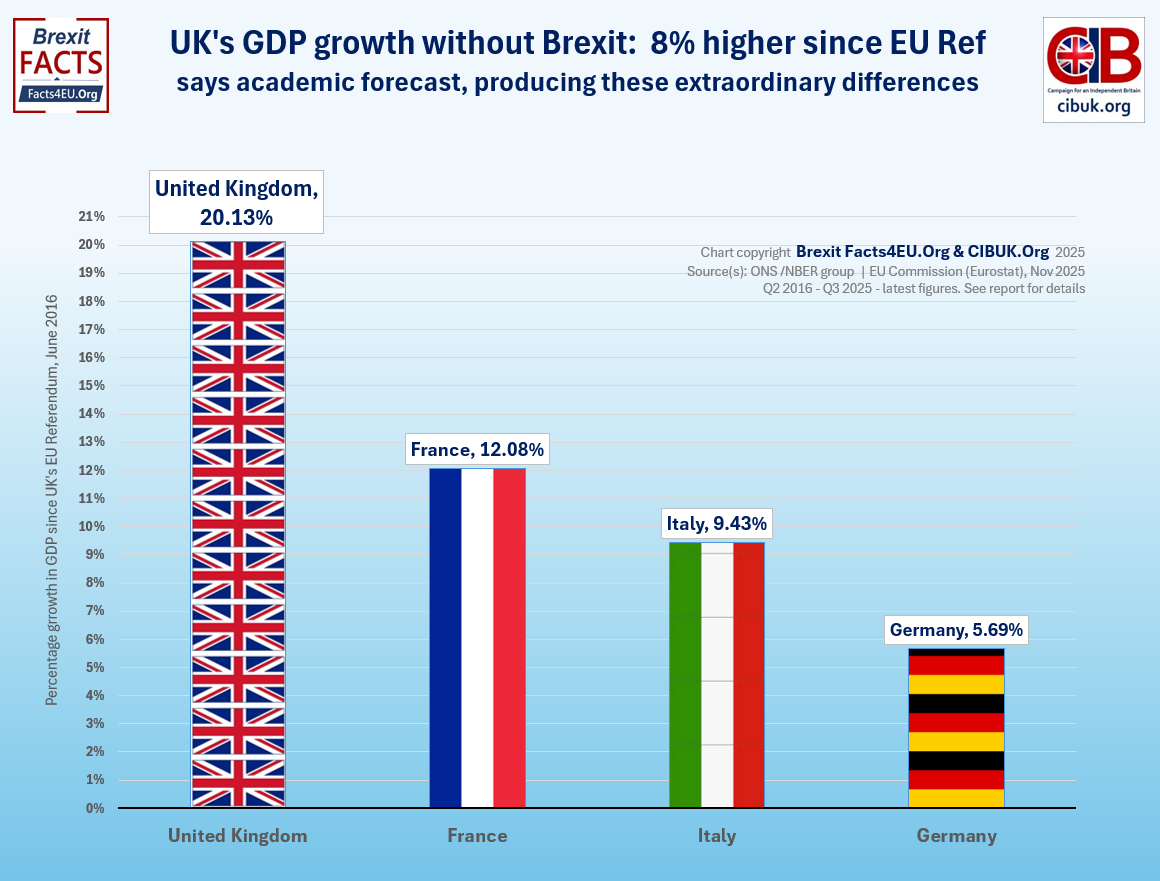
On the left is the actual position of the UK and the EU’s Top 3. On the right is what it would look like with the UK’s GDP 8% higher, “without Brexit”.
UK GDP has grown 12.1% in real terms since the Referendum,
beating the EU's Top 3 economies
© Brexit Facts4EU.Org 2025 - click to enlarge
© Brexit Facts4EU.Org 2025 - click to enlarge
The right-hand chart, using the academics’ forecast that UK GDP would be
8% higher without Brexit, is completely implausible.
The right-hand chart, based on the forecasts used by the LibDems and others, is clearly implausible as it is highly unlikely that the UK would have out-performed the EU's Top 3 economies by such an amount. This is partly due to the refusal of the British establishment to take advantage of Brexit freedoms to follow better growth policies holding us back. If we want to grow like the US we need to dump a lot more EU baggage.
Why do you want forecasts, when you have the facts?
It is important to state that although this academic paper covers the 10-year period for which there are facts such as annual GDP, it does not use them. Nor does it compare the UK to its closest competitors, as Facts4EU typically does. Instead the authors created their own formulae to make forecasts of what the UK economy might have looked like without Brexit. The most important problem, however, concerns the methodology.
To arrive at its conclusions, the ‘NBER’ working paper uses different countries for its comparisons. It would be hard to pick a more bizarre list. In the crucial GDP series, it uses 60% US, 11% Estonia, 10% Greece and 10% Italy and Ireland. The normal thing to do would be to compare with similar economies.
None on the list is remotely comparable with the UK with the possible exception of Italy. The US is far larger and has had superfast growth from lower taxes and digital supremacy. Former Soviet Estonia is an economic outlier and its economy is 1/85th of the size of the UK’s. Ireland has fast growth from extra low business taxes making it a home for US digital giants. Greece is recovering from the Euro crisis with generous EU subsidies, as is Italy to a lesser extent. France and Germany are nowhere on the list.
GDP per head
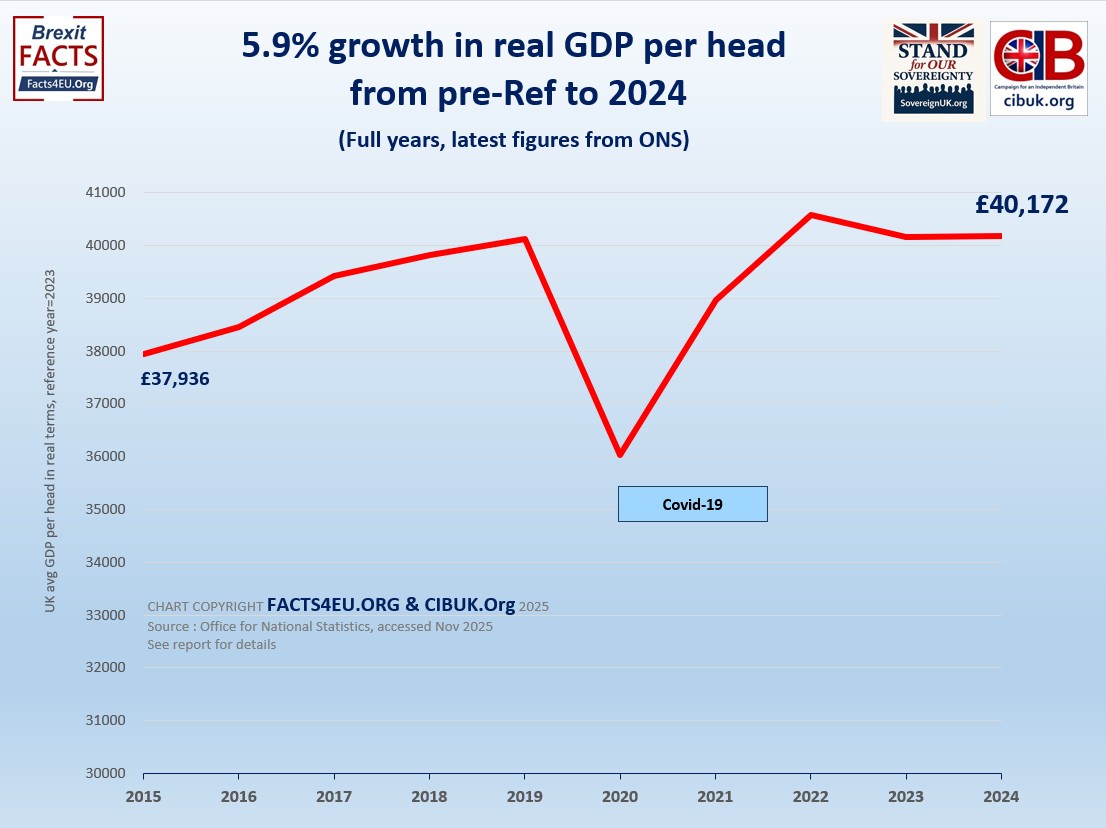
The paper also mentions GDP per head. Once again, contrary to what the public are told, this has actually risen. Below is the proof, with data from the Office for National Statistics.
GBP per head has risen in real terms by 5.9%
since the EU Referendum
© Brexit Facts4EU.Org 2025 - click to enlarge
[Source(s) : ONS, accessed Nov 2025]
"An abject economic failure"? That's not what the facts show
The LibDem spokesman for Europe has based his withering attacks on Brexit on an academic study that has not even been peer reviewed. The question has to be asked: Why not simply look at the official figures? These show categorically that UK GDP has risen - and has done so faster than the economies of our main competitors.
The reason, presumably, is that the facts do not suit the narrative the LibDems wish to tell; that Brexit has been a disaster and we must rejoin the EU as quickly as possible. The facts show healthy growth in GDP and even in growth in GDP per head. This is obviously an 'inconvenient truth'. Nevertheless, a truth is what it is, and the public have a right to know.
Please start our New Year off well !
Where else would you read research like this?
We rely wholly on patriotic members of the public to survive. Please donate today if you would like to continue reading us tomorrow, next week, and the weeks after.
Any credit card user
Quick One-off

From £5 - £1,000
Monthly

From £3 per month
Paypal Users Only - Choose amount first
Quick One-off
Monthly
Don't leave this to someone else. You are that 'someone else'.
The Rt Hon Sir John Redwood gives us his thoughts on
The most used forecast of them all
Pictured right: The Rt Hon Sir John Redwood, MPhil, DPhil, Distinguished Fellow of All Souls Oxford, former MP for 37 years, former Secretary of State, former Director of Lady Thatcher's Number 10 Policy Unit.

The OBR forecast made before the referendum said that UK productivity could suffer a 0.25% per annum decline, leading to a potential 4% loss over 15 years. This became translated falsely into a loss of 4% of GDP from Brexit, which many have wrongly claimed has already taken place. The crucial things to note in the OBR version was it was a long-range forecast, it was not an actual reduction in GDP nor even a reduction in productivity, but a forecast of a slightly slower rate of growth in productivity. So what has gone wrong with interpretations of it?
It is not possible to accurately forecast an outturn in 15 years’ time when so many things affecting growth and productivity will come to weigh on the results. A list of things affecting productivity today for the UK would lead with the deliberate closure of some of the most highly productive industries including oil, gas, oil refining, heavy industry, and diesel and petrol car making. It would include the impact of working at home and the collapse of productivity in the UK public sector brought on by the Covid lockdowns. On the positive side there would be the impact of Artificial Intelligence which had not been dreamed up when the OBR made its long-range guess.
The inconvenient truth
Imagine you are a Rejoiner politician. The first thing you would like to show people is how badly Brexit has affected the economy. You do what any normal person does and look up the figures using all the data available from the Office for National Statistics. Unfortunately, you immediately run into problems. No matter how you try to portray the information, it all comes out positive for Brexit.
GDP? It has grown faster than our main EU competitors. Ah, but real GDP, after taking out the effect of inflation? No, that has also grown faster. Okay, you think, what about altering the time period? Instead of using the time since the Referendum, what about the time since we actually left the EU? Oops, no. The economy grew even faster since then.
Example: GDP since Referendum compared to GDP since exit
- GDP increase since Referendum: +12.1%
- GDP increase since exiting the EU: +14.0%
You try this for all sorts of things, but all the metrics show that the country has done better as a result of Brexit than if the vote had been for Remain.
In desperation you turn to academic studies and finally you have some joy. There are some theoretical studies which suggest the country would have done even better without Brexit. They may only be theoretical but they’re better than nothing. And with luck, people might start to quote them as if it’s a fact that the economy is 4%, or 6%, or even 8% worse off. Bingo!
This is what the bulk of our MPs have been reduced to.
The claim of a 4% drop in GDP and why these doom-mongers are so disastrously wrong
Sir John Redwood comments further and Facts4EU provides facts in simple chart form
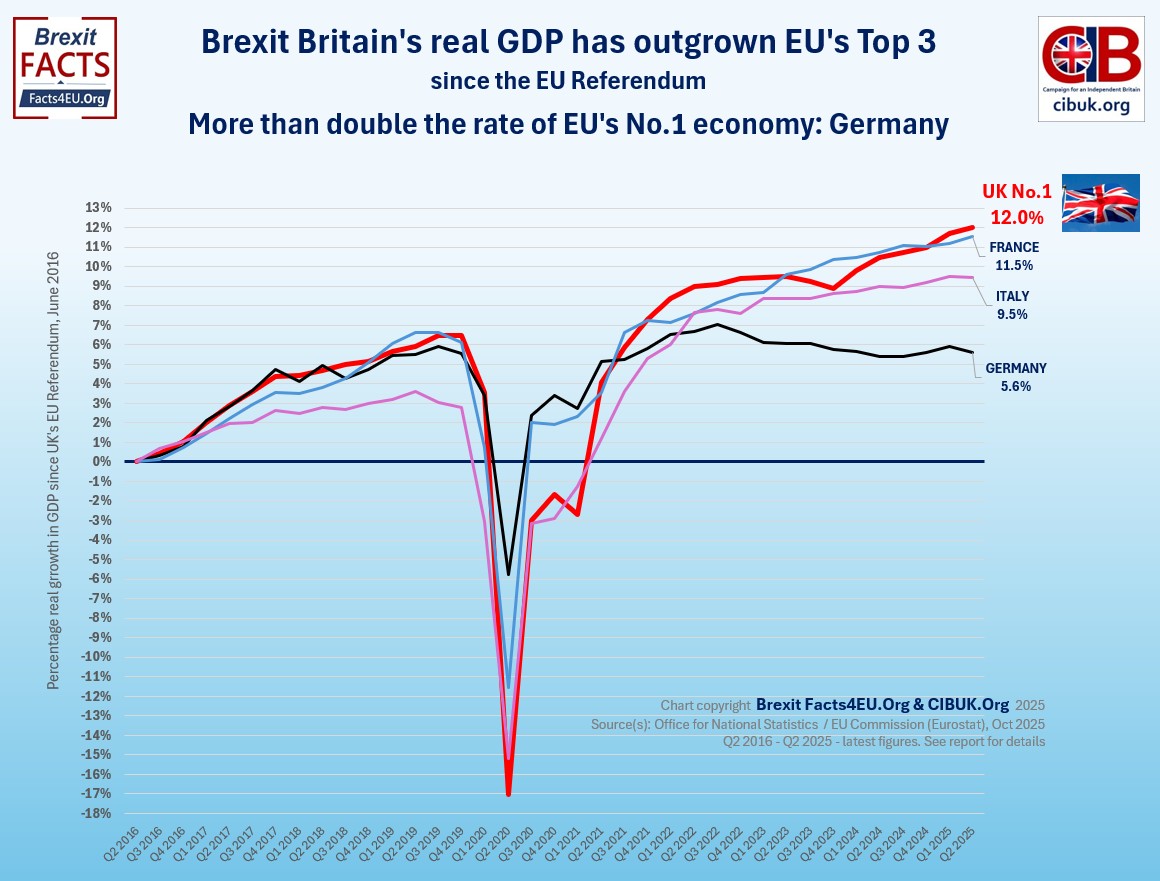
The casual abusers of the OBR figures wrongly say there has been a 4% fall in GDP (not productivity) which the outturn figures post the vote and post-exit show did not happen. There was a big fall in GDP from Covid lockdowns which mirrored similar falls in all the EU countries following similar lockdown policies with a recovery when the bans were lifted.
This is well-demonstrated in Facts4EU’s excellent chart below, which uses the official data from the Office for National Statistics and the EU’s Eurostat equivalent.
How the UK's GDP has outgrown the EU's Top 3 economies
since the EU Referendum
© Brexit Facts4EU.Org 2025 - click to enlarge
[Source(s) : ONS and Eurostat, Dec 2025]
Collectively, the figures demonstrate that the UK has grown slightly faster than the leading EU economies out of the EU. It has not suffered a Brexit fall. They show we along with the EU have continued to fall further and further behind the fast-growing USA.
The heavy burden of tax and regulation which the UK still shares in large part with the EU holds us back. Brexit is full of opportunities which so far governments have failed to grasp fully to free us from excessive EU-style government. The ending of UK money contributions to the EU has helped our budget, and the new trade deals with India, Trans Pacific Partnership (CPTPP) and others have helped boost our non-EU trade.
It is easy to continue with the items on the LibDems’ list
Dr Pinkerton also mentioned business investment as having been “choked”, as well as trade being "strangled", and other criticisms. We will deal with these in Part II of this definitive demolition of the overall claims about Brexit.
COMING UP IN PART II
In Part II we will complete the take-down of what was said in Parliament three weeks ago, plus some other recent statements. Readers will have the definitive set of facts with which to make up their own minds. Not academic studies, but the facts of what has happened to the economy since the country voted to leave the EU, and what happened after we actually left.
A variety of arguments might be made for rejoining the EU, but pretending the UK economy has been a disaster since Brexit cannot be included, as it is simply not true. As we enter a New Year which will bring many moves to pull us back under the EU’s orbit, readers will have the truth. And that’s not a bad place to be in, at the start of what promises to be a threatening year for those who believe the UK should be a strong, independent country.
Observations
This might make the gloomy predictions of the Rejoiners easier to take....
As it’s New Year’s Day, we thought it might alleviate the gloom from Dr Pinkerton, if we told readers that the so-called 'US' paper itself admits:
“The views expressed herein are those of the authors and do not necessarily reflect the views of the National Bureau of Economic Research…. NBER working papers are circulated for discussion and comment purposes. They have not been peer-reviewed or been subject to the review by the NBER Board of Directors that accompanies official NBER publications.”
In addition, it’s not exactly a US paper, as of the five individuals who wrote it, one works for the Bank of England, two more are British academics, and one works for Deutschebank. So, not so much of a US paper, and not approved by the think-tank itself. Other than that, we’re sure Dr Pinkerton read it in full, including passages like this:
“The equations that we estimate take for the form of equation (1):
Yit = β Ei x Postt + fi + mt + eit (1)
Where Yit is an outcome variable (e.g. investment, employment or TFP growth); Ei is EU exposure of firm i; Postt is a dummy variable that takes the value of zero before the Brexit referendum and one afterwards; fi are firm fixed effects and mt are time fixed effects.4 Standard errors are also clustered at the firm level.”
Our own information above is much simpler. 'At-a-glance' charts, with straightforward explanations. When you have facts from the official sources, it's so much easier...
Please, please help us to carry on our vital work in defence of independence, sovereignty, democracy and freedom by donating today. Thank you.
[ Sources: ONS | Eurostat | NBER | Hansard ] Politicians and journalists can contact us for details, as ever.
Brexit Facts4EU.Org, New Year's Day, Thurs 01 Jan 2026
Click here to go to our news headlines
Please scroll down to COMMENT on the above article.
And don't forget actually to post your message after you have previewed it!
Since before the EU Referendum, Brexit Facts4EU.Org
has been the most prolific researcher and publisher of Brexit facts in the world.
Supported by MPs, MEPs, & other groups, our work has impact.
We think facts matter. Please donate today, so that we can continue to ensure a clean Brexit is finally delivered.
Any credit card user
Quick One-off
From £5 - £1,000
Monthly
From £3 per month
Paypal Users Only - Choose amount first
Quick One-off
Monthly
Something to say about this? Scroll down for reader comments