Scary summary of benefit claimants, explaining why Rachel raised your taxes
8 million now on Universal Credit benefits, half of them with no work requirements
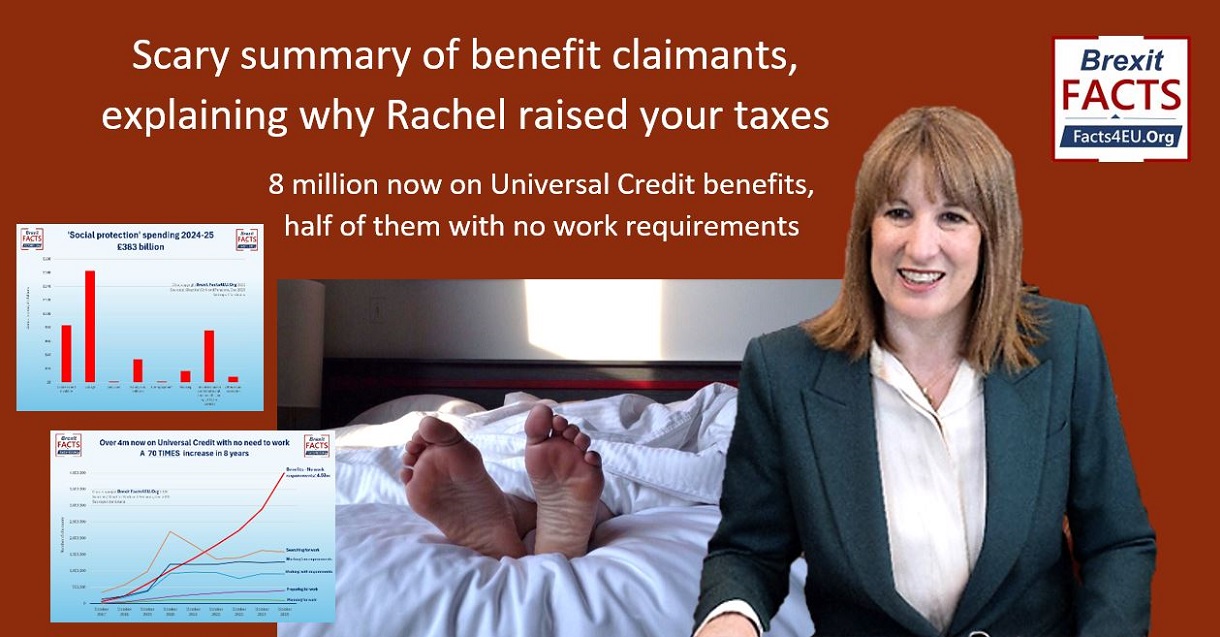
Montage © Facts4EU.Org 2025
Just who is all this benefitting?
This report by the Facts4EU think-tank analyses the extraordinarily rapid growth in the millions of people on benefits in the United Kingdom. It follows our report on public spending for GB News in the aftermath of Rachel Reeves’ further increases in tax in her second Budget on 26 November 2025.
In that public spending report we identified the £1.3 trillion spent by all branches of government. This report focuses on the area of benefits, which forms a significant area of spending, with a particular emphasis on Universal Credit. Facts4EU have researched and produced this report, with additional comments from Sir John Redwood, and in association with GB News.
Overall summary
The figures overall are quite extraordinary and there are so many breakdowns we can only provide so much in a summary report such as this. We start with the number of benefit claimants under the Universal Credit system, which came in to replace a great number of separate benefits.
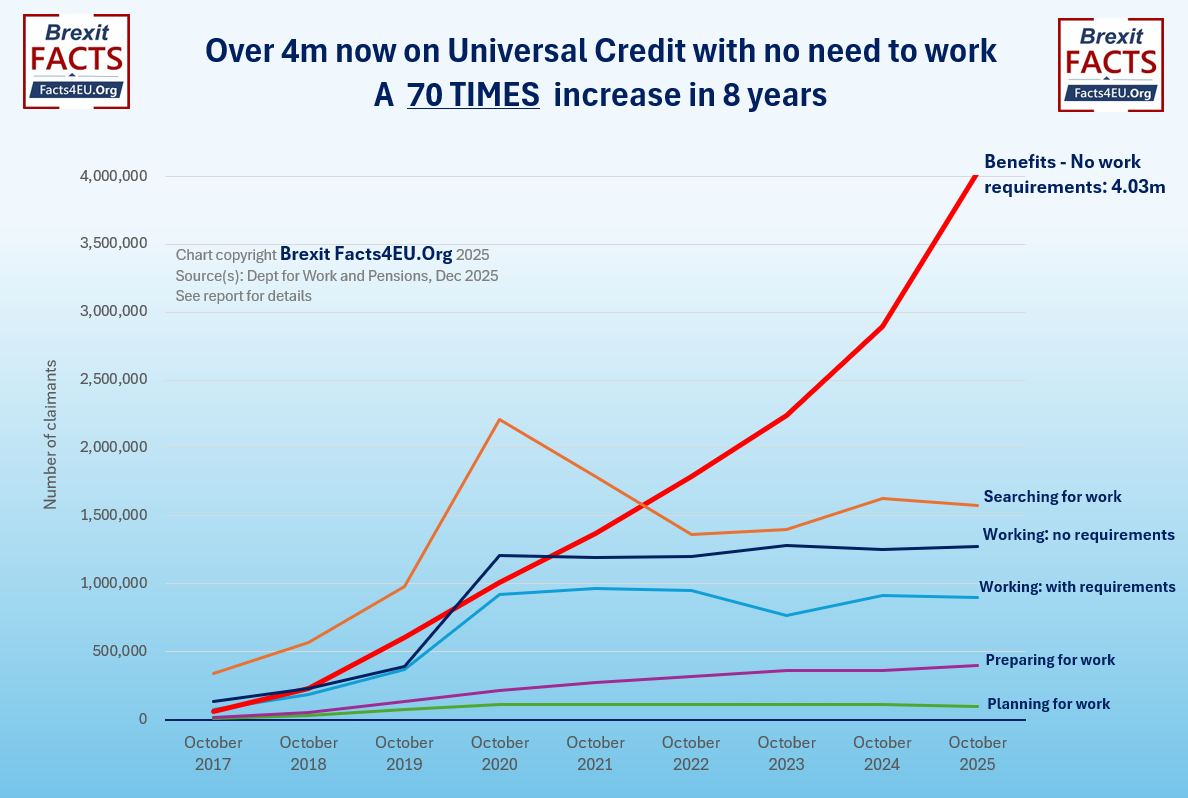
There were 8.3 million people (8,277,289) claiming Universal Credit as at end-Oct 2025. This shows an increase of 1.1m people since the same time last year (+15.5% in 12 months). As if this increase were not enough, below we show the number who do not appear to have to make any effort to work, and the increase since 2020.
© Brexit Facts4EU.Org 2025 - click to enlarge
[Source(s) : DWP]
The Rt Hon Sir John Redwood comments:
The ballooning benefits bill is forcing taxes and borrowing up. The main political parties say they want to bring it down, but the government is in practice letting it soar. It is even changing policies to increase the bill further.
Government policy of putting up taxes on jobs and increasing the cost and complexity of employing people is burdening the system with more people out of work needing benefits.

Those who qualify for health exemptions
There are different categories for Universal Credit and for the health component within this. This partly appears to arise out of the transition from one of the previous benefit systems it replaced: Employment and Support Allowance, or ESA.
- 3.2 million people were on Universal Credit (UC) health, up 933,000 (41%) in the year. 69% of the increase is from ESA (Employment and Support Allowance) transitions
- Of these, 294,000 (9%) had acceptable medical evidence of a restricted ability to work pre-WCA (Work Capability Assessment); 430,000 (13%) were assessed as limited capability for work (LCW), and 2.5 million (77%) were assessed as limited capability for work and work-related activity (LCWRA)
- Of all claimants on UC health, 58% were aged under 50, of whom 8% were aged under 25. (It should be noted: this is 8% of the total, not 8% of under 25s, so is a much larger percentage of under 25s.)
The Rt Hon Sir John Redwood comments:
The government is granting many more a sicknote for life, saying even to young benefit recipients they need not look for employment.
It is wrong to limit many people at a young age by saying they need not work. That is not compassion, it is cruelty. Many will be able to get a job in due course. Striving to make a contribution can be rewarding and can help recovery from illness.
Proportions of Universal Credit claimants
- In September 2025, 39% of people on Universal Credit were on UC Health – up 7 percentage points from September 2024
- Within England, the region with the highest proportion of UC health cases relative to overall UC claimants is the North-East (44%), followed by South-West (42%) and North-West (42%) – and the lowest is London (32%).
‘Social Protection’ and all its component costs
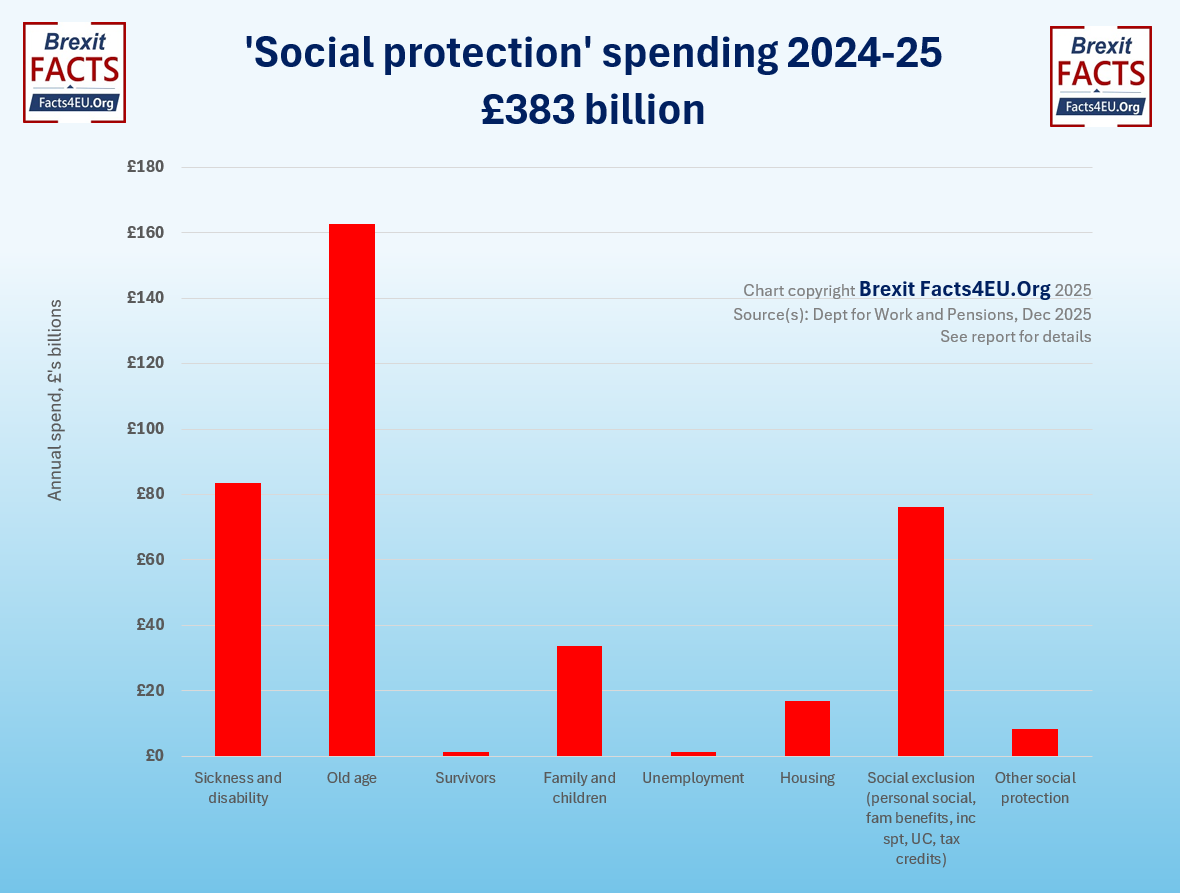
Buried in one of the DWP documents we found a table relating to ‘social protection’ and the costs associated with each element. We have summarised this in the chart below. One of the things this shows is how costs are clearly spread across different functions, with a person receiving sum benefits in respect of different elements of their needs.
For example, a person could be old, ill, and a survivor of abuse.
© Brexit Facts4EU.Org 2025 - click to enlarge
[Source(s) : DWP]
UC WCA Decisions (in the period April 2019 to August 2025)
- 4.1 million Universal Credit Work Capability Assessment (WCA) decisions have been made in the period from April 2019 to August 2025
- Of these, 12% of decisions found claimants had no limited capability for work and hence no longer on UC health, 17% limited capability for work (LCW), and 71% limited capability for work and work-related activity (LCWRA)
- Within England, the region with the highest proportion of LCWRA decisions was the North-West (73%) and the lowest the North-East (66%)
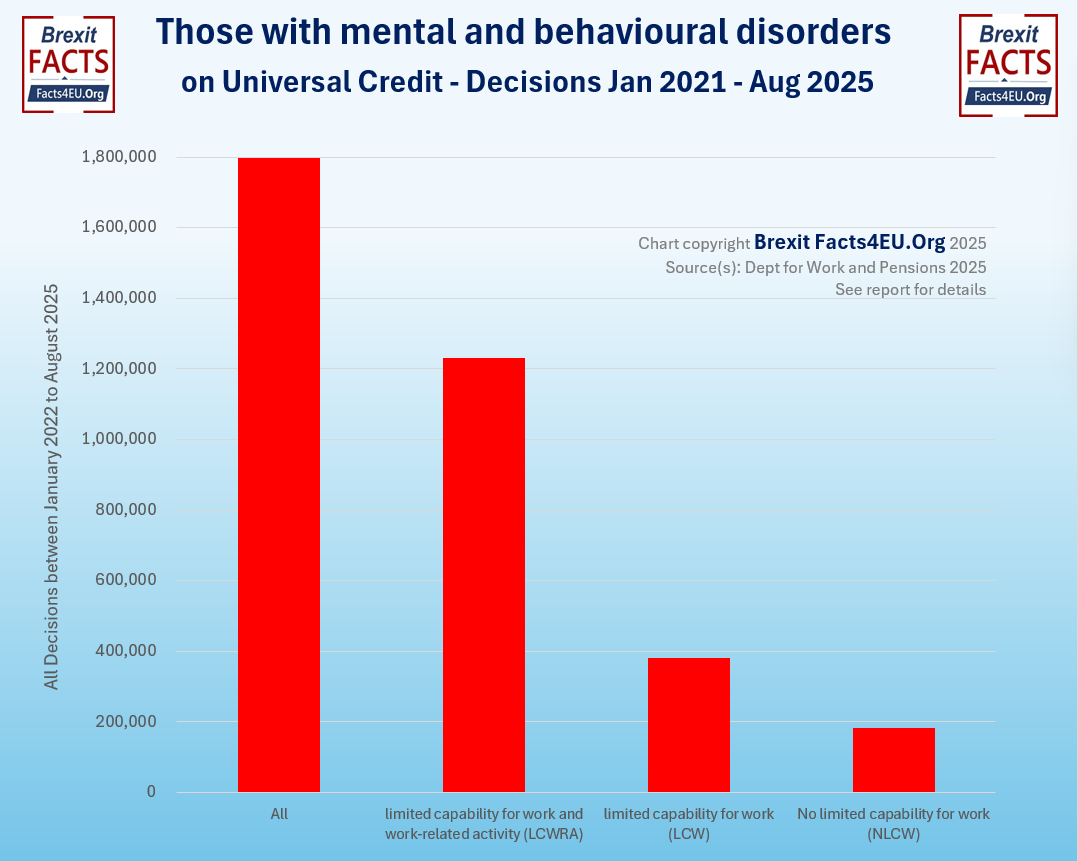
- Of all WCA decisions in the period January 2022 to August 2025, at least 61% of them are recorded as having mental and behavioural disorders, albeit this may not be their primary medical condition.
The Rt Hon Sir John Redwood comments:
Some people are too ill or too disabled to work and deserve decent support. Too many others will be able to work and in the case of mental health cases may find work is good therapy but are not asked to do this.
We've used up our own money. Now we rely wholly on patriotic members of the public to survive. Please donate today if you would like to continue reading us tomorrow, next week, and the weeks after.
Any credit card user
Quick One-off

From £5 - £1,000
Monthly

From £3 per month
Paypal Users Only - Choose amount first
Quick One-off
Monthly
Don't leave this to someone else. You are that 'someone else'.
© Brexit Facts4EU.Org 2025 - click to enlarge
[Source(s) : DWP]
Assessing claimants by telephone
One of the disturbing aspects of all of this that we came across more than once was the assessment of benefit claimants by telephone interview.
The assessment and determination of an applicant’s claim is – or should be – a serious matter. The outcome for the genuine claimant is important because the amount of the benefit they receive, and the lifestyle they are able to have, depends on this.
Conversely, the outcome for the taxpayer of a somewhat optimistic (or fraudulent) claim by an applicant can result in overly generous payments for years. Repeated on a number of cases running into the tens of thousands, this can have a major impact on the overall amounts being paid out each year.
We believe this issue is being addressed and we certainly hope so.
The Rt Hon Sir John Redwood gives us his final comments:
The government is adding more to the bill by raising benefits or enlarging eligibility. People will be able to get more benefits for larger families as the two-child cap is removed. There is now a proposal for free tv licences paid for by taxpayers.
Those in work are complaining that taxes are too high. Talented people, entrepreneurs and people with good savings are fleeing penal taxation.
We need a fair and supportive benefits system for the very ill and disabled. We need to ensure it is always worthwhile working for others.

Government needs to do much more to help people into work and needs to rein in excessive and self-defeating welfare that drives up unemployment and removes incentives to find a job.
Taxpayers also want better controls over illegal migrants. They should not come in to a life on benefits and hotel stays, boosting bills still more.
We began looking at benefit payments as part of the burgeoning welfare bill, which in itself rose out of the enormous increase in taxes in Rachel Reeves’ second Budget, after telling us all that she was getting all the pain out of the way in her first Budget.
The sheer number of those on Universal Credit – over eight million and rising fast - is worrying. The number of young people is equally troubling.
Observations
In the 10 days it has taken to research this report, we became aware of the complexity of the subject. It is our opinion that someone should be brought in from the world of business to run the Department.
It is our further view that this person should then, after a suitable period, start employing a team, again brought in from outside. They would be very expensive but, we believe, fully self-funding.
This is not personal. We would do the same thing and replace the Permanent Secretaries and Top Teams of all the Government's Civil Service Departments.
Please, please help us to carry on our vital work in defence of independence, sovereignty, democracy and freedom by donating today. Thank you.
[ Sources: Dept for Work and Pensions ] Politicians and journalists can contact us for details, as ever.
Brexit Facts4EU.Org, Thurs 18 Dec 2025
Click here to go to our news headlines
Please scroll down to COMMENT on the above article.
And don't forget actually to post your message after you have previewed it!
Since before the EU Referendum, Brexit Facts4EU.Org
has been the most prolific researcher and publisher of Brexit facts in the world.
Supported by MPs, MEPs, & other groups, our work has impact.
We think facts matter. Please donate today, so that we can continue to ensure a clean Brexit is finally delivered.
Any credit card user
Quick One-off
From £5 - £1,000
Monthly
From £3 per month
Paypal Users Only - Choose amount first
Quick One-off
Monthly
Something to say about this? Scroll down for reader comments