Extra 700,000 public sector employees since the Referendum – what are they doing?
We also ask : “Why is the public sector growing over twice as fast as the private sector?”
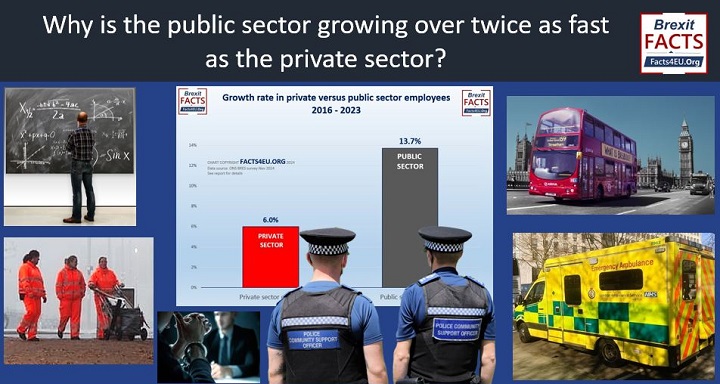
Montage © Facts4EU.Org 2024
Facts4EU’s analysis reveals which economic sectors all these new public employees are engaged in
On Tuesday (05 Nov 2024) we showed that the overall number of employees in the UK has grown by 2.1 million since the UK’s EU Referendum, despite all the Government and Remainer forecasts of massive job losses if the British people voted to leave the EU.
In this Part II today, we reveal how the public sector has grown at over twice the rate of the private sector. We also look at what all these new employees are doing.
Myth-buster – These new public sector workers have NOT been employed to deal with Brexit
Below we show the results of our analysis of the sectors which public sector employees are working in.
Brexit Facts4EU.Org Summary
Analysis of the public sector, 2023
1. The private/public sector split, 2023
The overall split between private and public sector employees is shown below. The proportion of public sector workers has been increasing, as we we show further down.
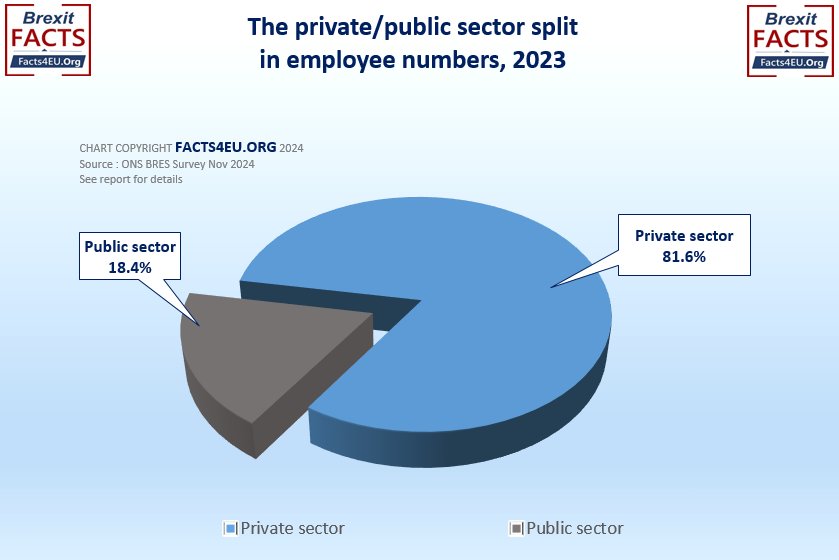
© Brexit Facts4EU.Org 2024 - click to enlarge
2. The growth rates of employees in the private sector versus the public sector
One of the stand-out facts from our analysis is the highly significant difference between the growth in numbers of employees in the last eight years, when comparing the private sector to the public sector.
The majority of new employees are employed in the private sector, by a ratio of 2:1. That said, the growth rate in the public sector is double that of the private sector. The overall proportion of private to public has been changing - in a negative direction.
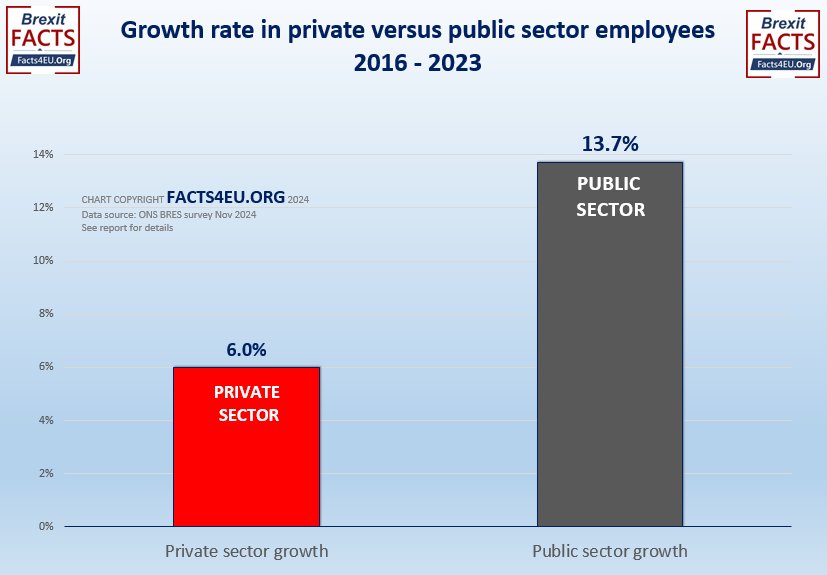
© Brexit Facts4EU.Org 2024 - click to enlarge
The Rt Hon Sir John Redwood, former Secretary of State, commented on our report
“The civil service and administrative numbers in the main public services and public bodies have expanded hugely in the last eight years. At the same time the state has spent large sums on new computing systems which replace personal service with on line and automated responses to the public. Productivity has plunged, driving up costs and the taxes to pay for them. The new government says it is going to tackle poor productivity. How and when? It should start with a recruitment freeze on admin staff, letting numbers decline as people retire and leave.”
- The Rt Hon Sir John Redwood, 06 Nov 2024

We get the messages out there but if you want us to keep doing work like this,
please support us with a small (or large!) gesture, or we will have to cut back dramatically.
Every few pounds helps to keep us fighting for Brexit,
and for independence, sovereignty, democracy and freedom.
Please help us today if you can – it takes just two minutes and your details are kept confidential.
Brexit Facts4EU.Org Summary
Analysis of the public sector, 2023 - Continued
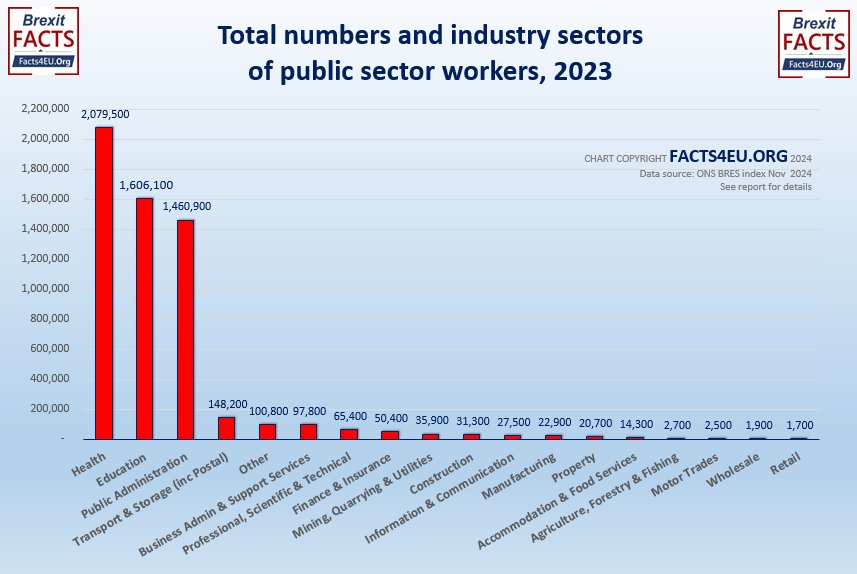
3. Total numbers and industry sectors of public sector workers, 2023
- Health : 2,079,500
- Education : 1,606,100
- Public Administration : 1,460,900
- Transport & Storage (inc Postal) : 148,200
- Other : 100,800
- Business Administration and Support Services : 97,800
- Professional, Scientific & Technical : 65,400
- Finance & Insurance : 50,400
- Mining, Quarrying & Utilities : 35,900
- Construction : 31,300
- Information & Communication : 27,500
- Manufacturing : 22,900
- Property : 20,700
- Accommodation & Food Services : 14,300
- Agriculture, Forestry & Fishing : 2,700
- Motor Trades : 2,500
- Wholesale : 1,900
- Retail : 1,700
TOTAL : 5,770,500
[Source: ONS BRES survey Nov 2024.]
© Brexit Facts4EU.Org 2024 - click to enlarge
4. NEW public sector workers since 2016 by industry sector – breakdown of the increases
- Health : 278,700
- Public Administration : 218,100
- Education : 118,500
- Transport & Storage (inc Postal) : 52,200
- Business Administration and Support Services : 28,000
- Professional, Scientific & Technical : 13,500
- Manufacturing : 3,800
- Mining, Quarrying & Utilities : 2,900
- Property : 600
- Motor Trades : 300
- Construction : -200
- Retail : -300
- Wholesale : -600
- Information & Communication : -800
- Agriculture, Forestry & Fishing : -1,100
- Accommodation & Food Services : -3,200
- Other : -7,500
- Finance & Insurance : -7,900
TOTAL : 695,000
[Source: ONS BRES survey Nov 2024.]
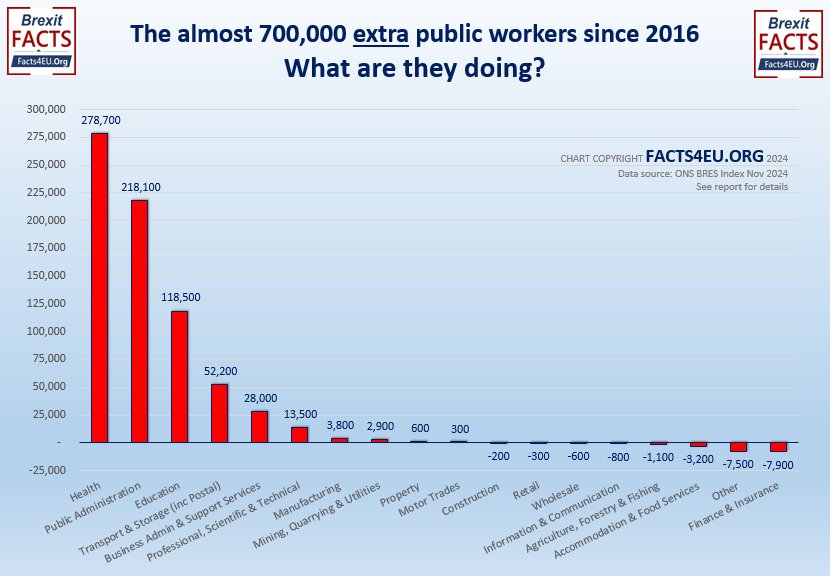
© Brexit Facts4EU.Org 2024 - click to enlarge
Observations
As ever, the Facts4EU.Org team dived into the latest, raw, official data that lay behind the report released by the Office for National Statistics on Monday. It is only by analysis like this that we are able to bring readers some insights which are simply not available in the mainstream media.
In this case we discovered an interesting trend. The increase in the number of public sector employees in the last eight years is more than double that of the increase in private sector employees.
We were also able to look in some detail at this increase in the public sector, and it is clear that the bulk of it comes from health, education, and 'public administration'.
The Facts4EU.Org site and its activities such as conferences, TV & video interviews, forums, etc, are :-
- Advert-free : no annoying distractions or ‘pop-ups’
- Paywall-free : Reading our news and reports does not require you to sign up and pay
- Merchandising-free : We don’t try to sell you t-shirts or coffee mugs advertising us
- Sponsorship-free : No corporate sponsorship funds our reports – we’re independent
- We’re funded by donations from you – the public
The content :-
- Unique, original, well-researched reports
- No ‘re-hashing’ of articles you’ll read elsewhere
- Based on official data, statements and reports, analysed by us
- Transparent sources : Whether it’s the EU Commission, the ONS, or the IMF, we state where we obtained our data
- We rely solely on donations from you – the public - to keep us going
NOTICE : Facts4EU has now scaled back to publishing 5 days-a-week
For over eight years we have worked seven days-a-week. As far as we are aware we are the only organisation of our type to have done this. We are grateful to those of our readers who have made donations but sadly the level of our funding is now such that we must make it stretch for as long as we can. This means team members taking other paid work and reducing our output to five days-a-week.
Please, please help us to carry on our vital work in defence of independence, sovereignty, democracy and freedom by donating today. Thank you.
[ Sources: Office for National Statistics, BRES survey ] Politicians and journalists can contact us for details, as ever.
Brexit Facts4EU.Org, Wed 06 Nov 2024
Click here to go to our news headlines
Please scroll down to COMMENT on the above article.
And don't forget actually to post your message after you have previewed it!
Since before the EU Referendum, Brexit Facts4EU.Org
has been the most prolific researcher and publisher of Brexit facts in the world.
Supported by MPs, MEPs, & other groups, our work has impact.
We think facts matter. Please donate today, so that we can continue to ensure a clean Brexit is finally delivered.
Any credit card user
Quick One-off

From £5 - £1,000
Monthly

From £3 per month
Paypal Users Only - Choose amount first
Quick One-off
Monthly
Something to say about this? Scroll down for reader comments