REVEALED: ‘Second mortgage’ – the National Debt – now costs average taxpayer £2,740 per year
Latest figures show this huge amount will soon surge and make you even poorer
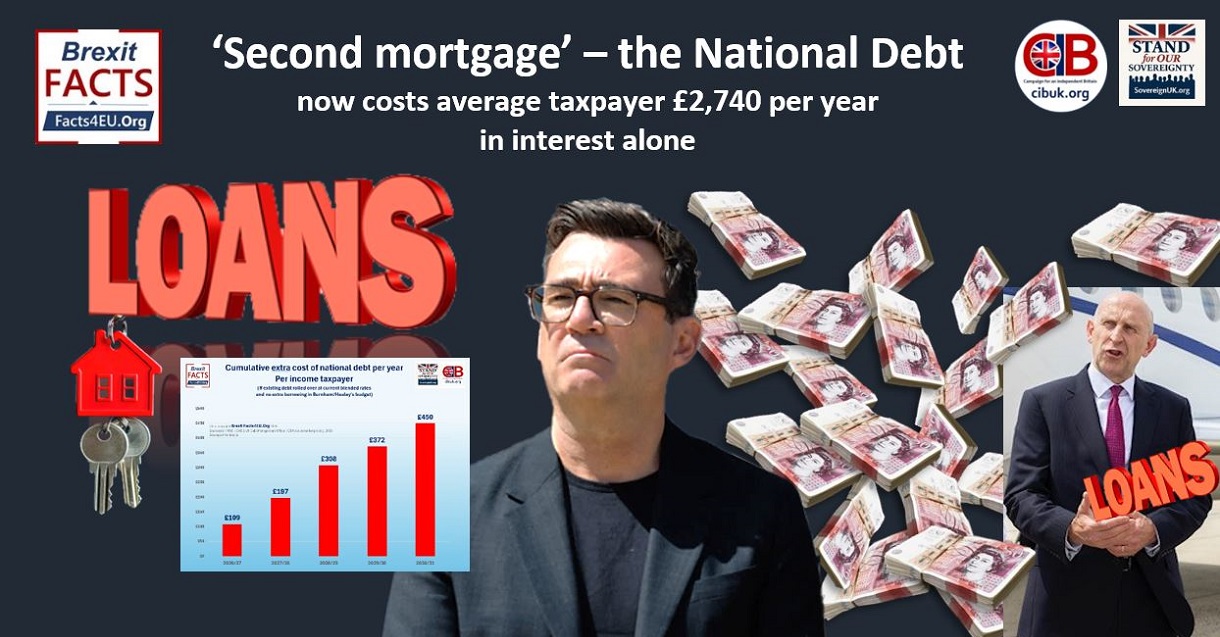
Montage © Facts4EU.Org 2026
Will Burnham-Healey budget next month add to borrowing and costs – And can we afford it?
The UK’s ‘mortgage’ (National Debt) equates to
£76,340 for each taxpayer in the country
* * * * *
“Labour inherited a large national debt and immediately set about making it much worse.”
- The Shadow Chancellor, the Rt Hon Andrew Griffith MP, commenting on this report, 17 Sept 2026
The National Debt is now so large it’s akin to the average income taxpayer having a second mortgage. The latest official figures show that in 2025/6 it cost the UK’s taxpayers the equivalent of £2,740 each - just to pay the interest on the country’s ballooning borrowing.
In a hidden extra shock this huge annual bill - being paid by 40m income taxpayers - is set to rise by as much as £450 per person per year, due to existing debts being ‘rolled over’ at ever-higher interest rates. This can happen even if John Healey’s budget next month requires no more borrowing to cover Andy Burnham’s spending plans.
The think-tank Facts4EU, in collaboration with Stand for Our Sovereignty and The Campaign for an Independent Britain (CIBUK.Org), has cut-through all the jargon and technical terms to explain a disturbing report to readers in everyday language. Using simple charts this summary shows the impact on people by presenting the numbers on a ‘per average income taxpayer’ basis.
The main questions
- How much are we each paying, just to service the interest on our National Debt?
- How much higher could it go? Will we all have to pay even more?
- How does the UK compare to the other main economies?
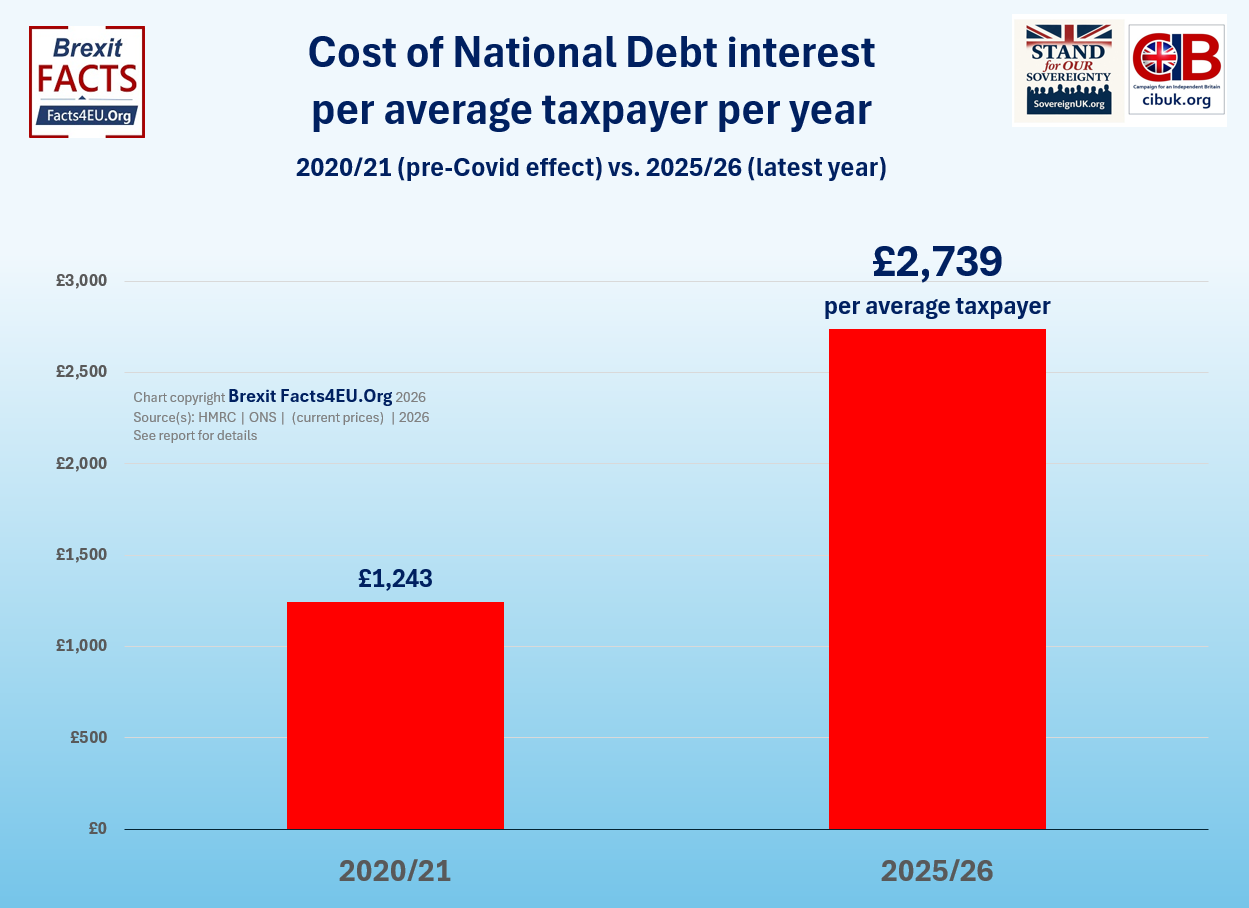
The average annual cost per taxpayer per year has more than doubled since 2020
© Brexit Facts4EU.Org 2026 - click to enlarge
[Note: To keep things simple, we have based costs on the average annual figure per taxpayer, in order to present the numbers in an easily relatable way.]
Servicing the debt: average annual cost per taxpayer per year
The chart above speaks volumes but it doesn’t say it all. Since 2020, the number of taxpayers has increased by 8.1 million to 39.8 million according to the latest figures from HMRC. This means the total cost of paying interest on the National Debt is now being spread across a much larger number of people. Despite this, far from dropping the cost per taxpayer has more than doubled since 2020.
The Shadow Chancellor, the Rt Hon Andrew Griffith MP,
commented exclusively on this report to Facts4EU and GB News
“Labour inherited a large national debt and immediately set about making it much worse.
“The lack of credible plans to cut spending mean interest payments - already twice the defence budget - are far higher than they should be.
“The Conservatives are the only party who will tackle out of control welfare and restore the nation's finances.”
The reason for the huge increase in taxpayers is mostly down to one fact. Millions of low-to-middle income earners have been quietly dragged into the tax system as a result of their personal allowances being frozen.
In effect, successive governments have participated in a ‘stealth increase’ in taxation. The number of income taxpayers has increased by over a quarter since 2020.
What’s coming down the road?
In some ways the government’s national debt is a little like your mortgage or credit card bill. There is one crucial difference, however. Governments almost never repay the principal loan.
Instead the Debt Management Office (DMO) issues a new bond to the markets on the day the old one expires. They then use the cash raised from the new investors to pay off the loan owed to the old investors.
Lord Redwood, former Secretary of State
commented exclusively to Facts4EU and GB News
“It is bad enough having to pay the interest on your own mortgage, and gradually repay the debt. With a spendthrift government you also have to shoulder part of the burden of the great state mortgage taken out in all our names.
“Worse still the government is not gradually repaying this mortgage, but every year borrows more. Next year they plan to add another £3,600 to the debt for the average taxpayer. This will mean more taxes to pay all the interest on that debt, and a growing annual bill for each of us to sustain the government's debt addiction.
“The bond markets which lend the government all this money, now more than £3,000 billion, are getting nervous about the country's ability to pay all the interest and to meet its commitments, so they are now charging the government ever higher interest rates to borrow.”
The ‘hidden’ cost coming back to bite us all – What has John Healey said?
The government took out loans – akin to fixed-rate mortgages – when the interest rate was half what it is today. Issuing new bonds to replace the old ones does not change the amount of the loan, but it will double the interest that has to be paid. The main reason is very simple: the markets see the UK as a worse risk now and are demanding far more interest on their money.
As for the new Chancellor, John Healey, he has shown little inclination to talk about this, nor indeed about many aspects of his new job. Perhaps he is concerned that journalists will ask him about the defence spending plans in his upcoming budget.
BEFORE WE CONTINUE...
To be a full-time, effective voice in opposition to what's happening to our country,
it costs around £15,000 per month.
We receive far, far less than that and really need more readers to help us.
Please donate or become a member today so we can make even more of a difference.
Any credit card user
Quick One-off

From £5 - £1,000
Monthly

From £3 per month
Paypal Users Only - Choose amount first
Quick One-off
Monthly
Don't leave this to someone else. You are that 'someone else'.
The resignation that helped to bring down Starmer
It is only 14 weeks ago today that John Healey sent the then PM, Sir Keir Starmer, the following letter, where he stated:
"...your [Defence Investment Plan] financial settlement - which I was first given in full on Monday afternoon this week - falls well short of what is required for defence and the country at this dangerous time."
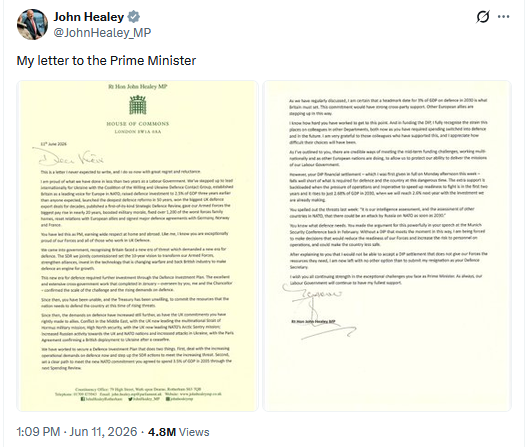
Healey's X account, 11 June 2026
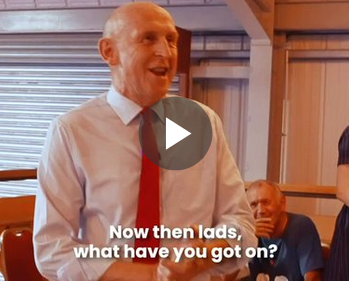
The Chancellor's X account
Since his resignation as Defence Secretary, John Healey has kept a low profile
Last week Andy Burnham’s new Chancellor was forced to borrow at 5.8% - nearly three times the rate it cost the UK just over a decade ago.
Rather than talk about this ticking time-bomb, the Chancellor prefers to publish 'feel-good' videos about his nationwide travels.
The extra annual costs per taxpayer - best case
Assuming the interest rates remain at the same historically-high levels, the average taxpayer will soon be spending £3,190 per annum on interest alone. The reality is that if the Burnham/Healey budget next month produces no spending cuts and even more borrowing, the interest rates are likely to rise further.
This then risks sending the UK into a ‘Doom Loop’. This danger will be explored in a future report.
The chart below assumes no new additional borrowing. It shows the annual extra bill to the average taxpayer as each existing bond reaches maturity and has to be ‘rolled over’, i.e. renewed, at the rates prevailing last week.
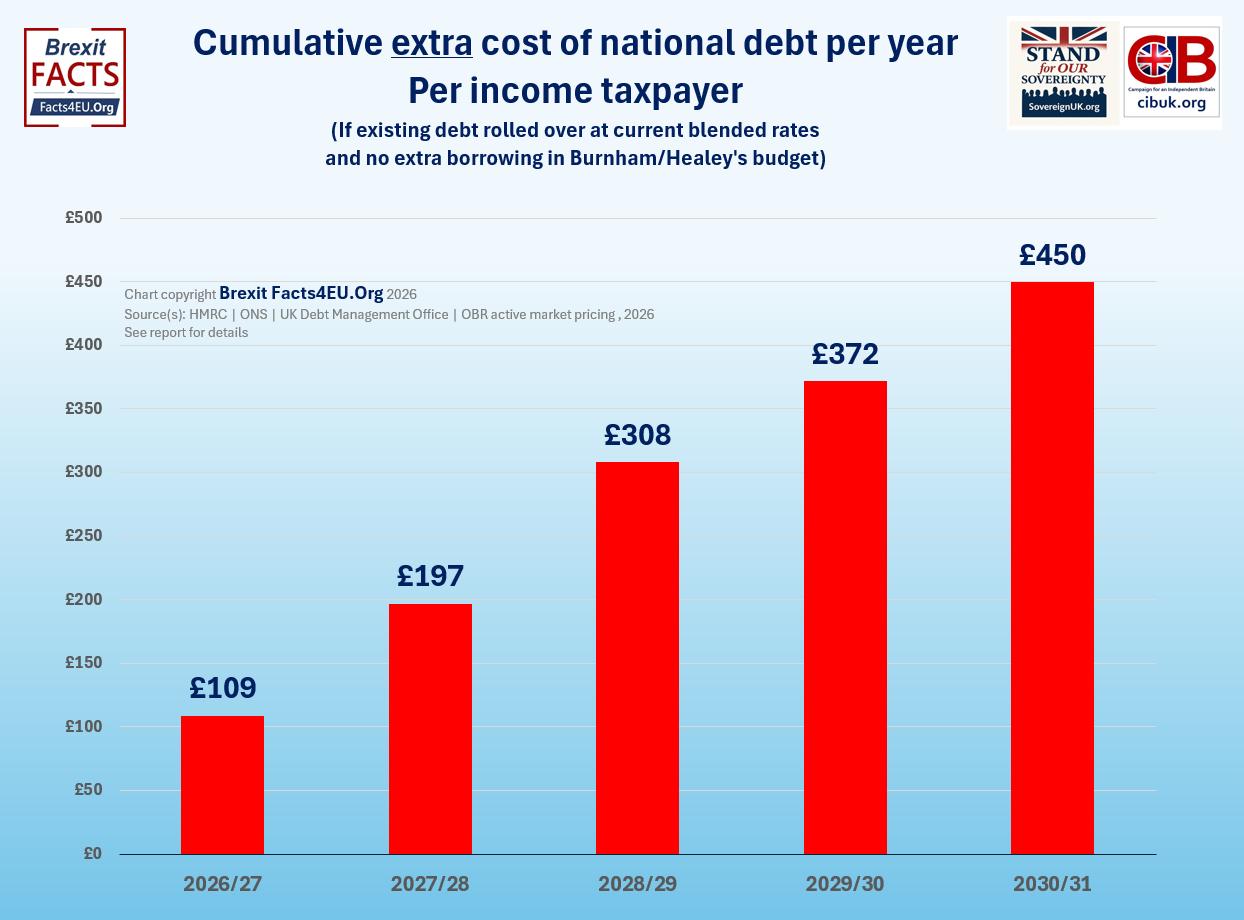
© Brexit Facts4EU.Org 2026 - click to enlarge
[Technical notes: We took a blended average of the 2-year, 5-year, 10-year, and 30-year bonds as they mature, according to the Debt Management Office’s register. This produced a yield (interest rate) of 4.85%.]
The UK’s world standing
According to the Office for Budget Responsibility – a Labour invention – in March of this year :-
“UK government 10-year bond yields [are] currently the highest in the G7, and fourth-highest among the advanced economies”
- OBR, March 2026
Put simply, this means the UK is paying more for its debt than any other major, developed economy.
Unfortunately, market sentiment on Andy Burnham’s Government is now moving fast. It has worsened considerably since the OBR made their statement in March.
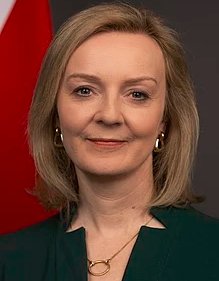
Last Tuesday, the Debt Management Office issued £4.25bn of a 30-year gilt at a yield of 5.82% - the highest auction rate since 1998.
In layman's terms, the government had to borrow over £4 billion from the world's markets at the highest interest rate in over 25 years.
5.8% is far more than the brief 4.1% spike under Liz Truss, about which Mr Burnham and his cabinet have spoken in Armageddon-like terms.
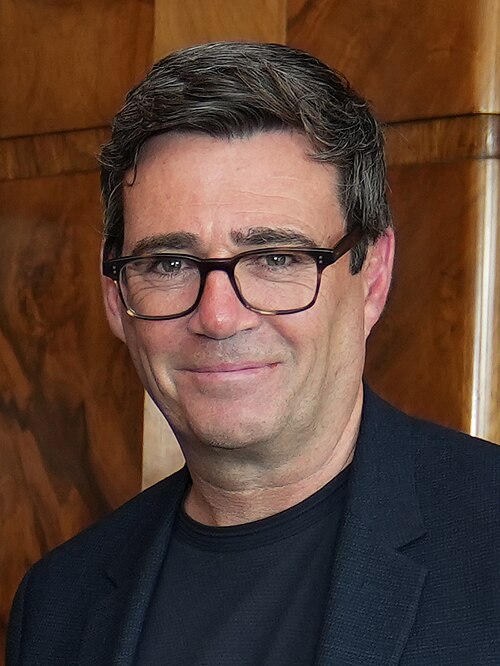
The beginning of the end of the 'Burnham bounce'?
The worry now is that the rate will go much higher still, risking the UK entering into a ‘doom loop’ and ‘Banana Republic’ territory. If this continues, at some point it will become impossible for Mr Burnham to keep blaming his woes on previous governments. More importantly, he won’t be able to pay his bills.
Prime Ministers have fallen over much less than this, as Liz Truss could tell Andy Burnham...
Lord Redwood, former Secretary of State
with his final, exclusive comments to Facts4EU and GB News
“The UK is now in a doom loop. The government borrows more money, the market charges us a higher interest rate, the government then needs to borrow more money to pay the extra interest.
“We are going bust slowly and one day we might find the debt is no longer affordable. Facts4EU have done a great job exposing this and showing us all in a few stark charts just how bad the situation is.
“In the 1970s a Labour government overspent, over-borrowed, and had to start cutting spending in order to be able to borrow some more. This government is having to borrow at much higher rates than its old debts it has to repay when they fall due, burdening taxpayers with more interest bills just to maintain current high debt levels.
“They then compound the problem by borrowing more to spend more. This drives up interest rates. Taxpayers suffer the double whammy of more debt to pay interest on, and higher rates of interest on the original and the new debt.”
Observations
The takeaway from this report is that the average income taxpayer is paying for an additional mortgage costing around £2,750 per year each, set to rise to nearly £3,200 per year by 2030 given current trends in rates. This is the effect of successive governments living beyond their means.
In a summary report such as this we can't cover every aspect of the dangers facing the country. For example, there is a global upward pressure on bond yields (interest rates) caused by competing demands for funds such as the oil price effects from wars in the Middle East, the massive investments in AI, etc. That said, the UK's financial position is not looked on favourably by the markets and the UK is paying more for its debt than any other G7 country.
It would make a big difference to market sentiment if Andy Burnham and John Healey were to start talking about cutting spending. Instead they hear about the government's plans to spend on devolution and on spending on the public sector to stimulate growth.
Independence Facts4EU is currently engaged in economic modelling of likely scenarios showing what happens to us all if the markets turn against this government even more. Unlike many think-tanks we will be translating the results into short reports written in language everyone can understand.
Without wishing to be alarmist, unless this government changes tack we believe the UK is rapidly heading towards a 'Doom Loop'. We will explain what this means to us all when we publish our findings.
Please, please help us to carry on our vital work in defence of independence, sovereignty, democracy and freedom by donating today. Thank you.
[ Sources: As stated on charts and in the text. ] Politicians and journalists can contact us for details, as ever.
Brexit Facts4EU.Org, Thurs 17 Sept 2026
Click here to go to our news headlines
Please scroll down to COMMENT on the above article.
And don't forget actually to post your message after you have previewed it!
Since before the EU Referendum, Brexit Facts4EU.Org
has been the most prolific researcher and publisher of Brexit facts in the world.
Supported by MPs, MEPs, & other groups, our work has impact.
We think facts matter. Please donate today, so that we can continue to ensure a clean Brexit is finally delivered.
Any credit card user
Quick One-off
From £5 - £1,000
Monthly
From £3 per month
Paypal Users Only - Choose amount first
Quick One-off
Monthly
Something to say about this? Scroll down for reader comments