The PM’s new financial advisor, Gordon Brown, has even more to answer for
After last week’s exposé, we reveal yet more calamities to scare us all about Labour's economic management
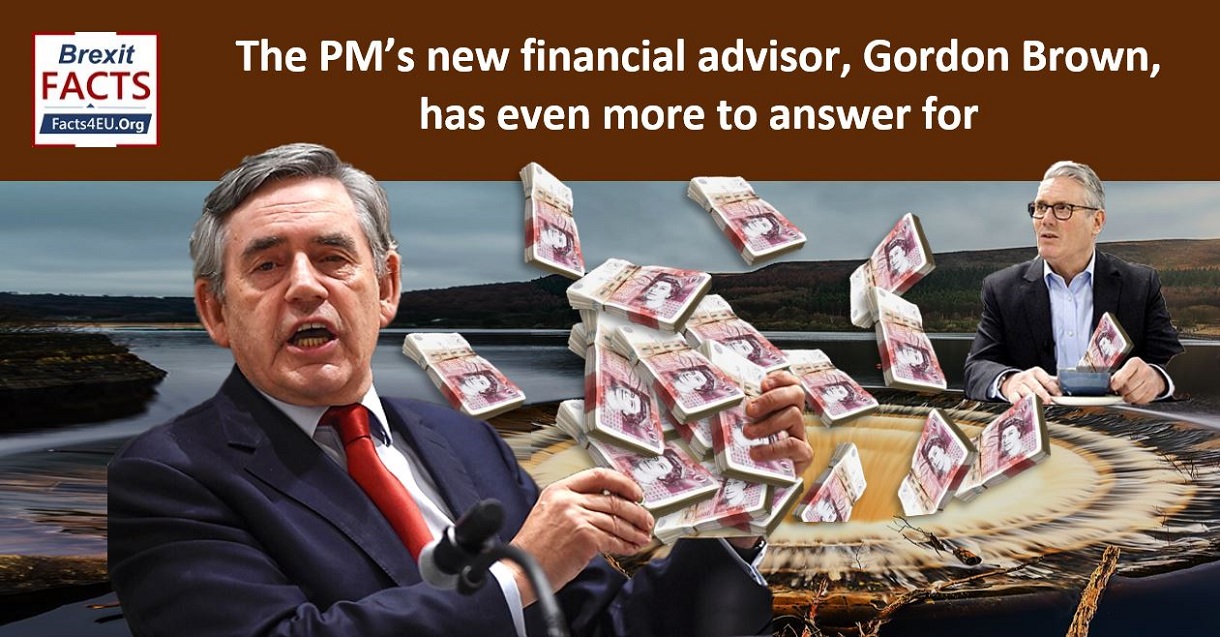
Montage © Facts4EU.Org 2026
Following our big report on Brown’s £50bn losses, splashed by GB News, it gets worse
In today’s report Facts4EU’s Deputy Chairman, Ben Philips, adds yet more to the questionable reputation of the UK’s self-styled ‘prudent’ Chancellor, Gordon Brown.
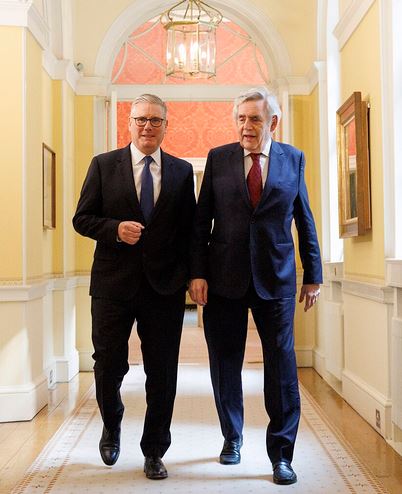
This is the man who has been personally appointed by Sir Keir Starmer as his ‘Special Reviewer on Global Finance and Cooperation’.
This follows our major report last week which received prominent coverage from GB News and if you haven’t already done so, we recommend reading that report first.
Facts4EU Summary
- Gordon Brown self-styled himself as ‘prudent.’
- In reality he was nothing of the sort. He kept a lid on the public finances by matching Tory spending commitments for the first two years of the New Labour government (1997-1999).
- After that he returned to the way of all Labour chancellors and turned the public expenditure taps on.
- By the time the global financial crisis came along in 2008, the government were running a budget deficit of £40bn.
- This followed nearly eleven years of almost continuous economic growth.
- It made the UK among the most vulnerable to external financial shocks among the developed economies
- In short, the more money the government received in tax revenues, the more it spent, leaving nothing in reserve to meet external shocks or unexpected liabilities.
1. Mismanagement of the public finances
On the eve of the 2008 crash, the UK public finances appeared superficially stable but contained severe structural vulnerabilities. By 2007–08, public debt was around 37% of GDP, but the structural budget deficit was significant. The economy was highly leveraged, over-reliant on financial services, and fuelled by a massive housing boom and household debt.
Last week we raised the lingering questions over Gordon Brown’s handling of the RBS failure. To bring this home, we can add an astonishing fact.
At the time of crash, the RBS balance sheet was more than that of the UK’s entire annual GDP.
Almost unbelievably, in 2008 RBS’ balance sheet showed approximately £2.2 trillion. This compares with the UK’s GDP which stood at c.£2.0 trillion. The risks taxpayers took on were simply too great but that did not stop the current Prime Minister’s financial advisor.
A snapshot of the UK's economic and fiscal state just before the financial crisis reveals the following core indicators
- Public Debt & Deficit: In 2007–08, public sector net debt sat at a seemingly manageable 37% of GDP.
- However, the UK entered the crisis with one of the largest structural budget deficits in the industrialised world, running a budget deficit of approximately £40 billion.
- Economic Imbalances: Growth was heavily skewed toward the financial services sector in London, which accounted for a disproportionately large share of tax revenues. The broader economy was heavily reliant on consumer credit and a housing market that peaked in September 2007 with average house prices over £190,000.
- The Private Debt Bubble: The total debt of the UK's private sector was over four times larger than that of the government, with highly leveraged banks operating with dangerously low capital levels and a reliance on short-term wholesale funding to cover lending gaps
- Interest Rates: The Bank of England base rate stood at 5.5% in late 2007, leaving relatively little room for monetary manoeuvring as the credit crunch took hold.
- Initial Shock: The first signs of the crisis appeared in August 2007, culminating in the run on Northern Rock in September 2007. This required emergency liquidity injections by the Treasury well before the broader global meltdown in the autumn.
To be a full-time, effective voice in opposition to what's happening to our country,
it costs around £15,000 per month.
We receive far, far less than that and really need more readers help us
Please donate today so we can recruit more staff and make even more of a difference.
Any credit card user
Quick One-off

From £5 - £1,000
Monthly

From £3 per month
Paypal Users Only - Choose amount first
Quick One-off
Monthly
Don't leave this to someone else. You are that 'someone else'.
2. Disastrous negotiation of Private Finance Initiative (PFI) contracts
Under the Brown-era New Labour governments, the PFI model was heavily utilized to construct hundreds of hospitals, schools, and transport projects.
- The ultimate cost: While the capital value of PFI schemes initiated under Labour was roughly £57 billion, the eventual cost of these repayment contracts will reach upwards of £300 billion over their 25- to 30-year lifespans
- Interest disparity: Projects were largely financed through more expensive private borrowing rather than lower-cost government bonds.
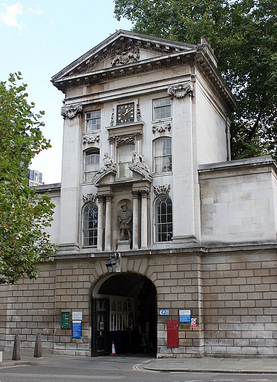
- For example, the Barts Health NHS Trust PFI had an initial construction cost of £1.1 billion, but total repayments are expected to reach £7.1 billion by 2049.
Pictured right: One of 5 hospitals in this Trust: Barts in London. The King Henry VIII Gate at Barts was completed in 1702.
The reason why readers may be interested
In his efforts to preserve his premiership of the country, Sir Keir Starmer has once again turned to the subject of growth. In doing so, he has doubled down on his insistence that the UK must get ever-closer to the EU in every way, including economically, to achieve this.
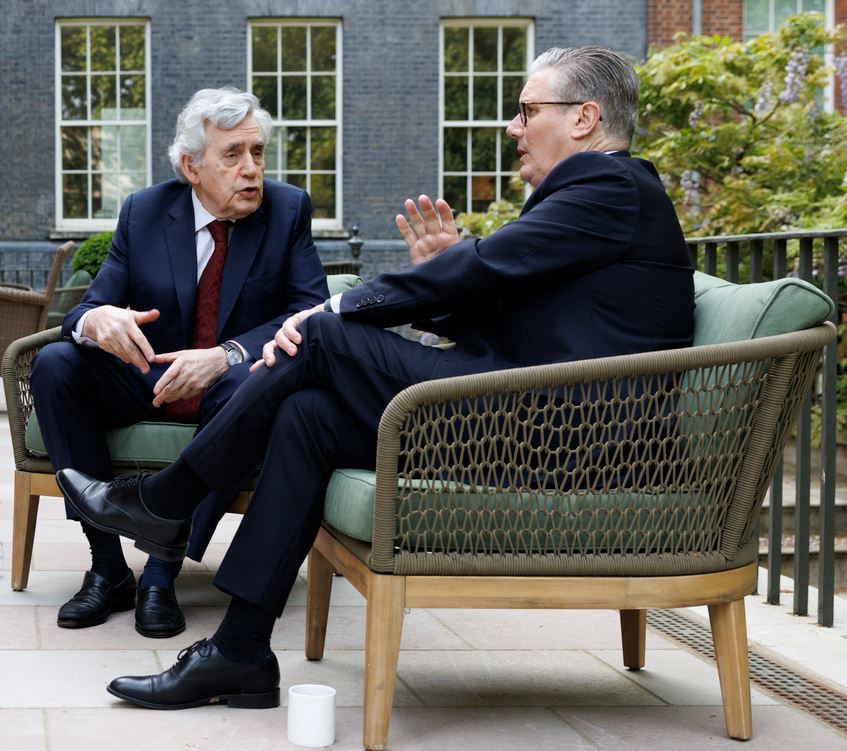
His appointment of Gordon Brown as his ‘Special Reviewer on Global Finance and Cooperation’ is worrying for many reasons which we have identified in this report and in our report of last week. The Prime Minister promised at the election that his No.1 priority would be on economic growth.
He also set out three 'red lines' in the Labour Party's manifesto: not rejoining the Single Market, Customs Union, nor permitting freedom of movement.
It is now clear he is in the process of breaking all three red lines in the mistaken belief that rejoining the EU (in all but name) will somehow help in his key objective. Indeed, his principal challengers all believe the same thing.
What is equally as bad is his thought that having Gordon Brown to advise him will help him to achieve the growing standard of living this country deserves.
We hope these two reports will at least help to dispel any idea that economic competence is something on which we can rely, when it comes to Sir Keir's and this Government's judgements.
Observations
A myth has been allowed to develop that Gordon Brown was both prudent and courageous when in office – the so-called ‘Iron Chancellor’ taking tough but responsible decisions in the long-term interests of the United Kingdom.
Nothing could be further from the truth. As both reports comprehensively indicate, he was among the most spendthrift Chancellors this country has ever had, squandering extraordinary amounts of tax-payers’ money on a plethora of disastrous policies and prohibitively expensive public expenditure projects which the British tax-payer will be saddled with for years.
Sir Keir’s appointment of Gordon Brown to his inner circle is yet another baffling and ill-thought through decision which he and the rest of the country will come to regret.
Please, please help us to carry on our vital work in defence of independence, sovereignty, democracy and freedom by donating today. Thank you.
[ Sources: OBR | Parliament research briefings | ONS | SSRN ] Politicians and journalists can contact us for details, as ever.
Brexit Facts4EU.Org, Tues 26 May 2026
Click here to go to our news headlines
Please scroll down to COMMENT on the above article.
And don't forget actually to post your message after you have previewed it!
Since before the EU Referendum, Brexit Facts4EU.Org
has been the most prolific researcher and publisher of Brexit facts in the world.
Supported by MPs, MEPs, & other groups, our work has impact.
We think facts matter. Please donate today, so that we can continue to ensure a clean Brexit is finally delivered.
Any credit card user
Quick One-off
From £5 - £1,000
Monthly
From £3 per month
Paypal Users Only - Choose amount first
Quick One-off
Monthly
Something to say about this? Scroll down and be the first to comment