Whoever is in the driving seat, who’s going to save the British car industry?
UK car production has dropped by 1,000,000 p.a. (nearly 60%) in the last 10 years
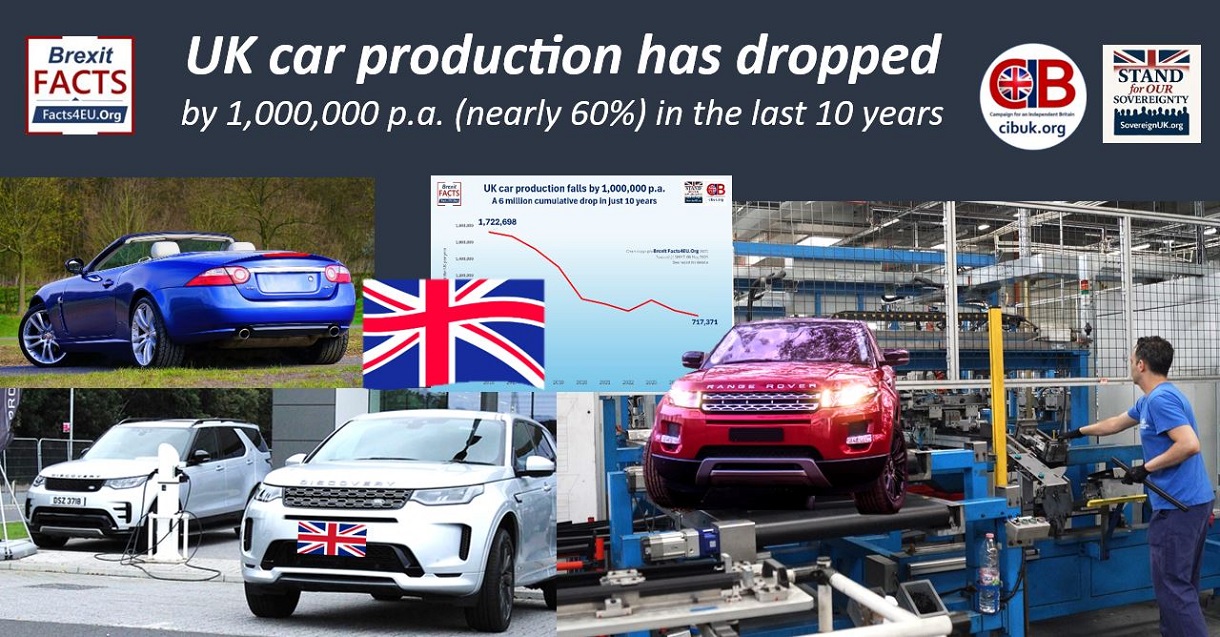
Montage © Facts4EU.Org 2026
Multiple pile-up for one of the UK’s most iconic industries as our plants close
In Sir Keir's slow-motion, car-crash economy, what’s been happening to our automotive industry?
A GB News exclusive on how a £92bn industry sees closure after closure thanks to Net Zero. In this GB News Special, we reveal just how the UK’s iconic motor industry is rapidly pulling over onto the hard shoulder, with one plant closure after another. From increasingly disastrous Net Zero policies to the Chinese peril, the road ahead contains more than potholes.
This report looks at how we’ve lost production of over 1,000,000 cars per year in the last 10 years – a drop of nearly 60%.
A predictable car-crash?

Range Rover
The facts about auto plant closures are telling. A once-great, car-making nation will end up with just three main battery car works: Nissan Sunderland, Toyota Burnaston, and Land Rover/Range Rover.
The think-tank Facts4EU, in collaboration with its partners Stand for Our Sovereignty (SovereignUK.org) and The Campaign for an Independent Britain (CIBUK.org), has researched and produced this exclusive report for GB News, revealing the shocking facts of a British industry which will soon be unrecognizable unless action is taken and Ed Miliband and the entire government is ‘persuaded’ to do a U-turn.
Car production has dropped by 1,000,000 in the last 10 years – Why?
Many readers will remember the bleak years of British Leyland, the constant strikes, the woeful build-quality, and the enormous taxpayer subsidies. This was then followed by a seemingly miraculous transformation into a thriving sector delivering for consumers - and for the Exchequer in tax revenues.
UK car production decimated by fall of 1 million p.a. in 10 years
Cumulative shortfall of 6 million cars in that time
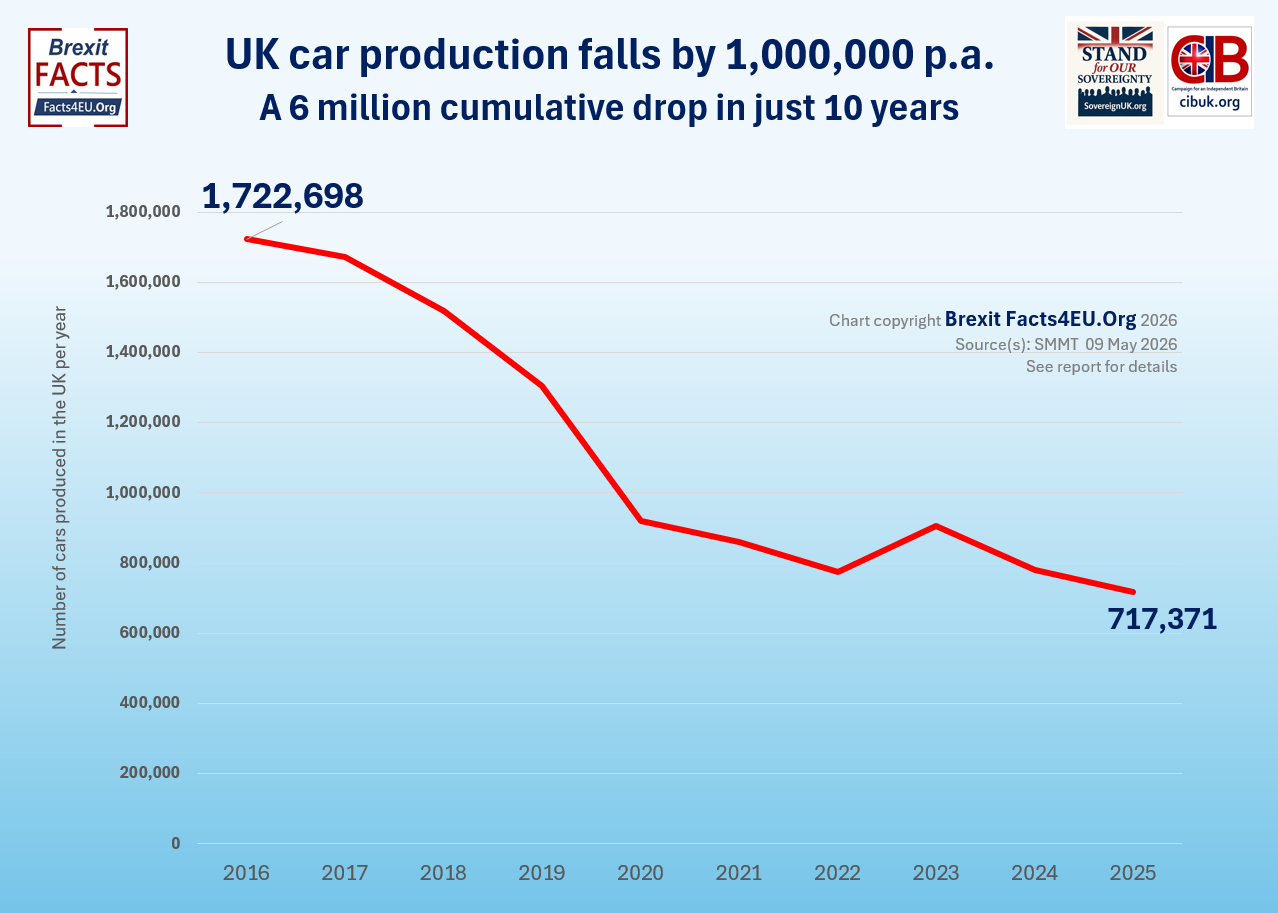
© Brexit Facts4EU.Org 2026 - click to enlarge
[Source: SMMT, 09 May 2026.]
As can be seen above, all this is changing. It has happened gradually, to the extent that the decline has been almost imperceptible, except to those unfortunate enough to have been amongst the thousands to have lost their jobs.
This has increased in speed with recent policies on Net Zero, meaning that new petrol and diesel-engined vehicles will no longer be available in just four years’ time.
Lord (John) Redwood, former Single Market Minister and former Secretary of State
commented exclusively to GB News and Facts4EU
“Facts4EU are right to expose the deliberate destruction of a whole industry in the name of Net Zero.
“This country has long been an important centre for making petrol and diesel cars. The EU and government policy has been - and is - to close every plant making these vehicles and to ban new ones by 2030.
“Mr Miliband insists on this unique harm even after the EU has relented slightly and given the industry five more years of life on the continent. Why does the UK government want to do this and why has the industry been accomplice to this disaster for jobs and consumer choice?”

Gifting our manufacturing to China - Global electric vehicle production 2024
According to the International Atomic Energy’s (IEA) latest 2025 report, China continues to storm ahead in its dominance of the production of electric vehicles. Meanwhile, the UK is going backwards, despite the billions of taxpayer subsidies.
The UK’s production of electric cars fell by 30% in 2024. It is now almost invisible in the chart below.
From being a major car producer to being irrelevant
In global production of electric cars, the UK is now virtually invisible
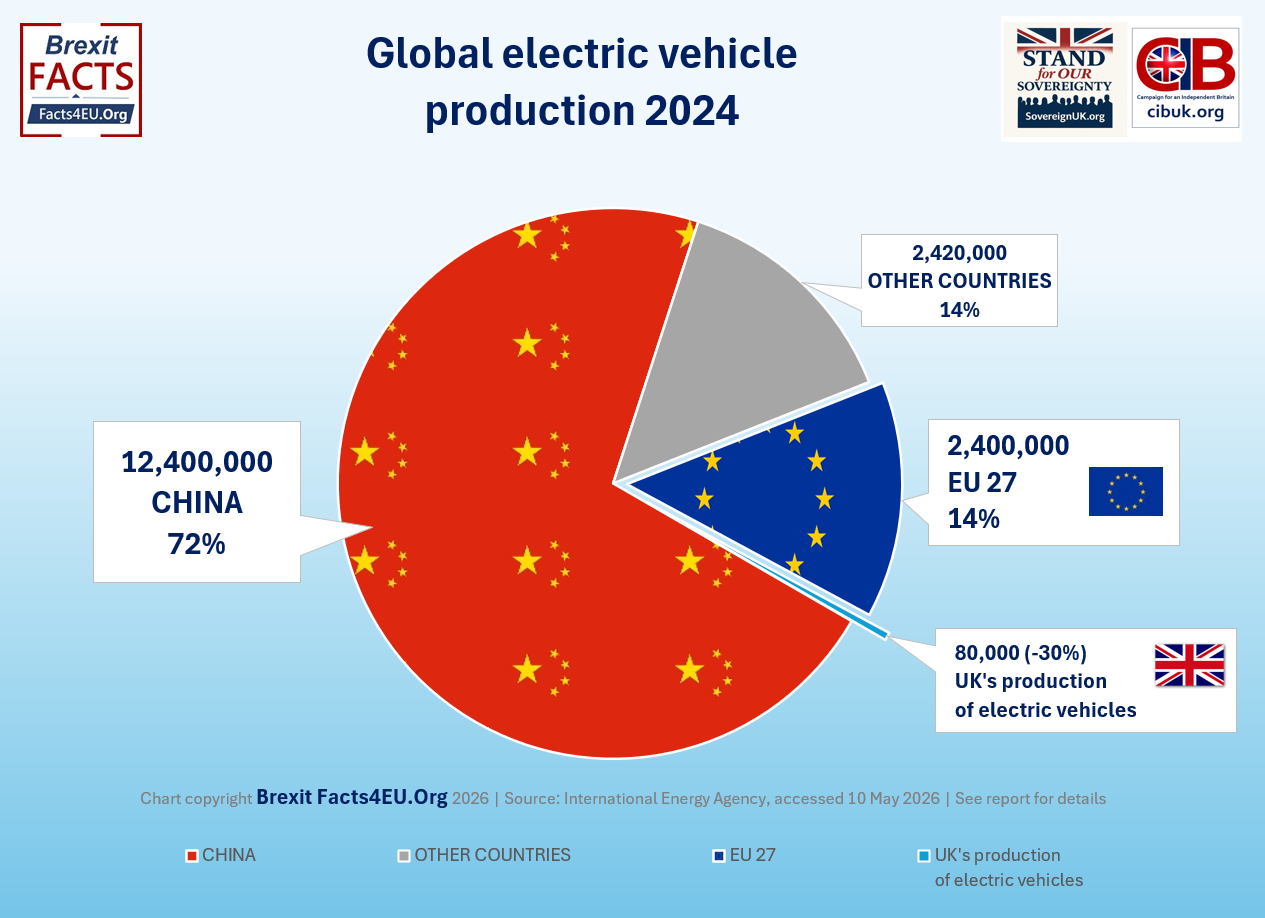
© Brexit Facts4EU.Org 2026 - click to enlarge
[Source: International Energy Authority, latest report, accessed 10 May 2026.]
The UK’s production of electric cars is still at such a low level it seems it will never again offer the jobs and revenues of the traditional British motor industry.
From ‘foot hard down’ to life in the slow lane
List of closures and reductions reads like the who’s who of the UK car industry
- Nissan is halving its car-making capacity in Sunderland.
- Honda closed down in the UK and EU in 2021 with the end of the Swindon plant.
- Vauxhall closed Luton, just leaving Ellesmere Port. It will only make electric vans.
- Jaguar has stopped making petrol and diesel cars altogether though it is building a new battery car plant in Somerset.
- After this it will only sell small volume, high-priced models.
- Ford closed its engine production in Wales, and has no car assembly left here.
- BMW now only makes three up-market Mini Cooper models in Oxford.
- Investment has been paused, to make replacement EVs there.
- With small volumes this plant may well close.
- Toyota is on reduced output from Burnaston.
To be a full-time, effective voice in opposition to what's happening to our country,
it costs around £15,000 per month.
We receive far, far less than that and really need more readers help us
Please donate today so we can recruit more staff and make even more of a difference.
Any credit card user
Quick One-off

From £5 - £1,000
Monthly

From £3 per month
Paypal Users Only - Choose amount first
Quick One-off
Monthly
Don't leave this to someone else. You are that 'someone else'.
100% tariffs on Chinese cars in US, 0% in UK
It isn’t hard to understand why the UK is the most popular market for the Chinese. With tariffs at 100% in the US and 17%-38% in the EU, the UK’s zero tariff rate makes it a very attractive destination for Chinese car salesmen.
The reason for the zero rate is simple: Net Zero. Ed Miliband is keen on any electric vehicle being sold in the UK. The irony is that many Chinese vehicles are in fact hybrids, whose usefulness in reducing our ‘carbon footprint’ is of course rather less than a full electric version. Quite how any of this helps domestic car production is a matter which Mr Miliband and his DESNZ team will have to answer.
So too is the question of how this helps the planet’s overall CO2 output.
If you think your energy bills are bad…

To add insult to injury, the power-intensive manufacturing processes involved in car production have meant the automotive industry has been one of those to experience the most pain from the soaring energy costs under this government and the previous ones.
This began with Theresa May’s last act, of passing a law setting out the effective de-industrialisation of Britain.
And where once was the threat of Japan, now we have the menace of cheap Chinese electric vehicles (EVs), from a country which is belching out CO2 like there’s no tomorrow, with new coal-fired power stations being built on a regular basis.
The Rt Hon the Lord Redwood commented exclusively to us again
“The government ordered the industry to produce battery cars. This requires completely new assembly lines, factories and suppliers. The UK is miles behind China in designing and developing EVs. The UK did not move quickly to secure supplies of lithium, rare earths, cobalt, copper, nor to put in battery making capacity. The Chinese did.
“So today the government encourages mass imports of cheaper battery cars from China tariff-free alongside importing their solar panels and wind turbines. Net zero policies are de-industrialising the UK at a terrifying pace with Mr Miliband the cheerleader.
“Jaguar is spending more than two years producing no cars at all and may emerge as a producer of very small numbers of very dear battery cars as a result of these policies.”
Reaching the widest possible audience - with GB News!
Every day we work on reports to bring the public the truth about issues relating to our core principles of independence, sovereignty, democracy and freedom.
Whilst we can reach tens of thousands – and for some reports over half-a-million – we are sure readers will agree that collaborating with ‘Britain’s News Channel’ helps our well-researched work reach a large number of people who would otherwise not see it.
As this Government - whoever leads it - is clearly intent on reversing Brexit and taking us back into the EU, under the yoke of a foreign, mostly unelected power, it is imperative we fight back once again. To the right is how GB News have covered this report.
Please do your bit by clicking on the GBN image to increase page views and keep us flying high! If you are not already a Member, it's well worth joining.
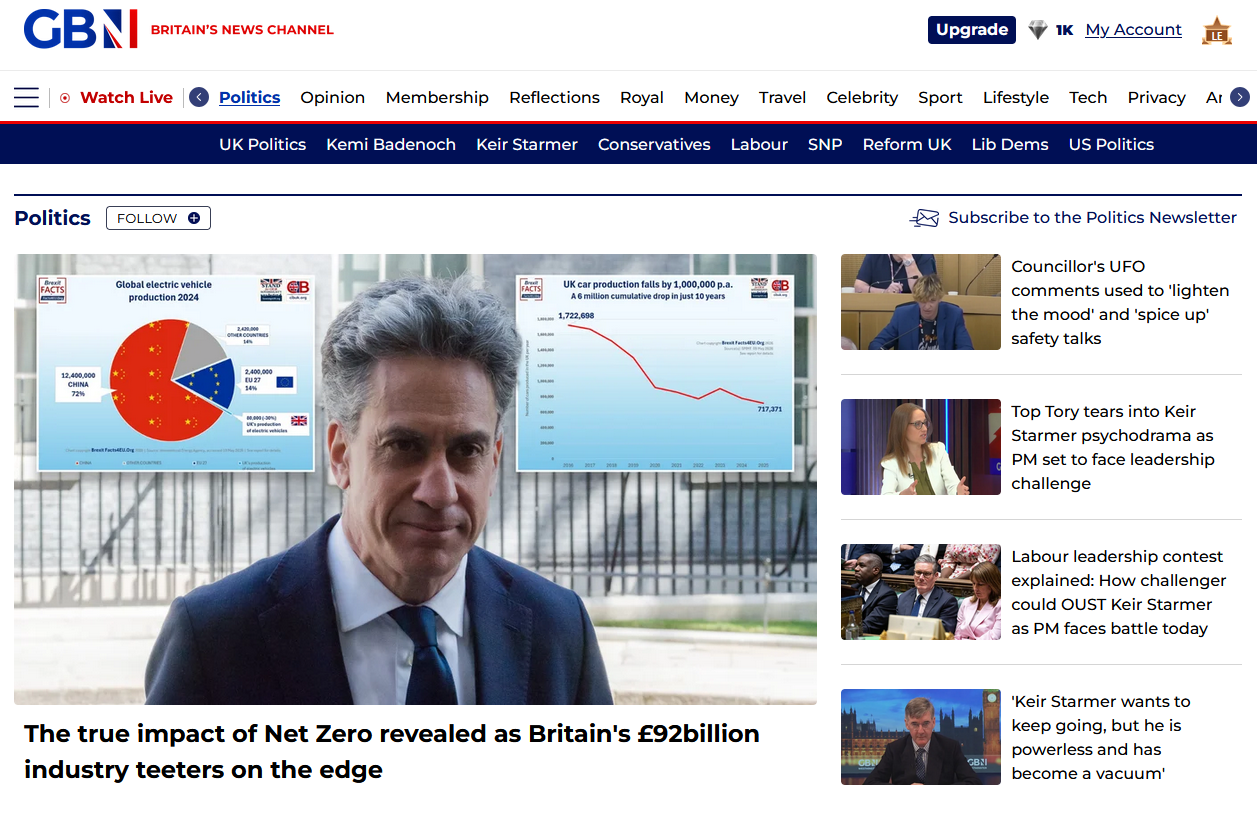
From the GB News UK Politics page,
No.1 at the time this was written
And please find it in yourself to become a Facts4EU Member now.
We need your support, just as the People's Channel does!
Observations
It’s not all doom and gloom… Yet
One of the problems is that the car industry and its spokespeople have always been pro-EU and have endorsed Net Zero. When they should have been fighting back, they acquiesced. Even now, they are somehow upbeat about their industry.
Below we summarise. The big question is whether we will be able to write anything remotely similar in the next few years?
The automotive industry is a vital part of the UK economy. According to the SMMT’s latest report, it contributes £92 billion turnover and £25 billion value added to the UK economy and invested £5 billion in R&D, with 183,000 people employed directly in manufacturing and some 796,000 in total across the wider automotive industry.
Many of these jobs are outside London and the South-East, with wages higher than the UK average. The sector accounts for 13.4% of total UK exports of goods selling to more than 140 countries.
The UK has been manufacturing almost every type of vehicle, from cars, to vans, taxis, trucks, buses and coaches, as well as specialist and off-highway vehicles, supported by more than 2,500 component providers and some of the world's most skilled engineers. In addition, the sector has its aftermarket and re-manufacturing industries. The automotive industry also supports jobs in other key sectors – including advertising, chemicals, finance, logistics and steel. But all of this is contracting.
We can only hope policies will change and that we will still be able to write something positive about the industry in the next few years. Right now, we doubt it.
Please, please help us to carry on our vital work in defence of independence, sovereignty, democracy and freedom by donating today. Thank you.
[ Sources: SMMT | DESNZ | IEA ] Politicians and journalists can contact us for details, as ever.
Brexit Facts4EU.Org, Thurs 14 May 2026
Click here to go to our news headlines
Please scroll down to COMMENT on the above article.
And don't forget actually to post your message after you have previewed it!
Since before the EU Referendum, Brexit Facts4EU.Org
has been the most prolific researcher and publisher of Brexit facts in the world.
Supported by MPs, MEPs, & other groups, our work has impact.
We think facts matter. Please donate today, so that we can continue to ensure a clean Brexit is finally delivered.
Any credit card user
Quick One-off
From £5 - £1,000
Monthly
From £3 per month
Paypal Users Only - Choose amount first
Quick One-off
Monthly
Something to say about this? Scroll down for reader comments