Britain Did Not Invent Slavery - We Stopped It
Britain used its naval power to interdict slavery throughout the World
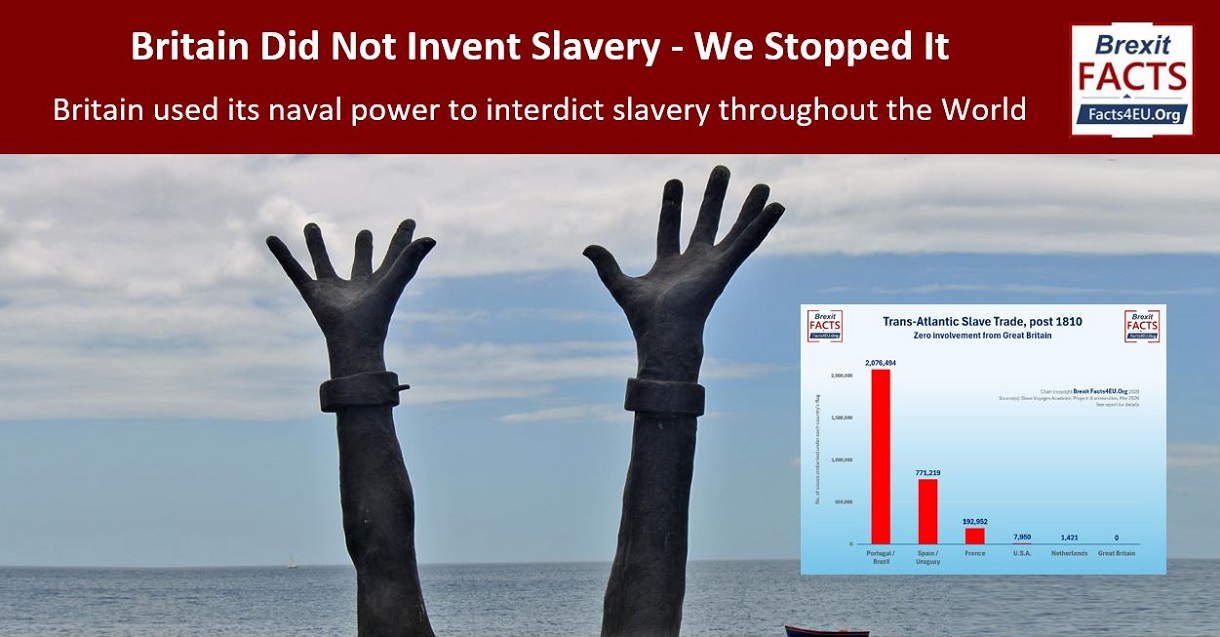
Montage © Facts4EU.Org 2026
Over 200 years ago Britain was the first country in the world to make slavery illegal
As a change from our usual Wednesday podcast, today Facts4EU takes on the tidal wave of misinformation and disinformation that has been peddled in some political quarters. With talk of reparations for Britain's involvement in the slave trade now becoming accepted amongst some of our politicians, it falls to us to put the record straight.
We present a short essay by Facts4EU team member Graham Dale which will no doubt be shocking for some people and will refuse to be accepted by a highly vocal contingent of them. Nevertheless, facts are facts and if they take the trouble to read this and also do their own research using reputable sources, they might learn a thing or two.
Britain Did Not Invent Slavery
By Graham Dale of Brexit Facts4EU
Slavery in all its forms is vile and abhorrent and an affront to humanity. There can be no excuses for it.
When George Floyd was murdered by the police in America the backlash there washed up on our shores and Britain became the target for all manner of ignorant abuse, including rewriting history to portray Britain as the inventor, almost, of slavery and its leading proponent. Nothing could be further from the truth.
The early historical perspective, from the ancient Egyptians
Slavery has a long and discreditable history extending back for at least 8,000 years. We all know from recorded history that the Jews were the slaves of the ancient Egyptians in the 3rd millennia BCE (over 5,000 years ago), yet even long before then the ancient civilisations of Mesopotamia (Sumerians, Assyrians, Babylonians, et al) were known to keep slaves.
There's abundant documentary evidence that slavery was common in China and the East (including Korea and Japan) over a thousand years ago, and the tribes of Central and South America, such as the Incas and Aztecs, kept slaves and sacrificed tens of thousands of them to appease their gods.
The Romans and, before them, the Greeks were slavers. It may come as a surprise to some of the ignorant pedlars of bogus history that “I Spartacus” isn't fiction. The Roman Empire was literally built and sustained on the backs of slaves taken during their conquests of Europe and the Middle East.
Most slaves were taken in battle through conquest or just plain, organised, kidnapping, where the women and girls became sex slaves and domestics and the men and boys were worked to death, executed as human sacrifice or sold on the local slave market.
The Arabic demand and the African supply
Long before the Atlantic Slave Trade in which Britain participated, the Arabs of north Africa took slaves from the Sub-Saharan areas, either forcibly or through buying from local kingdoms and tribes, particularly of west Africa, in the local slave markets and transported north. The kingdom of Ashanti (modern Ghana) did a roaring trade with the Arabs and later with the Europeans. Slavery was also widespread throughout the Islamic caliphates where domestic slavery is sanctioned in Sharia Law.
Contrary to popular belief, slavery was indigenous and a fact of life throughout Africa and there was a massive market in this human misery. The European slavers had no need to fight the local tribes for slaves. They simply purchased them.
The European involvement
The Vikings of Scandinavia were slavers. Through their raids in northern and eastern Europe and Britain they took their captives to the slave markets of north Africa.
The Barbary Pirates based in Algeria, Tunisia and Libya raided ships and coastal towns and villages from Italy to the Netherlands, Ireland, the Cornish and Devon coasts of England and as far north as Iceland to take non-Muslims as slaves who were carted off to the Arab slave markets. They even had a staging post on the Isle of Lundy in the Bristol Channel. In the 200 years from the 16th century in which they were active it's estimated that up to 1.25 million non-Muslims were taken in this way.
It's been calculated that a total of 12,521,337 slaves were transported from west Africa to the American colonies of Portugal, Britain, Spain, France, the Netherlands and Denmark in the roughly 400 years from the mid-15th to mid-19th centuries. This process was begun by the Portuguese from about 1450, principally for slaves to work on their plantations on the Isle of Madeira. This situation was changed dramatically following the discovery of the New World in 1492 and the grant of sovereignty of Brazil by Pope Julius II to the Portuguese in 1506. Brazil then became the principal destination for Portuguese slaves.
The total number of slaves transported from west Africa to the Americas has been allocated as follows:
Portugal/Brazil : 5,848,266 (46.70%); Britain : 3,259,441 (26.03%); France : 1,381,404 (11.03%); Spain/Uruguay : 1,061,524 (8.48%); Netherlands : 554,336 (4.43%); USA : 305,326 (2.43%); Denmark/Baltic : 111,040 (0.90%).
[Source: Slave Voyages Academic Project: Eight universities including Harvard and the University of California (Berkeley etc).]
To be a full-time, effective voice in opposition to what's happening to our country,
it costs around £15,000 per month.
We receive far, far less than that and really need more readers to step up
Please donate today so we can recruit more staff and make even more of a difference.
Any credit card user
Quick One-off

From £5 - £1,000
Monthly

From £3 per month
Paypal Users Only - Choose amount first
Quick One-off
Monthly
Don't leave this to someone else. You are that 'someone else'.
Britain led the World in the abolition of slavery
The movement for the abolition of slavery began in Britain from about 1750 and was promoted by the Methodist and Evangelical wings of the Church of England by people such as John Wesley. The Society for the Abolition of the Slave Trade was established in 1787 and politicians such as William Wilberforce took the campaign for abolition into Parliament, resulting in the passage of the Slave Trade Act in 1807 which outlawed the importation of slaves into Britain. This legislation was followed by the Slavery Abolition Act of 1833 which outlawed all British trade in slavery and emancipated all slaves throughout the British Empire.
The abhorrence of slavery was so strong in Britain that the abolition movement successfully persuaded the British government to campaign for abolition throughout the world. The government was successful in this endeavour insofar as the principal countries remaining engaged in the Atlantic trade at the time (the United States, Portugal/Brazil, Spain/Uruguay and France) agreed in principle to end it, but would not agree to effective enforcement.
The end of Britain's involvement in the transatlantic slave trade
After 1810, we are showing below the countries still involved in the Atlantic slave trade until it ended in 1866. Just over three million slaves were transported in total, and as can be seen, Britain had no involvement whatsoever.
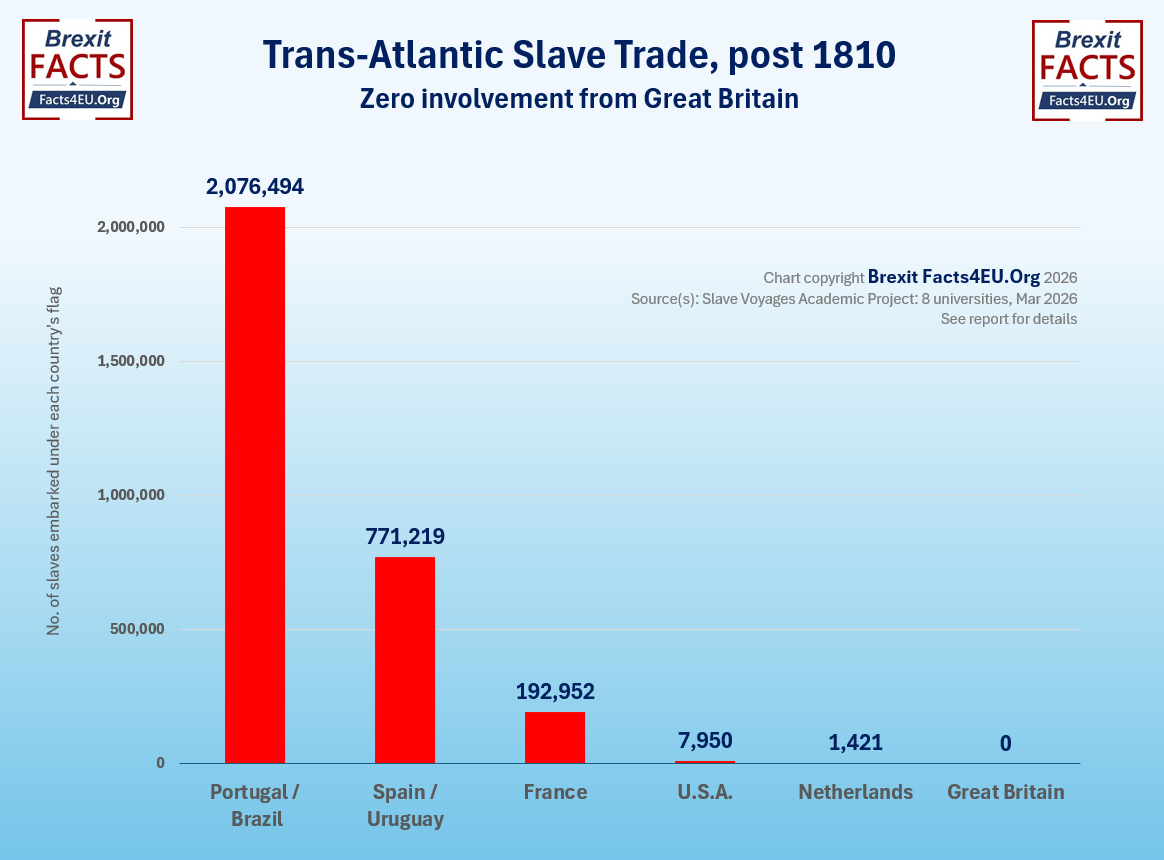
© Brexit Facts4EU.Org 2026 - click to enlarge
[Source(s) : Slave Voyages Academic Project: Eight universities including Harvard and the University of California (Berkeley etc).]
British Royal Navy interdiction of slavery
Britain was the world's leading naval power and so the government formed the West Africa Squadron (also called the Preventative Squadron) of war ships, at one point involving 36 ships, stationed off the coast west Africa to intercept any ship it suspected of transporting slaves. This blockade lasted from 1808 to 1867 during which period it captured around 6% of the transatlantic slave ships and freed an estimated 150,000 Africans. Over the period 1830 to 1865 nearly 1,600 British sailors died on squadron duty.
Whilst most recent publicity has been given to the Atlantic Slave Trade due to the strength of the African-American lobby, the slave trade was also big business in east Africa, but supplying a different, eastern, market. Again, the British government used its international clout and naval power to throttle the trade until it was stopped completely by the end of the 1890's.
In conclusion
There is no doubt that Britain willingly participated in the evils of the Atlantic Slave Trade, but despite the current ill-informed and malicious historical falsifications Britain did not invent it and nor was it its greatest participant.
Once the British government accepted the inhumanity and morally indefensible nature of the trade it did its best to stop it and outlaw it worldwide. It partially succeeded in this endeavour although, sadly, there are still many countries in the world beyond Britain's influence where slavery remains an unacceptable and indefensible fact of life.
Observations
No-one is denying Britain's role in the slave trade, even though this was eclipsed by that of the Iberian peninsula. However, given the large number of African countries who were actively involved in the slave trade, selling slaves to ships to embark for the Americas, there is an obvious question to ask. Are they going to sue themselves for reparations?
Please, please help us to carry on our vital work in defence of independence, sovereignty, democracy and freedom by donating today. Thank you.
Politicians and journalists can contact us for details, as ever.
Brexit Facts4EU.Org, Wed 18 Mar 2026
Click here to go to our news headlines
Please scroll down to COMMENT on the above article.
And don't forget actually to post your message after you have previewed it!
Since before the EU Referendum, Brexit Facts4EU.Org
has been the most prolific researcher and publisher of Brexit facts in the world.
Supported by MPs, MEPs, & other groups, our work has impact.
We think facts matter. Please donate today, so that we can continue to ensure a clean Brexit is finally delivered.
Any credit card user
Quick One-off
From £5 - £1,000
Monthly
From £3 per month
Paypal Users Only - Choose amount first
Quick One-off
Monthly
Something to say about this? Scroll down for reader comments