‘Devolving doors’ – What did we learn from Andy Burnham?
Exclusive: What the last 25 years teach us about Mr Burnham’s top priority
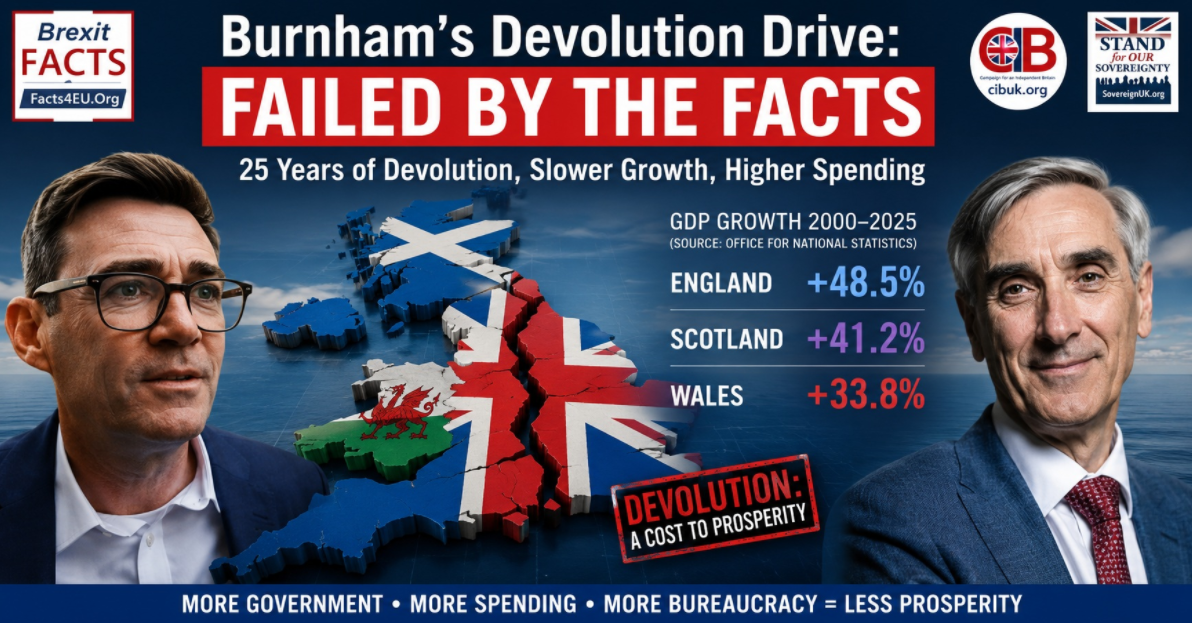
Montage © Facts4EU.Org 2026
A Brexit Facts4EU summary of a national experiment – and its economic results
Andy Burnham is once again demanding more powers, more spending and more bureaucracy for England's regions. Following his speech yesterday, difficult questions are already being asked.
Before Britain embarks on another round of constitutional tinkering, Lord Redwood tells us, voters should look carefully at the results of the devolution experiment thus far. In this report we look at this experiment, which has already been running for a quarter of a century in Scotland and Wales.
The economic record is difficult to ignore
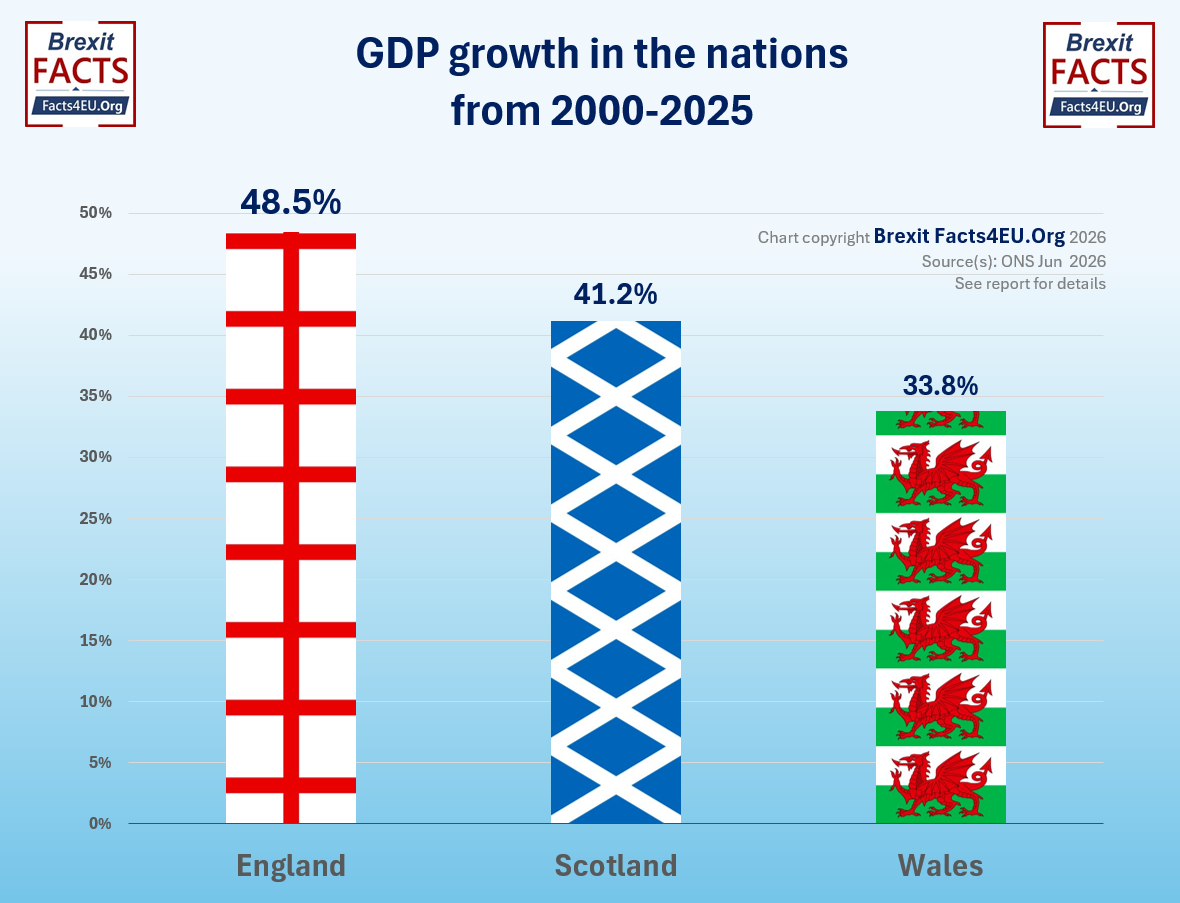
According to long-term GDP data compiled by the Office for National Statistics, England has significantly outperformed both Scotland and Wales since devolution was introduced in 1999. Below we show the last 25 years.
GDP growth in the nations, from 2000-2025
© Brexit Facts4EU.Org 2026 - click to enlarge
Note: We have not included Northern Ireland in this report as it is generally considered to be a special case.
Those figures represent a striking divergence in economic performance over a 25-year period.
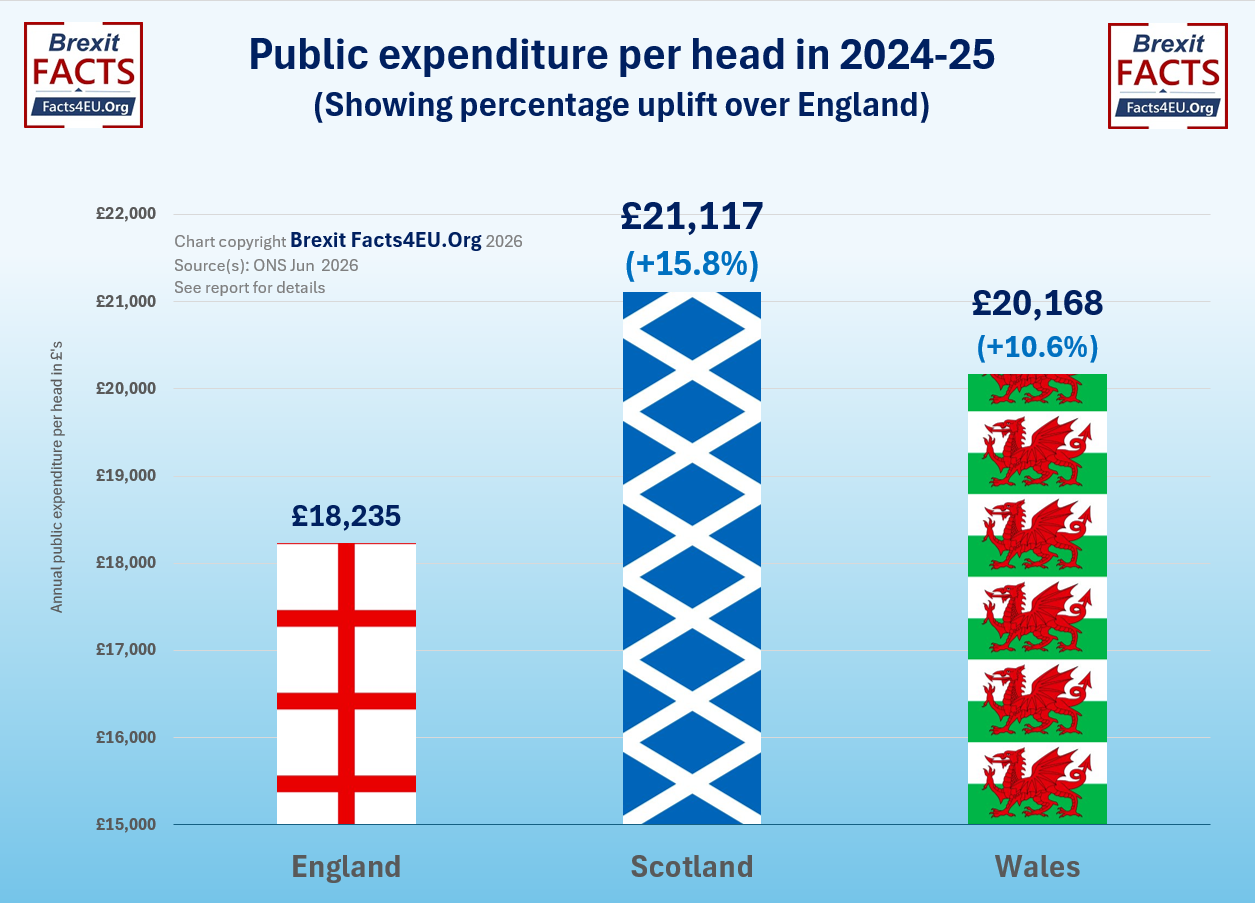
At the same time, Scotland and Wales have enjoyed substantially higher levels of public spending than England. Government figures show public expenditure per head remains significantly higher in both devolved nations than in England itself.
“These are huge divergences showing there is a big prosperity cost to expensive, devolved government.
“Doubtless many Scottish and Welsh voters want to carry on with it, and that is their democratic right confirmed by a referendum. Voters in England see from that that we do not want the economic harm even bigger government brings. When voters in the North East were offered a regional assembly in the 2004 referendum, they rejected it overwhelmingly. Nearly 78 per cent voted No and they were right to do so.”
- Lord Redwood speaking to Facts4EU, 30 June 2026

Scotland and Wales are less productive but we spend more on them per person
The 'Barnett formula' for subsidising Scotland, Wales, and Northern Ireland was introduced by then Labour Chief Secretary to the Treasury Joel Barnettt as a temporary measure for two years in 1978. Despite having no permanent legal basis, the Treasury persist in using it to this day. In the last year for which we have ONS data, 2024-25, Scottish people had nearly £3,000 (16%) more per person spent on them in UK taxpayers' money than the English.
Will Andy Burnham address this disparity in the use of taxpayers' money?
© Brexit Facts4EU.Org 2026 - click to enlarge
Note: We have not included Northern Ireland in this report as it is generally considered to be a special case.
Supporters of devolution promised that moving power away from Westminster would unleash economic dynamism, improve decision-making and deliver greater prosperity.
As shown above, however, the evidence suggests otherwise.
To be a full-time, effective voice in opposition to what's happening to our country,
it costs around £15,000 per month.
We receive far, far less than that and really need more readers to step up
Please donate today so we can recruit more staff and make even more of a difference.
Any credit card user
Quick One-off

From £5 - £1,000
Monthly

From £3 per month
Paypal Users Only - Choose amount first
Quick One-off
Monthly
Don't leave this to someone else. You are that 'someone else'.
Devolution has failed: The economic evidence Andy Burnham cannot ignore
After twenty-five years of devolved government, neither Scotland nor Wales has managed to outperform England economically. Instead, both nations have experienced slower growth despite receiving higher levels of public spending.
Former Cabinet minister Lord Redwood believes the figures expose a fundamental flaw in the argument for ever-larger regional government.
Layers of politicians, officials and bureaucracy
In that 2004 referendum, the public in England appeared to recognise a simple truth: creating additional layers of politicians, officials and bureaucracy does not automatically create jobs, investment or growth. Indeed, critics argue that it often achieves precisely the opposite.
Burnham's vision would hand more powers to metro mayors and regional authorities, creating larger political structures funded by taxpayers. Yet the strongest economic growth in the United Kingdom since 2000 has occurred in the part of the country with the least constitutional bureaucracy.
There is also a further difficulty at the heart of Burnham's position, as Lord Redwood explains.
Devolution and the parallels with Brexit
For Brexit supporters, the lesson is clear. The United Kingdom voted to take back control from distant institutions and return democratic accountability to elected representatives answerable to British voters.
“Andy Burnham also needs to consider the contradiction in his policies. He both thinks more devolved power to regions help, and thinks more laws and taxes should be set by the EU through the EU re-set giveaways.
“Both these propositions cannot be true as they contradict each other. Both can be wrong, and are wrong. You get faster growth, more jobs and more investment with less government, fewer laws and lower taxes. That is why you need to say No to the EU re-set and to bigger devolved government to city regions.”
- Lord Redwood speaking to Facts4EU, 30 June 2026
The answer to sluggish growth is not more layers of government, more bureaucracy or more political offices.
The devolution experiment has now been running for 25 years. Before England is asked to embrace an even bigger version of it, voters deserve an honest assessment of the results.
And those results raise serious questions about whether devolution has delivered the economic benefits its supporters promised.
Observations
To quote Sir Jacob Rees-Mogg paraprasing Dickens in the Commons some years ago, yesterday we were treated to what might be described as “thin gruel”.
With a great many key issues facing the country, our prospective Prime Minister chose to focus his speech on an area of interest to him personally. It is of course devolution in the form of city mayors which gave Andy Burnham the platform from which he has ultimately launched his bid to occupy Downing Street for the next two-to-three years.
Immigration, anyone? Or defence?
Nothing was said about some of the more pressing issues of the day, such as defence spending and immigration. Nothing at all was said about the present government’s headlong rush into aligning us with the laws coming out of Brussels in the ‘great re-set’. In fact nothing was said of any substance whatsoever.
Putting aside the warm words about the North and working 'from the bottom up', there were not even any policies to analyse, let alone to criticise for not having their funding set out.
The public still remains in ignorance about the policies likely to be pursued under this new premiership. With Parliament due to enter recess on 16 July, there is not a lot of time left for MPs to be able to interrogate Andy Burnham across the full range of his intended policies and plans.
Whilst less satisfying for MPs, a general election would of course provide an opportunity for a more complete scrutiny. Unfortunately this, we are told, is highly unlikely.
Please, please help us to carry on our vital work in defence of independence, sovereignty, democracy and freedom by donating today. Thank you.
[ Sources: ONS | Lord Redwood ] Politicians and journalists can contact us for details, as ever.
Brexit Facts4EU.Org, Tues 30 Jun 2026
Click here to go to our news headlines
Please scroll down to COMMENT on the above article.
And don't forget actually to post your message after you have previewed it!
Since before the EU Referendum, Brexit Facts4EU.Org
has been the most prolific researcher and publisher of Brexit facts in the world.
Supported by MPs, MEPs, & other groups, our work has impact.
We think facts matter. Please donate today, so that we can continue to ensure a clean Brexit is finally delivered.
Any credit card user
Quick One-off
From £5 - £1,000
Monthly
From £3 per month
Paypal Users Only - Choose amount first
Quick One-off
Monthly
Something to say about this? Scroll down for reader comments