Frexit Fever
France's Quiet Revolt Against the EU Elite
We are hugely indebted to Claire Bullivant, Editor-in-Chief at Conservative Post, for the following article on the febrile attitude towards the European Union by one of its principal co-founders. The people of France it appears are as fed up with the European Union as the most ardent pro-Brexiteers on this side of the Channel.
The list of complaints now being publicly aired across France will be wearily familiar to British audiences: disillusion with the political-bureaucratic class, economic stagnation, falling living standards, failure to secure the nation’s borders, social and cultural fragmentation.
Such are the depths of disillusion that debate on leaving the European Union is now part of mainstream political discourse, a phenomenon that would have been unthinkable just a few years ago.
How ironic that our own pedestrian government should be planning to crawl back to Brussels at just the moment when one of its principal founders now wants to get out!
The French have had enough.
Enough of the lectures from Brussels. Enough of the regulations. Enough of the mounting costs, stagnant growth and endless political sermons from unelected European officials who many ordinary French citizens believe neither understand nor care about their daily lives. Across France, a quiet political revolt is already underway.
Widespread disillusion
You can hear it in Normandy fishing towns, in cafés in Marseille, in villages in Brittany, in farming communities outside Toulouse and in industrial areas struggling with decline in the north. Speak to locals almost anywhere in France and the conversation repeatedly circles back to the same themes: immigration, bureaucracy, rising living costs, loss of sovereignty and growing frustration with Brussels.
The resentment is no longer confined to fringe political movements. It is becoming mainstream. And the numbers explain why.
Economic Decline
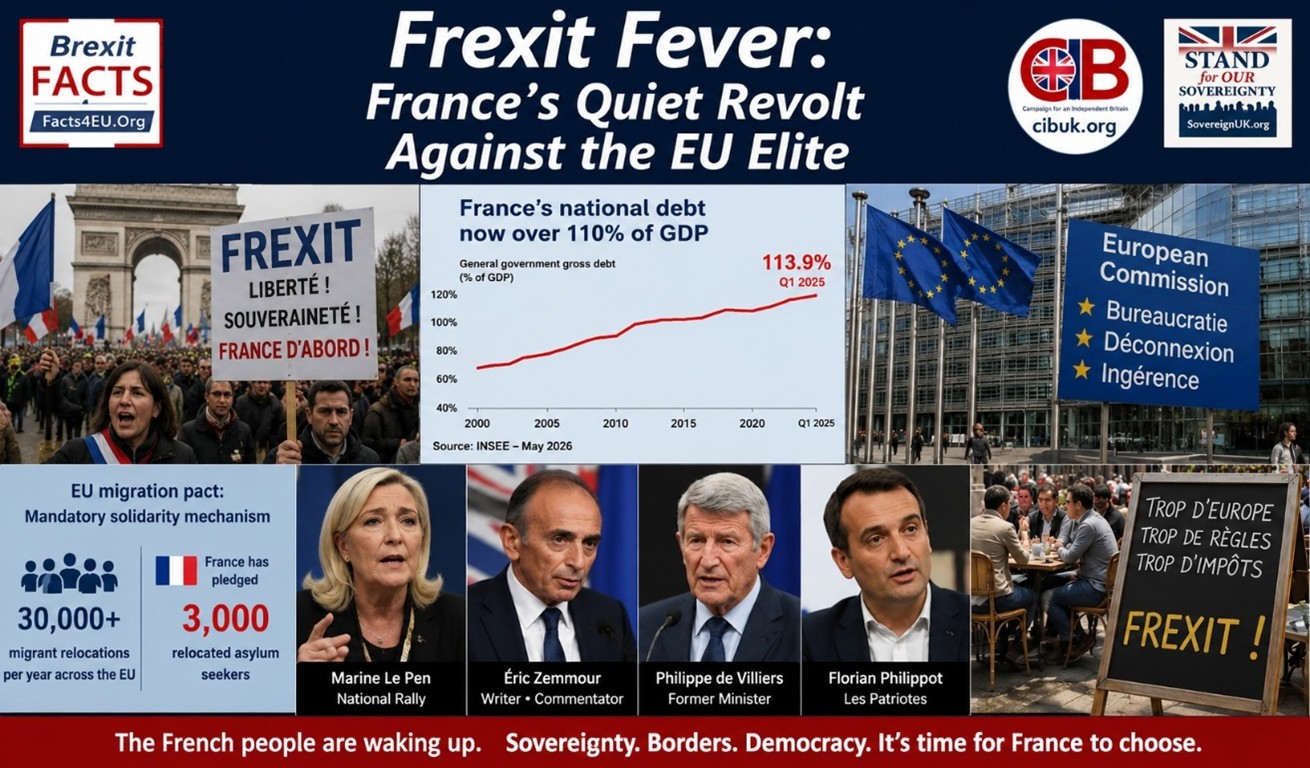
France’s national debt has climbed above €3.3 trillion, more than 110% of GDP. Economic growth remains weak, with forecasts hovering around 0.6% to 0.8% in some recent projections. Unemployment has consistently remained above Britain’s for years, while industrial competitiveness has weakened against both the US and Asia.
At the same time, France faces rising fiscal pressure from an ageing population, welfare costs and slowing productivity, while remaining tied to EU fiscal structures and collective economic obligations.
Meanwhile, ordinary French taxpayers are increasingly asking a simple question: What exactly is Brussels delivering in return?
Fury of French farmers
French farmers have become the clearest symbol of the revolt against EU policymaking. In recent years, tractor protests paralysed roads across the country as farmers demonstrated against environmental mandates, fuel taxes, import competition and what they described as suffocating EU regulation.
France now has roughly 390,000 farms and the number continues to decline year after year as smaller family-run operations struggle to survive.
One protesting farmer near Agen told French television: "We cannot survive like this. Brussels keeps adding rules while our incomes collapse."
Another farmer in the south-west declared: "People sitting behind desks in Brussels have no understanding of life in rural France."
Ongoing Migrant Crisis
That fury extends well beyond agriculture.
Under the EU's new migration pact, member states are expected to participate in a mandatory "solidarity mechanism" involving at least 30,000 migrant relocations annually across the bloc. France has pledged to accept 3,000 relocated asylum seekers under the system. For many French voters, the issue is not simply migration itself, but the growing sense that democratic control over borders and national policy is steadily shifting too far away from Paris and towards Brussels.
Frexit Referendum?
That perception has transformed French politics.
Marine Le Pen, leader of the National Rally and one of the most well-known political figures in Europe, built her movement on arguments that French borders, laws and sovereignty should be controlled by the French people rather than EU institutions.
During the Brexit years, she openly called for France to hold its own referendum on EU membership and warned: "The European Union will die because people do not want it anymore."
Her movement now regularly polls at or near the top of French politics.
Separately, Éric Zemmour, bestselling author, television commentator and former presidential candidate and head of a small party Reconquete who rose to prominence arguing that mass immigration, cultural decline and European federalism were fundamentally weakening France.
Zemmour has repeatedly attacked what he calls the EU’s “bureaucratic hell” and warned that France risks becoming "a province in a federal Europe".
Philippe de Villiers, veteran French Eurosceptic and former presidential candidate, accused Brussels of "destroying jobs, security and identity," while warning that ordinary citizens were losing democratic control over their own nation.
“Our turn now. #Frexit.”
Even Florian Philippot, former ally of Le Pen and now leader of the hard-Eurosceptic party Les Patriotes, continues openly campaigning for Frexit itself. Following the Brexit referendum, Philippot famously posted: “Our turn now. #Frexit”
What is remarkable is not simply that these voices exist. It is that ideas once dismissed as extremist are steadily becoming part of mainstream French political debate.
Calls for reducing EU powers, restoring French sovereignty, tightening borders, reclaiming control over immigration and resisting deeper political integration are no longer confined to the political fringes. Spend five minutes scrolling through French social media, or sit in almost any café from Normandy to Nice, and the mood becomes unmistakable. Ordinary French citizens increasingly believe the EU no longer works in their interests, and the resentment towards Brussels is growing louder by the day.
Even politicians who stop short of advocating Frexit increasingly speak the language of sovereignty rather than European unity.
Brexit Benefits
And quietly, beneath the surface, many French citizens are beginning to look across the Channel with growing curiosity.
Britain’s post-Brexit governments have not fully delivered the sweeping transformation many Leave voters hoped for. Much of the British establishment still appears reluctant to break completely from Brussels-era regulatory thinking.
Yet despite that, Britain has still avoided becoming tied into some of the EU’s largest collective liabilities, including the bloc’s enormous €800 billion post-Covid debt mutualisation programme.
Britain has also regained the power to negotiate independent trade agreements, including this week’s landmark Gulf trade agreement covering Saudi Arabia, the UAE, Qatar, Bahrain, Kuwait and Oman, a deal expected to generate billions for the British economy.
Meanwhile, the EU continues struggling through years of slow-moving collective negotiations and internal political division.
For many in France, the contrast is becoming harder to ignore. Brexit was supposed to serve as a warning. Instead, for growing numbers of Europeans, it increasingly looks like proof that a country can leave the European Union, survive and reclaim democratic control over its own future.
That single fact changed European politics forever. And Brussels knows it.
Because once ordinary people begin questioning whether laws affecting their borders, industries, migration policies and economies should be decided nationally rather than supranationally, the ideological foundations of the European project begin to weaken. Publicly, Europe’s political elite still insists the EU remains secure. Privately, the anxiety is becoming impossible to hide. Because Frexit fever is no longer a fringe fantasy.
France’s quiet revolt against the EU elite is already underway.
Claire Bullivant is Founder and Editor of the Conservative Post, campaign journalist and proud promoter of the UK’s political and cultural legacy around the world.
To be a full-time, effective voice in opposition to what's happening to our country,
it costs around £15,000 per month.
We receive far, far less than that and really need more readers help us
Please donate today so we can recruit more staff and make even more of a difference.
Any credit card user
Quick One-off

From £5 - £1,000
Monthly

From £3 per month
Paypal Users Only - Choose amount first
Quick One-off
Monthly
Don't leave this to someone else. You are that 'someone else'.
Click here to go to our news headlines
Please scroll down to COMMENT on the above article.
And don't forget actually to post your message after you have previewed it!
Since before the EU Referendum, Brexit Facts4EU.Org
has been the most prolific researcher and publisher of Brexit facts in the world.
Supported by MPs, MEPs, & other groups, our work has impact.
We think facts matter. Please donate today, so that we can continue to ensure a clean Brexit is finally delivered.
Any credit card user
Quick One-off
From £5 - £1,000
Monthly
From £3 per month
Paypal Users Only - Choose amount first
Quick One-off
Monthly
Something to say about this? Scroll down for reader comments