EXCLUSIVE: Latest data shows yawning gap opening between Public vs Private Sectors
This week the jobs news was generally bad – except if you’re a Public Sector worker
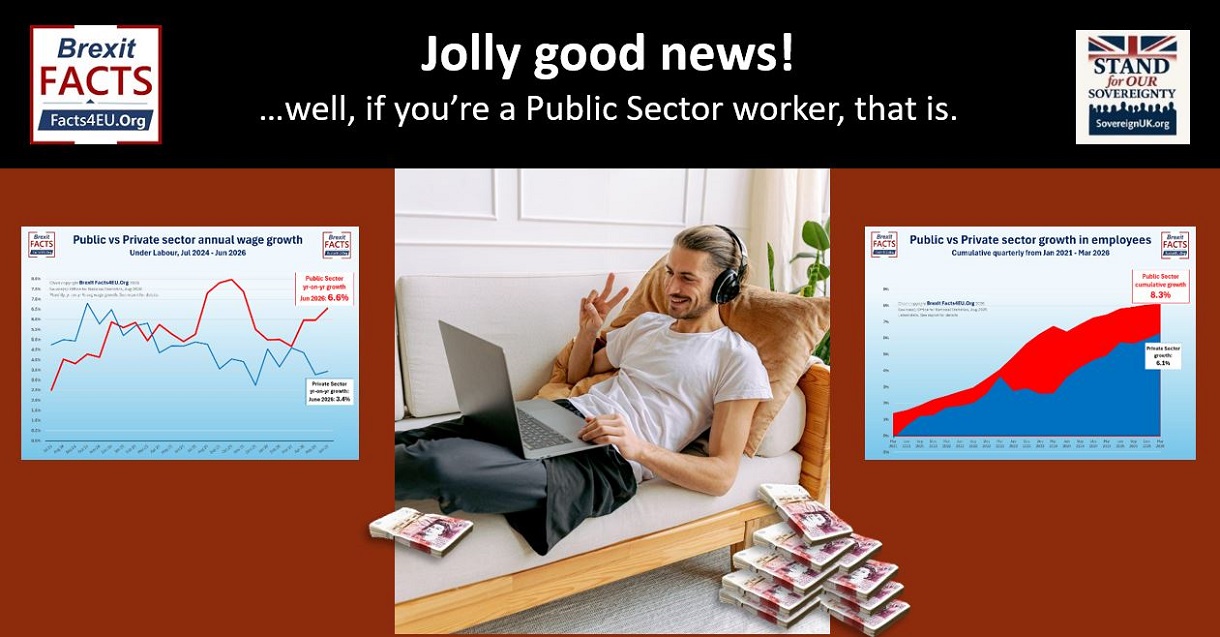
Montage © Facts4EU.Org 2026
An Independence Facts4EU summary of how ‘some are having it good at the expense of others’
“This government is a government of the public sector, by the public sector,
for the public sector,” Lord Redwood tells us
The latest labour market news this week has not been good, whatever government spin may be put on the figures. This ‘tell-all’ report from think-tank Independence Facts4EU and colleagues at Stand for Our Sovereignty, shared exclusively with GB News, gives readers an at-a-glance look at how bad things are. We also recommend reading the GB News version, as ever.
In particular it highlights the yawning gulf that has been emerging between the Public and Private Sectors when it comes to employment and pay rises.
The growing gulf in growth of average earnings in Public versus Private Sectors
The latest figures showing the growing gap between pay rises in the Public Sector compared to the Private Sector are adding to a strong sense of unfairness. In June, Private Sector wages barely kept pace with inflation, whilst Public Sector wages were well ahead of price rises with a 6.6% year-on-year gain.
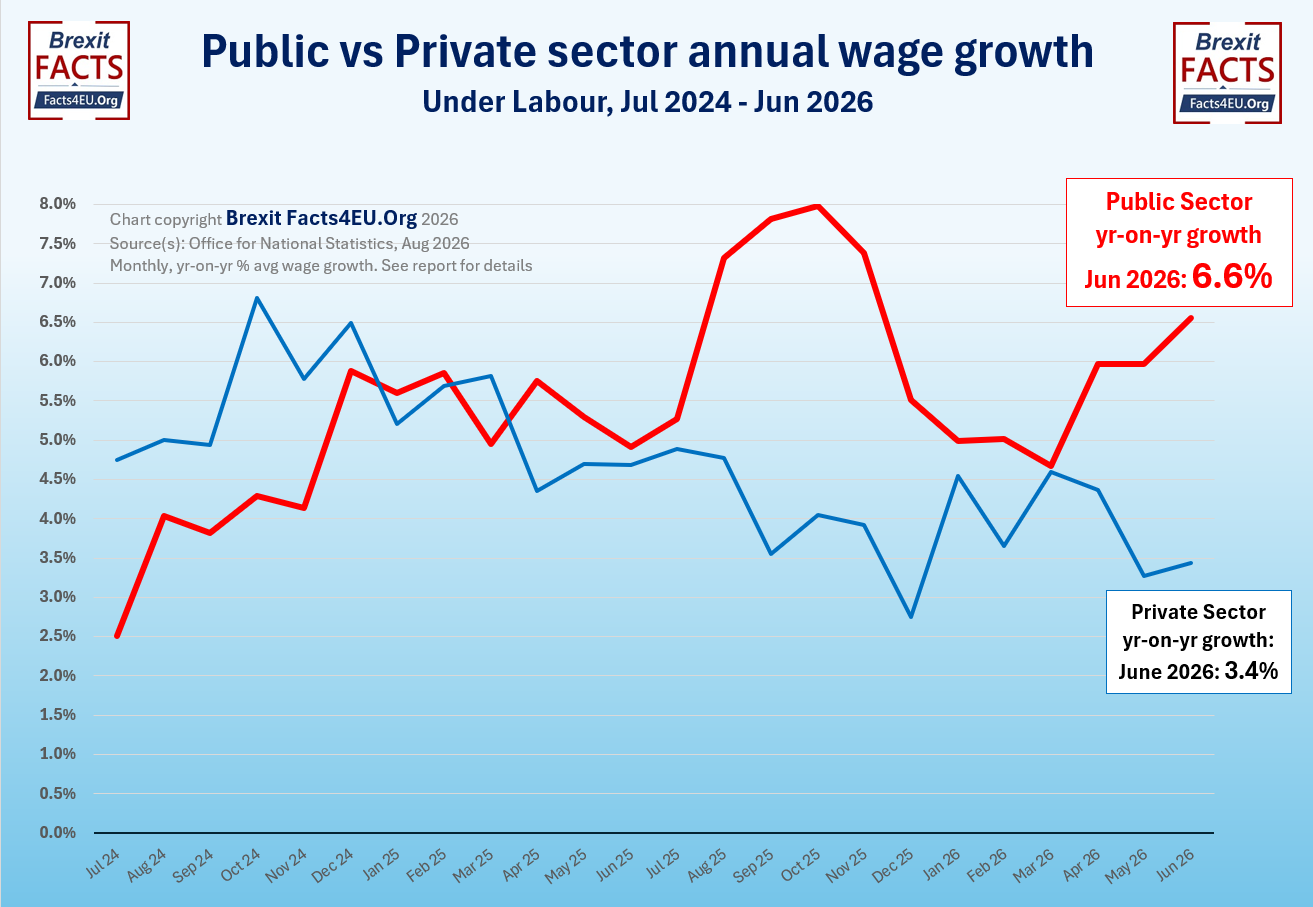
© Brexit Facts4EU.Org 2026 - click to enlarge
[Note: Current prices, not adjusted for inflation.]
Better pay rises, better pay-offs
The revelation that the Cabinet Secretary removed from post by the last Prime Minister is to get a compensation payment of around £500,000, rubs salt into the Private Sector’s wounds, as the government plans more tax rises to pay for such things.
Lord (John) Redwood, former Secretary of State
commented exclusively to GB News and Facts4EU
“This government is a government of the public sector, by the public sector, for the public sector. They have been busily recruiting even though they inherited a well staffed civil service with plenty of administrators in key public services.
“They have been boosting their pay well above the average pay awards in the economy and well above inflation, claiming they needed to catch up when in some cases, like train drivers, they were already well ahead. Their aim to end strikes in the NHS and on the railways did not succeed, with public sector employees getting a taste for well above average awards.
“The government failed to ask for higher quality and smarter working when making the awards, so they were giving something for nothing to services with a big productivity problem.”

BEFORE WE CONTINUE...
To be a full-time, effective voice in opposition to what's happening to our country,
it costs around £15,000 per month.
We receive far, far less than that and really need more readers to help us.
Please donate or become a member today so we can make even more of a difference.
Any credit card user
Quick One-off

From £5 - £1,000
Monthly

From £3 per month
Paypal Users Only - Choose amount first
Quick One-off
Monthly
Don't leave this to someone else. You are that 'someone else'.
The numbers in payrolled employment
Since the UK finally left the EU at the end of the Transition Period, the overall number of people in payrolled employment has grown. This number had been steadily rising for years but as can be seen below, from the time the current government won the July 2026 general election there has been a steady fall.
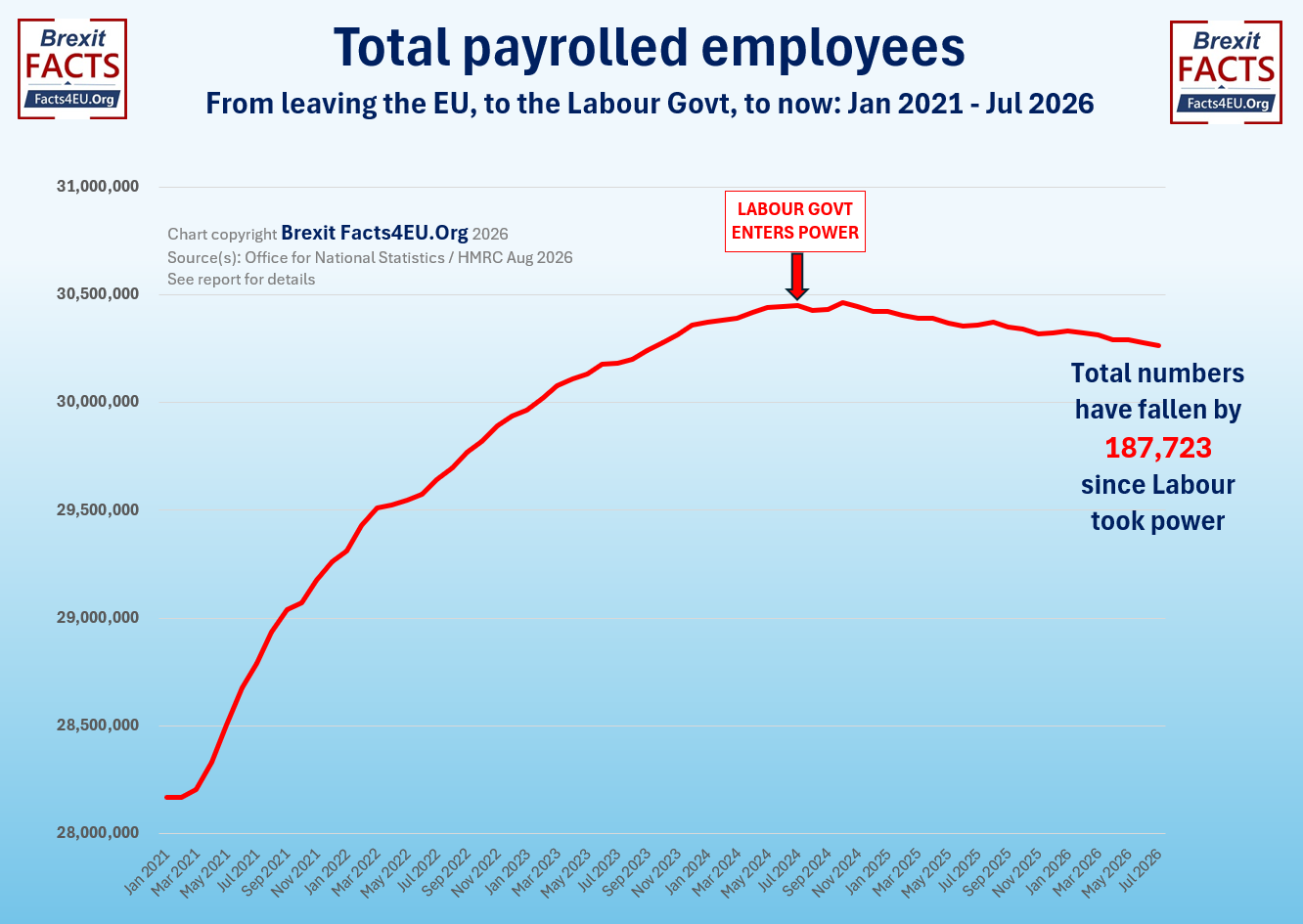
© Brexit Facts4EU.Org 2026 - click to enlarge
The number of employees is still higher than it was five years ago, but finally we look at the cumulative growth in the Public versus the Private Sectors.
The picture looks a little different when looking at the Public / Private Sector split
As the chart below clearly shows, the growth in the number of Public Sector workers is significantly higher than it has been in the Private Sector. Over one-third higher in the last five years, in fact.
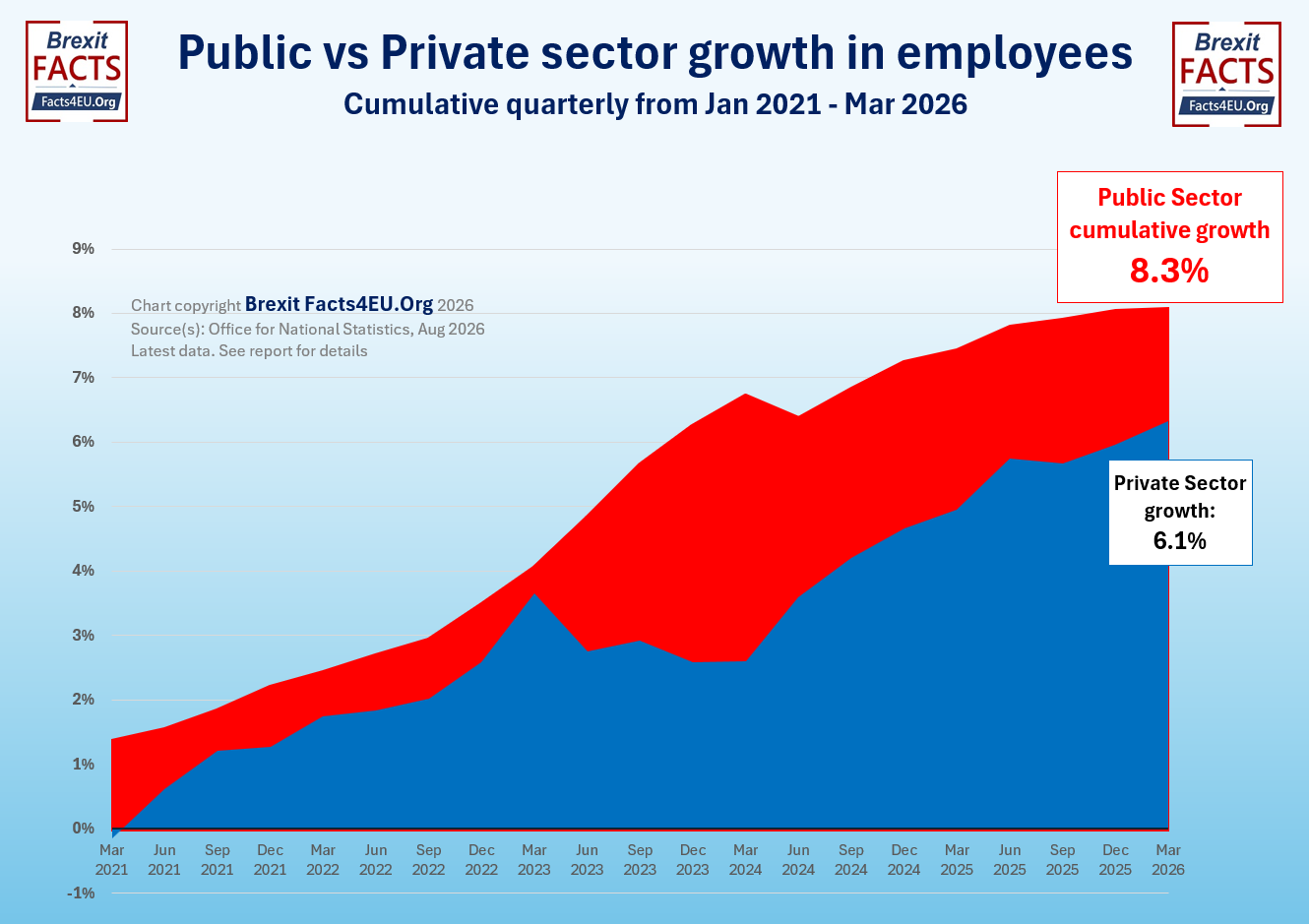
© Brexit Facts4EU.Org 2026 - click to enlarge
[Note: The Public/Private Sector data lags the overall employment data by 3-4 months, hence the last Quarter being March 2026.]
Public Sector employment for the many does not suffer from the threat of compulsory redundancy. Government has been expanding its workforce and shows no sign of stopping. Meanwhile Net Zero high energy costs and taxes are bankrupting some businesses and forcing others to slim down as they cannot afford all the salaries.
The so-called Jobs Tax is laying waste to work opportunities on the High Street and in hospitality. Any state slimming - when it does occur - usually comes with voluntary severance packages that are generous.
“Money for Nothing…”
Nor do most senior officials feel the rough hand of firm management when they make serious errors or lose a lot of money. People in the Private Sector get fired for doing badly.
In the Public Sector after an enquiry there is usually a conclusion that no-one was to blame. It was either a shortage of money and other resources that caused the difficulties, or a systems or institutional failure. A long list of changes is then proposed as a sop to those who were harmed by the errors.
Some senior very well-paid people, such as past Chief Executives of the Post Office and HS2, have even been awarded bonuses. Yet the Post Office has plunged into heavy losses and is having to pay compensation to many employees it wrongly accused of fraud and sent to prison. HS2 is many times over budget and running more than a decade late, yet that has not stopped all the bonuses.
Working(?) from home
The Public Sector likes working from home and is reluctant to accept that more time in the office could be good for productivity, training and improvement. There are issues over whether this is properly policed, with allegations that some abuse the privilege by spending more time on their own matters and less on working the full hours for the state.
The Private Sector is better at providing rules and a discipline for home working.

“Nice work if you can get it…”
The Public Sector often calls in consultants to tell it what to think on the policy and management issues that should be its forte. It regularly uses contractors to do actual work once a policy has been agreed and a programme set up. The Private Sector expects more of its in-house staff, and does not want to pay twice: once to them and once to an external helper.
Many in the Public Sector will benefit from generous inflation-linked pensions provided by schemes that are not funded. Taxpayers will need to meet the bills for the NHS, teachers, civil servants and other large employers out of future taxes to provide more generous pensions than others can afford. Only Local Government and Parliament have funded schemes where there are assets from people's savings to pay for the pensions, in the same way as happens in the Private Sector.
The Public Sector is also good at granting early retirement, which adds to the burden on the Private Sector having to pay for those generous pensions for longer.
Lord Redwood, former Secretary of State
with his final, exclusive comments to GB News and Facts4EU

“The generous treatment of the public sector comes at a big cost to the struggling private sector. Two Reeves budgets thumped private enterprise with the Jobs Tax, higher business rates, and the small business and farm taxes. That left the private sector reeling, having to cut back on its employee numbers and now offering them less than inflation for a pay increase.
“It is as Facts4EU brilliantly exposes, a two-tier economy. The public sector thrives with inflation-linked pensions, no pressure to work smarter, every opportunity to contract out the real work with no penalties on individuals when big mistakes are made and losses incurred.
“The private sector works smarter, raises quality and tries harder but has to shrink its staff and go mean on the pay awards just to survive.
“The grabbing government takes too much in tax, starving businesses of money to invest and expand. Customers have less money to spend as they too are caught having to pay more tax and ever higher rip-off energy bills thanks to Net Zero policies.”
Observations
It has become apparent to many people for some time that the current government has favoured the Public Sector. This was obvious when Sir Keir Starmer immediately bowed to union demands and granted massive pay rises to Public Sector workers on taking office. Since the arrival of Andy Burnham as the newly appointed - not elected - Prime Minister, many of his announcements and even his generalities in occasional interviews have indicated this is likely to intensify.
It seems Mr Burnham believes that Public Sector investment will generate economic growth in the same way as private investment. One of the many problems with this way of thinking is that Public Sector investment comes from the public purse. That money must be generated, either by taxing people more, or borrowing.
What is deeply troubling is that he seems relatively unaware of global market thinking. Servicing our current extraordinary levels of debt is having significant effects. If he is aiming to increase this substantially, as looks inevitable, then things could very quickly get far, far, worse.
Independence Facts4EU will be producing a serious report on this issue very shortly. Watch this space...
Please, please help us to carry on our vital work in defence of independence, sovereignty, democracy and freedom by donating today. Thank you.
[ Sources: ONS | HMRC | Government announcements ] Politicians and journalists can contact us for details, as ever.
Independence Facts4EU.Org, Thurs 20 Aug 2026
Click here to go to our news headlines
Please scroll down to COMMENT on the above article.
And don't forget actually to post your message after you have previewed it!
Since before the EU Referendum, Brexit Facts4EU.Org
has been the most prolific researcher and publisher of Brexit facts in the world.
Supported by MPs, MEPs, & other groups, our work has impact.
We think facts matter. Please donate today, so that we can continue to ensure a clean Brexit is finally delivered.
Any credit card user
Quick One-off
From £5 - £1,000
Monthly
From £3 per month
Paypal Users Only - Choose amount first
Quick One-off
Monthly
Something to say about this? Scroll down for reader comments