Think Sir Keir’s broken election promises are bad?
The new German leader’s are breathtaking
The last time a leader in Berlin acted like this, it didn’t end well for Europe, or the UK….
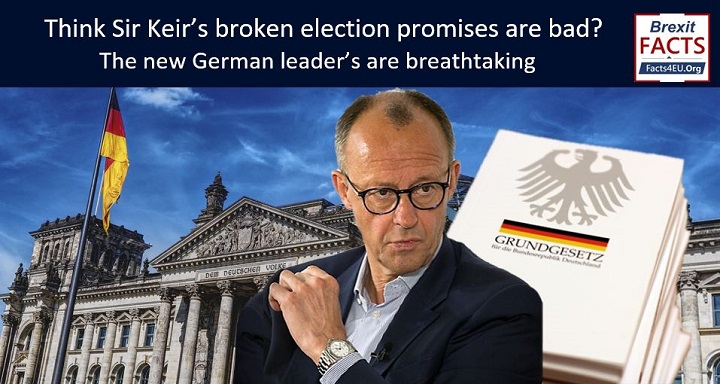
Montage © Facts4EU.Org 2025
Facts4EU summarises yesterday’s groundbreaking manoeuvres in Berlin
Yesterday (Tues 18 Mar 2025) Germany’s lower house of parliament backed a set of measures to change the Constitution, borrow hundreds of billions of euros, militarise on a large scale, and break the most fundamental pre-election promise by the incoming Chancellor which he made only a few short weeks ago.
And all of this was pushed through under a caretaker government before the new parliament, elected by the German people on 28 February, could take their seats in 10 days’ time and veto the new law.
Of the bi-polar axis that has dominated EU policy-making over the decades, it has usually been the French who have treated ‘the rules’ with a gallic shrug of the shoulders, as they paid only lip service to agreed policies and procedures and preferred to talk a good game instead, albeit with a splash of panache. No, longer, it seems.
Much has been changing in Berlin recently, of which yesterday’s events in the Bundestag are only one part. Facts4EU highlights just a few of the developments and considers their relevance for the United Kingdom.
Brexit Facts4EU.Org Summary
The new, key elements, totalling well over €500 billion
The key facts
- Constitutional change rushed through before new parliament can take its seats
- Enormous ‘bribe’ to Greens to back the deal
- Breathtaking U-turn on basic election promise only three weeks ago
The money
- €500bn special infrastructure fund created, voting to change the Constitution first to allow it
- €100bn of this fund: ringfenced for Net Zero projects to bribe the Greens to vote in favour
- Plus defence spending over 1% of GDP: excluded from debt brake, allowing it to rise significantly
- Billions in aid for Ukraine: also exempt
- Billions in borrowing by Germany’s 16 ‘Länder’ (regional states) now to be allowed
Members of the Bundestag voted by 512 to 206 to pass a law changing the much revered German Constitution, and allowing its incoming government to borrow hundreds of billions, radically expand its army, and give an astonishing €100bn uber-dose of funding to an already expensive Net Zero regime. Any change to the Constitution requires a two-thirds vote and yesterday’s easily exceeded this.
“Germany is back,” says incoming Chancellor
As we reported on Monday, incoming Chancellor Friedrich Merz and others have been talking up Germany’s military ambitions.
“This is a signal that we want to assume joint leadership responsibility in NATO and for Europe.”
- Boris Pistorius, German Defence Minister, Thurs 13 Mar 2025.
“Germany is back. Germany is making its great contribution to the defence of freedom and peace in Europe.”
- Friedrich Merz, Chancellor-elect, Fri 14 Mar 2025
“The decision we are taking today can therefore be nothing less than the first major step towards a new European defence community.”
- Friedrich Merz, Chancellor-elect, Tues 18 Mar 2025
Merz indicated by implication that the UK should play an important part in this ‘defence community’ – no doubt under German or other EU command.
The announcement of major German militarisation – talk of which once chilled veins across Europe in the last century – was immediately greeted with joy by the (German) unelected President of the EU Commission, Ursula von der Leyen.
"...Excellent news... Sends a very clear message to Europe that Germany is determined to invest massively in defence."
- Ursula von der Leyen, EU Commission President, Denmark, 18 Mar 2025
We badly need your support to continue
Please help us by making a donation below
Any credit card user
Quick One-off

From £5 - £1,000
Monthly

From £3 per month
Paypal Users Only - Choose amount first
Quick One-off
Monthly
A blitz-strike on election promises
Within days of being elected, Friedrich Merz was backpedalling furiously on his cast-iron promise not to touch the 'debt brake' (see below). The broken promises in the UK may seem to have started far too soon after the election for “a change of circumstances” to be a justifiable reason to do what Sir Keir and colleagues had insisted they would not do. However these were as nothing compared to the actions of Herr Merz.
The events in Germany have operated at simply breathtaking speed, making Sir Keir and colleagues look slovenly by comparison. The reason for this haste is simple. The results of the 28 February general election in Germany put the right-wing AfD party into second place. Neither they nor the Left party would have voted for the constitutional change and the two-thirds majority would not have been achieved. However, the newly-constituted Bundestag will not take its seats until at least 25 March. Merz therefore knew he had to act fast, or be constrained in his spending plans for the lifetime of the new parliament.
This was still not enough to achieve his aims. He needed the votes of the Green MPs to get over the line. Finally last week he was able to get their votes guaranteed, although the Green Party leadership unsurprisingly drove a hard bargain. An extraordinary €100 billion of the €500 billion infrastructure fund will now be spent exclusively on Net Zero projects.
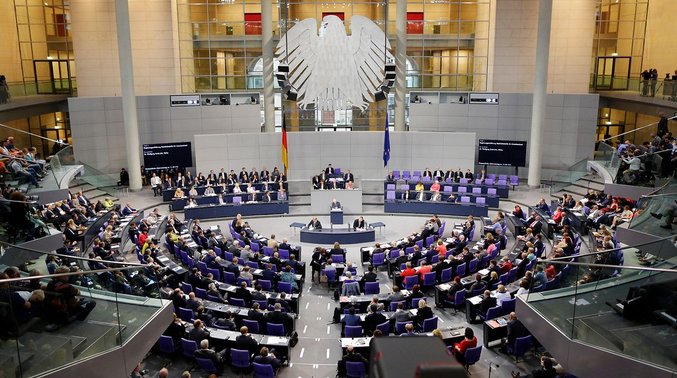
© Bundestag 2025
Background to the momentous events yesterday – The Constitution
Unlike the UK where the constitution is a fluid creature comprising numerous legal forms and precedents, and not codified in a single document, in Germany the written Constitution is ‘a big deal’ and any proposed amendments to it are not taken lightly.
Known as the ‘Grundgesetz für die Bundesrepublik Deutschland’, the Constitution has a title meaning ‘Basic Law’. At 51 pages, this law is basic in the sense of being fundamental, rather than simple. Formed after Germany’s defeat in the Second World War, it was of course a product of the time when the four Allied Powers – the US, UK, France and Russia – ran the country. Despite the fact that it has never been put to a public vote, this Basic Law has generally been seen as unmovable in its main principles, as set out in the first 20 articles. That said, this has not stopped a great many (over 50) minor amendments and perhaps two which might be called major ones.
Germany’s ‘Debt Brake’ has been released
The first major amendment occurred following German reunification, for obvious reasons. It is the second amendment, made in 2009 and instigated by former Chancellor Angela Merkel, that was overturned in the Bundestag yesterday. This had introduced the balanced budget amendment (known colloquially as the ‘debt brake’) which stipulates that a state cannot spend more than its income. In practice there was an upper limit on the structural deficit of only 0.35% of GDP.
All of this has changed, with the debt brake gone and the regional state governments will be allowed to borrow too.
Observations
Yesterday’s events in the Bundestag marked a departure for the normally rigid, fiscally-tight, and somewhat humourless disciplinarians guiding the ‘European Projekt’. No longer can Berlin demand absolute adherence to the strictures of financial envelopes within which all in the Eurozone must operate. Not only that, but the new broom sweeping the corridors of the Chancellery and the German parliament will find it rather more difficult to lecture all the lesser members about democracy with quite the same authority.
With the debt brake now gone, it seems that the new German government will be spending vast amounts in excess of the revenues coming in. These revenues have already been reduced due to the parlous state of the German economy over the last two years. With the brake released, it will now be time for “Spend, spend, spend!” and it will be interesting to see what the markets make of it. In the short term we expect there to be a boost, with more money flowing into the economy, followed later by a reckoning. The Eurozone has always been heavily propped up by the underlying strength of the very prudent German economy and its Bundesbank scrutiny. This now looks under threat.
The Germans’ reputation for order can be somewhat overstated, as anyone who has been living in Germany this century will tell you. To take but one example, the trains most definitely do NOT run on time. That said, there is undoubtedly more of a belief in sticking strictly to the rules – which in the European context are often of German origination.
Were this to happen in any other EU country, it is not difficult to imagine the ire and admonishments emanating out of Berlin and descending on the miscreant. When Berlin speaks the word ‘austerity’, it comes with a chilling effect which only a German accent can give it.
But this is Germany, economic powerhouse of the EU, guardian of the ‘Basic Law’, and de facto holder of the Eurozone’s purse strings. It seems they now do things differently there…
Please, please help us to carry on our vital work in defence of independence, sovereignty, democracy and freedom by donating today. Thank you.
[ Sources: Bundestag | Constitutional Court | German media ] Politicians and journalists can contact us for details, as ever.
Brexit Facts4EU.Org, Wed 19 Mar 2025
Click here to go to our news headlines
Please scroll down to COMMENT on the above article.
And don't forget actually to post your message after you have previewed it!
Since before the EU Referendum, Brexit Facts4EU.Org
has been the most prolific researcher and publisher of Brexit facts in the world.
Supported by MPs, MEPs, & other groups, our work has impact.
We think facts matter. Please donate today, so that we can continue to ensure a clean Brexit is finally delivered.
Any credit card user
Quick One-off
From £5 - £1,000
Monthly
From £3 per month
Paypal Users Only - Choose amount first
Quick One-off
Monthly
Something to say about this? Scroll down for reader comments