Part II - “Things…. can only get blurrier…”
How 25 years of the FOI Act from "Call Me Tony" has made it more difficult to get information from government
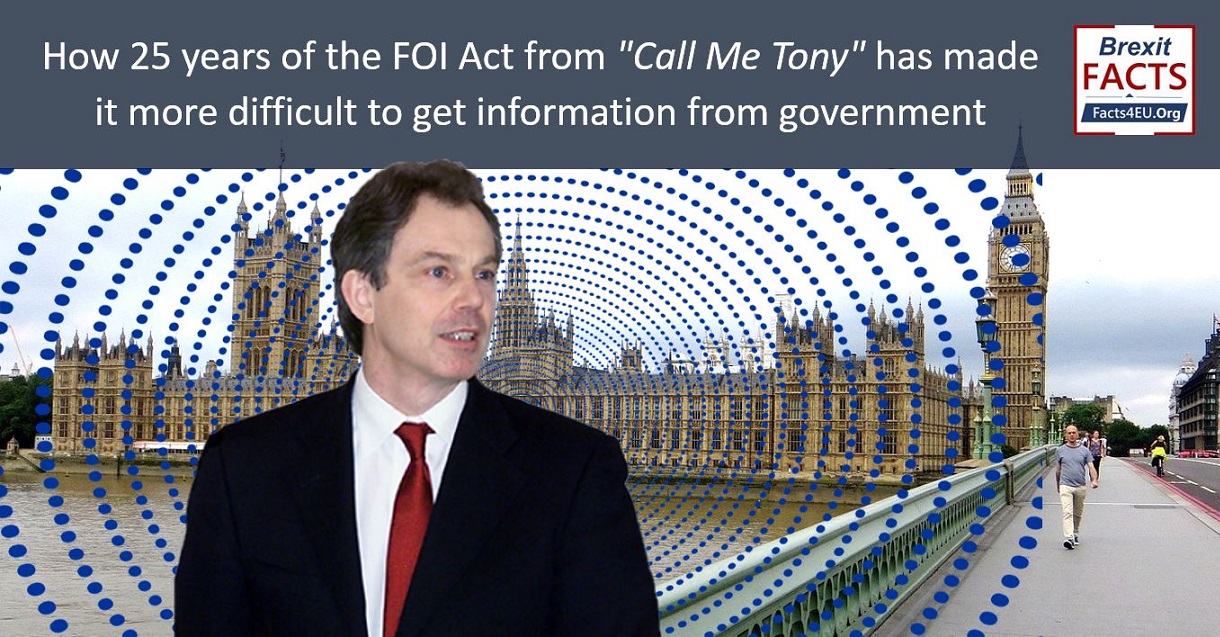
Montage © Facts4EU.Org 2025
The second part of a 25 year retrospective view of Blair’s Freedom of Information Act 2000
Today we publish the second and final part of a disturbing article by a guest author on the Freedom of Information Act 2000. If you missed Part I please read that first. In this second part, the journalist going under the nom de plume of Checkpoint Charlie provides specific examples of how the FOI Act works in practice. He shows that far from its original intentions, the Act obstructs rather than facilitates.
Part II - “Things…. can only get blurrier…”
The finale of a 25-year retrospective on Tony Blair’s ‘Freedom of Information Act 2000’
By Checkpoint Charlie
What follows is based on experience
Firstly, some basics in summary form, as the details are much more complicated than this. Here is very roughly how the FOI process works.
- All requests must be in writing
- The organisation has 20 working days to respond
- The subject matter must not be on the (very lengthy) exempt list
- It must not cost more than £600 to find the information and supply the answer
- The information must be available in the first place
- It must not already be available elsewhere
- To answer must be more in the public interest than not
How well does this serve us?
If I want some statistical information, my first thought is to phone the Department or Agency and ask them if it’s buried somewhere on their website and ask if they can direct me to the link. If it’s not on their site, then I want them to call me back when they’ve enquired internally. A call has the benefit of finding out what might be readily available on a particular subject, so that I know what it’s fast and practical to find out.
What I don’t want is to be told to put the request in writing and for the questions to be precise. This has the effect of making it easy for the Department to say: “We don’t collect that information.” What they will never volunteer is: “We don’t have exactly what you asked but we have this and it’s close, is that good enough?” Quite often the answer might well have been yes but they simply will not engage on this basis.
We rely wholly on patriotic members of the public to survive. Please donate today if you would like to continue reading us tomorrow, next week, and the weeks after.
Any credit card user
Quick One-off

From £5 - £1,000
Monthly

From £3 per month
Paypal Users Only - Choose amount first
Quick One-off
Monthly
Don't leave this to someone else. You are that 'someone else'.
Logic and pragmatism don’t work
When I press the point that I have no desire to create work and would be happy to consider what they do have readily available, I’m told the best thing to do is submit an ROI request. In other words, far from becoming a ‘freedom’, the FOI has become a denial of freedom and a ‘get out of jail’ card for the authorities. As far as they are concerned they have dealt with my enquiry and done their job.
Say I’m working on a deadline of 5.00pm that day and it’s 9.30am when I’m making this call. If I submit an FOI request they essentially have a month to respond, or 20 working days if I adopt their insistence on being precise. When I then explain we’ll have to go to press or on air without them, they will then produce some generic statement saying how seriously the Department takes such and such an issue, etc., etc.. Needless to say this never comes close to addressing the issue at hand.
What’s sauce for the Goose…
When working for TV, OfCom regulations require the channel to offer a Right of Reply (RoR) to the other party. The best response I ever had was last year from one of the four major Departments of State when I put to them some figures we were going to be showing in the report. The numbers I had produced were at the heart of the piece and constituted the main point the public wanted to know. The statement which I was offered from this major Department of State was somewhat lofty.
Statement from a Department of State
“We do not recognise those numbers,” said the statement.
“That’s fine,” I replied. “The public will be fascinated, as the numbers come from your own spreadsheets.”
After some embarrassed spluttering I was told I would be called back.
“I’m afraid you’ll have to put that in writing,” I said. It was simply impossible to resist.
25 years of ‘Freedom of Information’
Formalising what should be a natural process of asking questions and getting answers has its pros and cons. Overall my opinion of the effect of the FOI Act in respect of journalism is negative. Misinformation and even disinformation is commonplace. For individuals wishing to know what information is held about them personally, however, I can see major benefits.
We should also consider agents other than the Act which are now acting against freedom of information. A stand-out amongst these is the extraordinary idea of civil servants working from home. My personal experience is that getting someone you want to speak to on the phone is the biggest challenge of them all. These days many government departments seem to have one junior person in the Press Office (if you’re lucky) but they can’t transfer you to the right person because they are ‘WFH’. They promise to pass on the message but then you hear nothing.
So is Sir Tony’s FOI Act just another dodgy dossier?
It would be wrong to say there have been no successes in the last 25 years. Some major stories have been unearthed and some have led to changes in legislation. Readers will, I’m sure, be able to think of their own examples of good journalism uncovering important stories. For no particular reason the Daily Telegraph’s exposé of the MPs’ expenses scandal comes to mind and this was partly made possible by the Act.
The extent to which the FOI Act made a full difference is another matter, though. Take a wild guess at one set of individuals who – though information about them held by others can be requested – are themselves exempt from responding to requests under the FOI Act? Yes, that would be those who actually voted for it in the House of Commons: our MPs.
There you go, and you didn’t even have to submit an FOI request to discover that piece of information.
- By Checkpoint Charlie, Dec 2025
Observations
The original ‘Checkpoint Charlie’
Our guest author has used ‘Checkpoint Charlie’ as his pseudonym. For younger readers, this was the name given to the crossing point between East and West Berlin which could be used by non-Berliners, before the wall came down and Germany was reunified.
As such, it represented one of the most memorable symbols of the divide between the authoritarian regime of the GDR (East Germany) and the West (West Berlin).
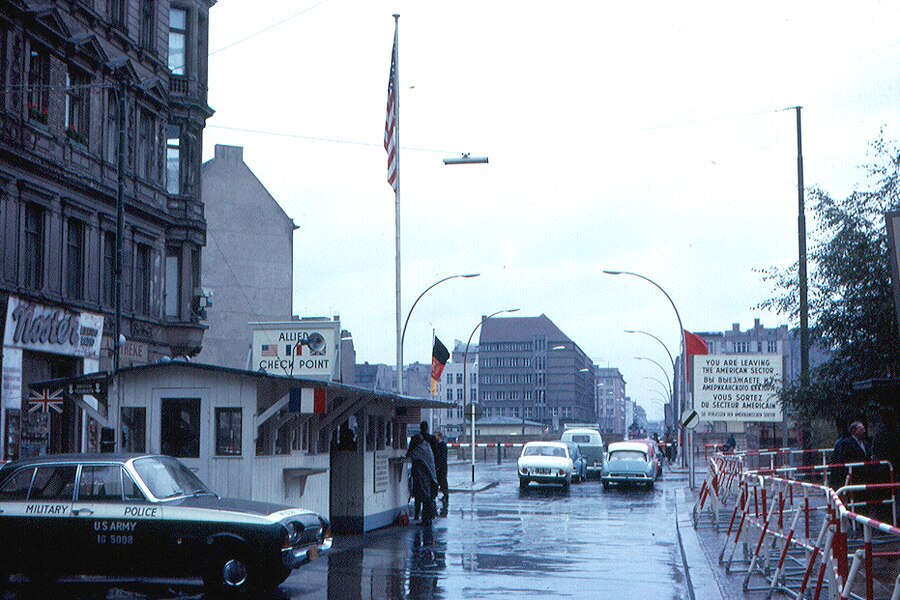
Checkpoint Charlie / West-East Berlin crossing
Perhaps our guest writer chose it as a symbol of his views of the Freedom of Information Act. We can tell readers from experience that there is a contrast between the word ‘Freedom’ in the Act’s title and the rules-based system encountered when trying to use it.
Similarly, anyone with experience of using Checkpoint Charlie and being taken aside for questioning by East German border guards will testify to the cold, authoritarian, and – frankly - scary attitude encountered when attempting to cross into the German ‘Democratic’ Republic (GDR) of East Germany.
Finally…
Again, for our younger readers, and because it is Friday, here is a clip of ‘Things can only get better’ by D:Ream, which was Tony Blair’s theme song for Labour Party rallies. This might help to explain the title of Checkpoint Charlie’s article.
Please, please help us to carry on our vital work in defence of independence, sovereignty, democracy and freedom by donating today. Thank you.
[ Sources: Checkpoint Charlie | D:Ream ] Politicians and journalists can contact us for details, as ever.
Brexit Facts4EU.Org, Fri 05 Dec 2025
Click here to go to our news headlines
Please scroll down to COMMENT on the above article.
And don't forget actually to post your message after you have previewed it!
Since before the EU Referendum, Brexit Facts4EU.Org
has been the most prolific researcher and publisher of Brexit facts in the world.
Supported by MPs, MEPs, & other groups, our work has impact.
We think facts matter. Please donate today, so that we can continue to ensure a clean Brexit is finally delivered.
Any credit card user
Quick One-off
From £5 - £1,000
Monthly
From £3 per month
Paypal Users Only - Choose amount first
Quick One-off
Monthly
Something to say about this? Scroll down for reader comments