In the last 10 years, Civil Service growth has cost us an extra £6bn
£2bn of this was due to it upgrading its officials to ever more senior ranks
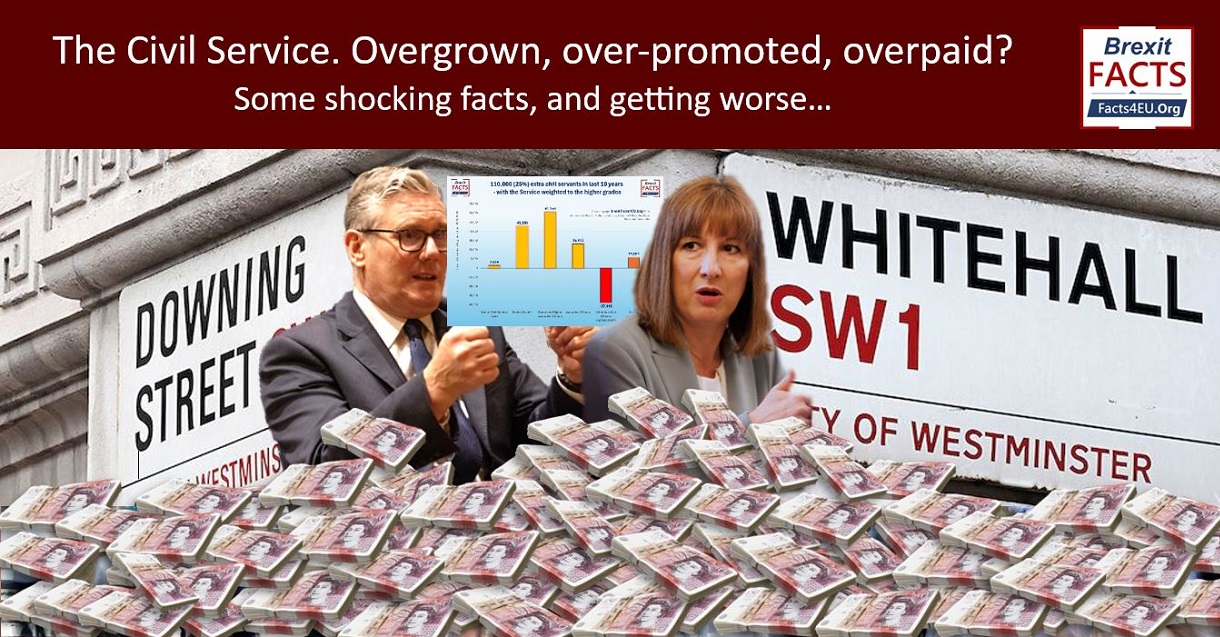
Montage © Facts4EU.Org 2025
Rachel Reeves just claws the money back from the hard-pressed taxpayer
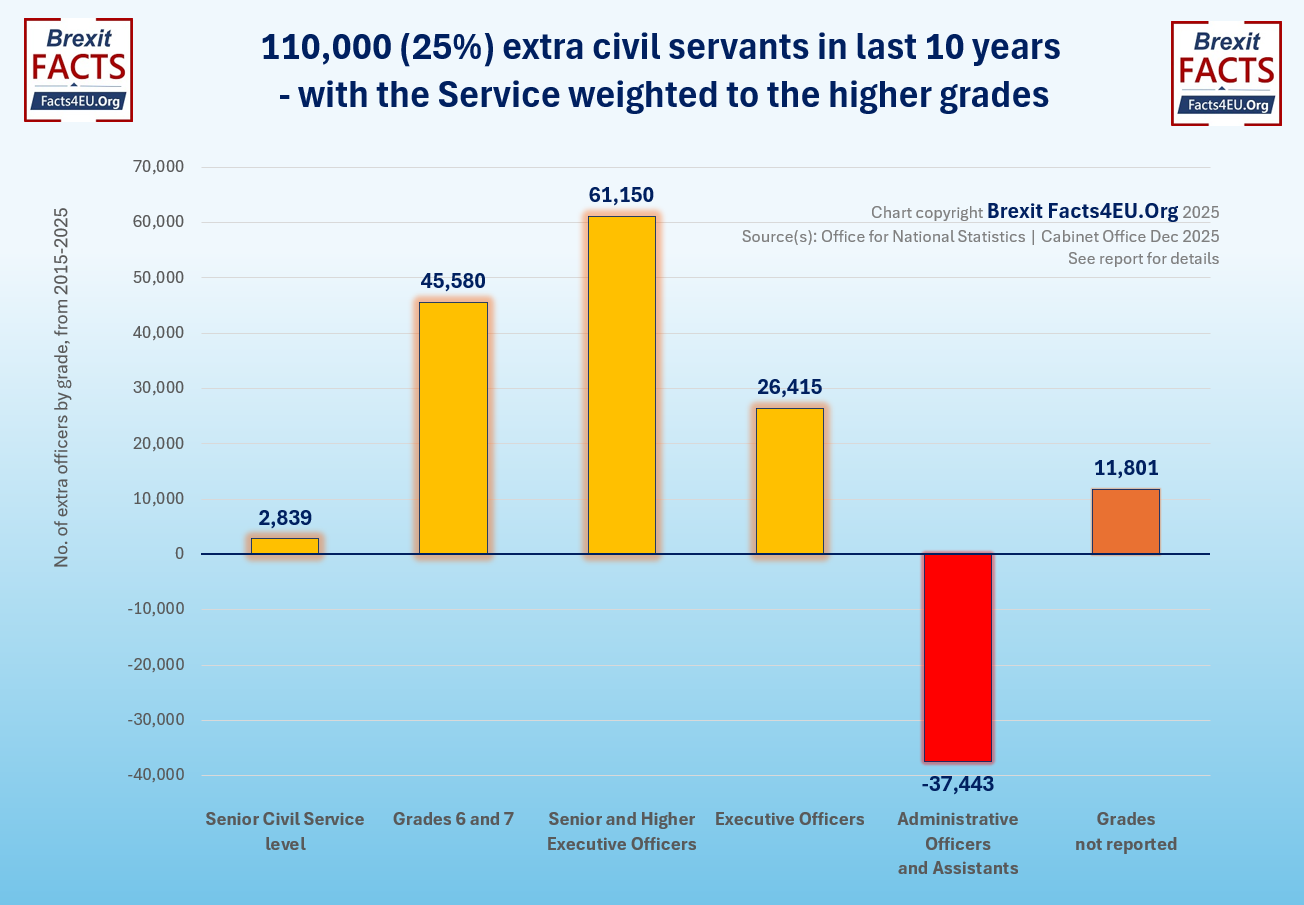
From 2015 to 2025, the Civil Service has grown by 110,000 officials. This represents a 25% increase in total staffing numbers. In doing so, it has also upgraded a disproportionately high number of senior ranks, while reducing the number of more junior administrative officials, pro-rata.
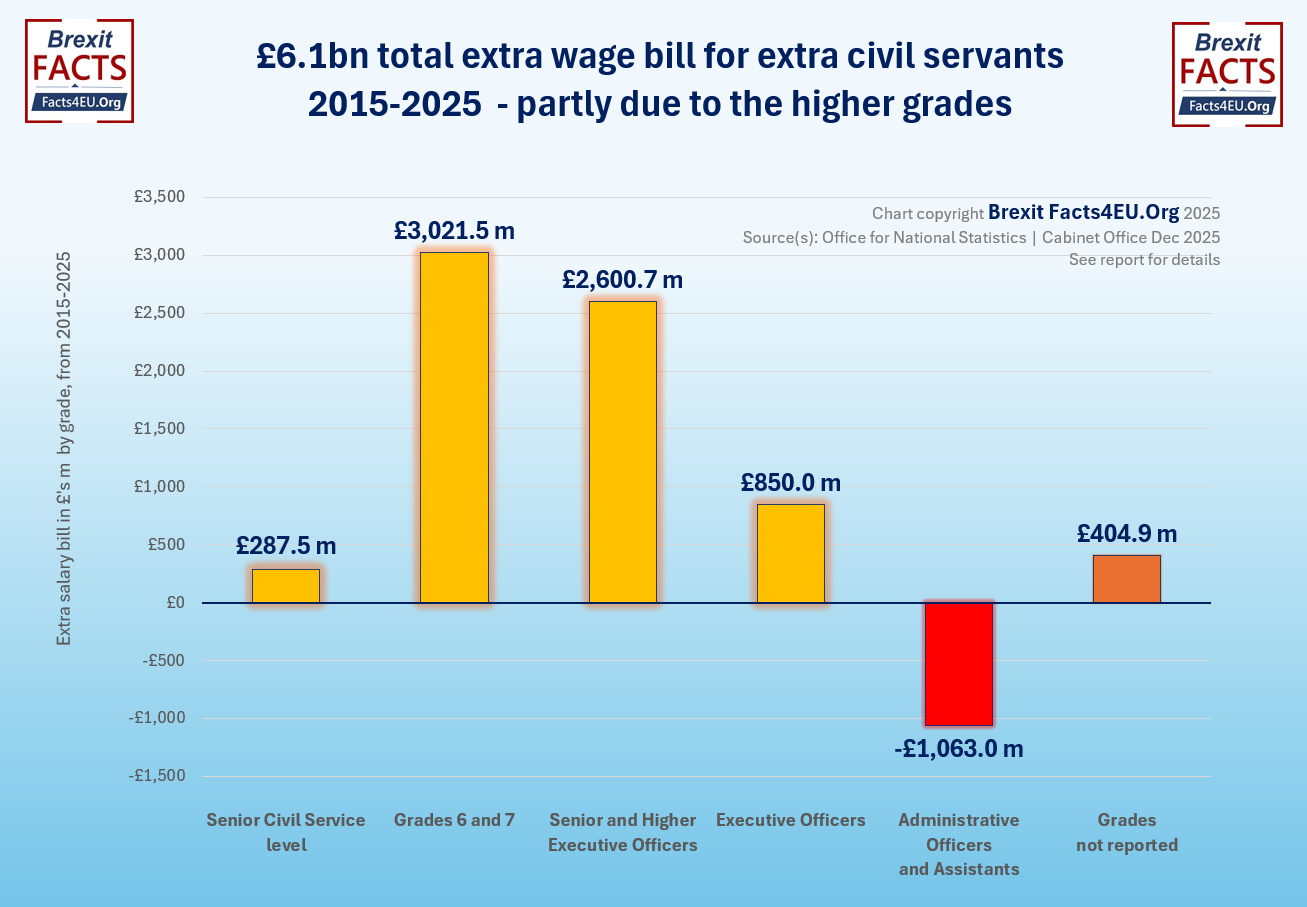
Its salary bill, excluding the extra costs of national insurance, gold-plated pensions, and other benefits, has risen by £6.1 billion. An astonishing £2 billion of this increase is due to the roles of a great proportion of officials being upgraded, which naturally means higher salaries.
This report has been researched and produced by Facts4EU, with additional commentary from the Rt Hon Sir John Redwood, and given to GB News as an exclusive. GB News published their coverage of it last Friday and we recommend this to readers as it provides a different 'take'. Today we publish our original, full version.
The extra 110,000 officials, showing the new proportions of higher rankings
© Brexit Facts4EU.Org 2025 - click to enlarge
The Rt Hon Sir John Redwood comments:
“It is difficult to see why the civil service needed to recruit so many extra people in the last year or so or why they hired so many permanent new staff during the Covid disruption.
“Productivity has fallen badly and is below 2019 levels. This has been a time of substantial spend on computers and software which should have led to fewer staff and higher labour productivity.”
“It is understandable they needed more people on a temporary basis to handle the widescale interventions of Covid lockdown. It is not understandable why these were not temporary staff or why a big recruitment has taken place on top of all that growth in numbers. Various Ministers in the past and present government have wanted deregulation, government to do less, but have found this impossible to get done.”
The chart above shows clearly how the roles which have increased are those which are higher-ranked, all the way up to the top level. Put in everyday terms, there are an increasing number of Chiefs, and a diminishing number of Indians.
Interestingly, this puts to the sword the claim that the reason the Civil Service has had to increase in size by 25.1% in the last 10 years is because of Brexit. If that were true, then there would be a need for an increased number of Administrative Officers and Assistants. The opposite has happened and there is now a greater proportion of the higher grades and a reduced share of the lower grades.
Because a higher ranking automatically comes with a higher salary band, this has had a dramatic effect on the overall extra wage bill, as we show in our chart below.
The salary bill for the extra officials based on many more elevated rankings for higher ranks
© Brexit Facts4EU.Org 2025 - click to enlarge
Our first chart showed the number of extra roles behind the overall rise in the headcount of the Civil Service. The second chart above shows the exaggerated effect this has had on the cost of the extra salaries in each category – except for the lower grades of Administration Officer and Assistant.
Facts4EU has calculated the combined effect of the additional wage bill arising out of the increased numbers overall, and the effect of the increase in grades. We took the blend of the different grades in 2015 and applied this to the workforce in 2025, to work out the effect of the grading increase on its own, which is shown in the chart below.
The Rt Hon Sir John Redwood comments:
“It is difficult to see why there has been so many promotions in the civil service in recent years. The civil service does not need more managers. It needs better management. The more managers it has appointed the worse the long delays in getting answers, the long waiting lists in the NHS, and the long waits to settle migration cases have got.
The system is top heavy with more of the staff talking to each other and finding reasons to delay or complicate things. We need more staff and friendly computers helping the public they serve. As managers increase in numbers so the public find it becomes more difficult to get to talk to someone who can help them.”
An astonishing £2bn of the £6bn extra salary bill is due to the proportion of higher rankings

© Brexit Facts4EU.Org 2025 - click to enlarge
As can be seen, the effect of the increased weighting towards higher grades has a dramatic effect. One third of the increase in the wage bill is applicable to the increased rankings, which equates to just over £2 billion pounds per annum. All figures in the report are expressed in real terms, at 2025 prices.
The question must be asked: who is actually managing the Civil Service in allowing their ever-growing seniority of their positions? There is absolutely no reason we can think of why this should be necessary, other than the fact it gives 110,000 civil servants a pay rise without it showing as such.
For the public to be picking up a £6 billion increased cost of the Civil Service is bad enough. To find out that £2 billion of this is down to ‘regrading’ seems unacceptable at a time when the public is being required to pay ever higher taxes.
A summary of Civil Service and public sector employment does not look good for Reeves
Anyone scouring through the employment figures for the public sector would find it hard to reconcile some of the figures with the Chancellor’s claims of more black holes and the need for more tax rises in her November Budget.
Looking at the last 12 months of Rachel Reeves’ tenure at No.11 Downing Street, the employment numbers on their own suggest “nothing to see here”, as the trend continues its inexorable climb upwards. Below we summarise some of these figures, this time using information available to September of this year. (The previous charts involved the more complex figures available up to the end of the financial year in March.)
When looking at the numbers, it is important to recognise two things. Firstly that even a relatively small-looking movement of 1% represents a great deal of money when the personnel counts and wage bills are already so high.
Secondly, as the public and many hard-pressed businesses are struggling when asked to pay more, it might be expected that the public sector be asked to take its fair share of the cuts.

© Brexit Facts4EU.Org 2025 - click to enlarge
“As Facts4EU has stressed before, we should be implementing recruitment freezes at the very least, which would result in very welcome falls of around 7% per annum due to natural wastage, as people leave and are not replaced. Instead, all the pain is being felt by the private sector. It seems to be ‘business as usual’ in Rachel Reeves’ public sector.”
- Chairman, Facts4EU, Dec 2025

Finally, spare a thought for your poor, underpaid civil servants
More than 120 civil servants earn more than the Prime Minister. In addition, the number of civil servants earning more than £150,000 p.a. is calculated to be 410, 45 of whom are only working part-time. On top of this there are the values of their gold-plated pensions and a whole raft of extras benefits, which total a not inconsiderable sum.
For those readers wondering which department they should apply to in the Civil Service, given that there is no chance of being made redundant or of being fired for incompetence, Facts4EU has prepared a guide. Money isn’t everything in life, that’s true, but with over a quarter of a million pounds a year coming in, plus a gold-plated pension, and extremely generous benefits and holiday allowance, it has a lot to be said for it.
The Rt Hon Sir John Redwood comments:
"The latest public sector rich list shows there are now many public sector employees paid more than the PM. Several who preside over making heavy losses for the taxpayer running HS2, the Post Office and the Bank of England are paid more than £500,000. These posts should with future hirings pay a basic salary around the level of the PM with bonus opportunities for much higher pay if they deliver. The Bank should have to deliver its inflation target and avoid all losses. The Post Office should make a profit. HS2 should deliver on time and to budget."
Below are just some of the departments you may wish to consider. And in case you think you might be able to get by on less than a quarter of a million pounds a year, we have included some less well-paid alternatives. We should point out that these are the salaries of the highest earners in the highest bands in each department or function therein.
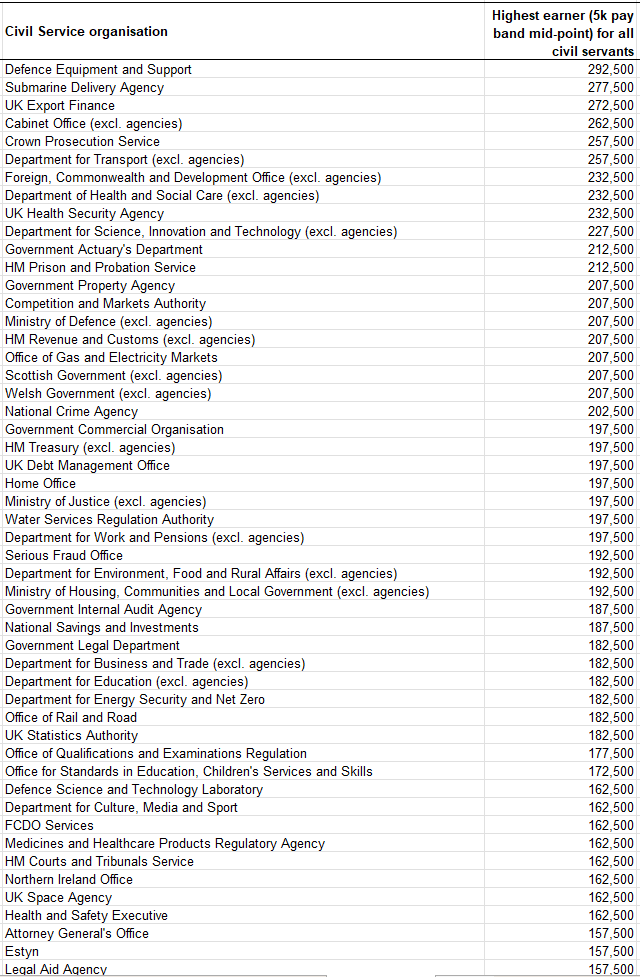
© Brexit Facts4EU.Org 2025 - click to enlarge
The Rt Hon Sir John Redwood concludes:
"The table of senior civil servants also reveals high pay. They too should have a basic salary a little below the PM's. Their bonuses should be based on boosting the productivity and service quality of the part of the public sector they run.
"We need a bonus revolution to align senior public sector pay with the country's interests. People in the public sector should be able to earn big sums only if they improve public services and cut costs."
Observations
It is difficult to reconcile the pressures on the public purse, about which Rachel Reeves waxed lyrical in the run-up to this year’s budget, with the way in which the civil service has rewarded itself.
Not only have staffing numbers increased by 25% in the last 10 years, but ‘grade inflation’ has run at levels which make us wonder if civil servants understand the anger in the country about the second round of tax rises imposed by Rachel Reeves.
Many industries have suffered terribly, not the least of which being farming and the hospitality sector. Other businesses that were planning to increase their workforce have been forced to cut back, which helps to explain the large reduction in vacancies. Unemployment has now risen to 5.1% and shows no sign of stopping its rise. Then we have the new employment rights bill which promises to make businesses think twice before employing any more people.
And all the while, the Civil Service appears not only to have been unaffected, but seems to be enjoying a golden period when wage increases can be increased yet further by the expedient means of upgrading a person’s grade.
For a government which has growth as its number one objective, it is showing a very peculiar way of trying to achieve this.
Please, please help us to carry on our vital work in defence of independence, sovereignty, democracy and freedom by donating today. Thank you.
[ Sources: Cabinet Office | Office for National Statistics ] Politicians and journalists can contact us for details, as ever.
Brexit Facts4EU.Org, Mon 29 Dec 2025
Click here to go to our news headlines
Please scroll down to COMMENT on the above article.
And don't forget actually to post your message after you have previewed it!
Since before the EU Referendum, Brexit Facts4EU.Org
has been the most prolific researcher and publisher of Brexit facts in the world.
Supported by MPs, MEPs, & other groups, our work has impact.
We think facts matter. Please donate today, so that we can continue to ensure a clean Brexit is finally delivered.
Any credit card user
Quick One-off

From £5 - £1,000
Monthly

From £3 per month
Paypal Users Only - Choose amount first
Quick One-off
Monthly
Something to say about this? Scroll down for reader comments