‘Pay public sector more, get less’ – 2019-2024 we paid in 19% more and got 8% less productivity
Summary of latest data shows dire state of public sector – and it’s twice as bad in the health part
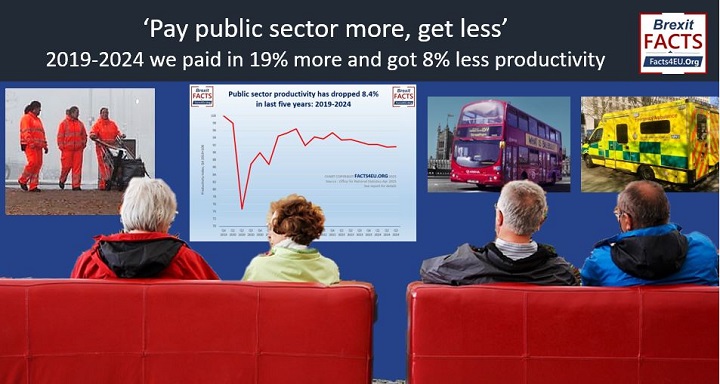
Montage © Facts4EU.Org
In the private sector the CEOs would be fired for this, in the public sector they’re more likely to get bonuses
Facts4EU think-tank has now analysed the latest data published by the Office for National Statistics for the last five years. It shows that if current trends continue, in 33 years’ time the UK will be getting half the productivity from the public sector that it did at the end of 2019, despite spending double the amount on it.
This report summarises the continuing deterioration in public sector productivity overall, as well as looking at productivity specifically in the public health sector on its own. The report’s conclusions are inescapable and we invited an expert on this subject to comment further.
Brexit Facts4EU.Org Summary
Public Sector Productivity, Total, and Health-only, 5 years from 2019-2024
Indexed to Q4 2019=100
1a. Total public sector productivity
- Q4 2019 : 100.0
- Q3 2024 : 91.6
- Drop in productivity : -8.4%
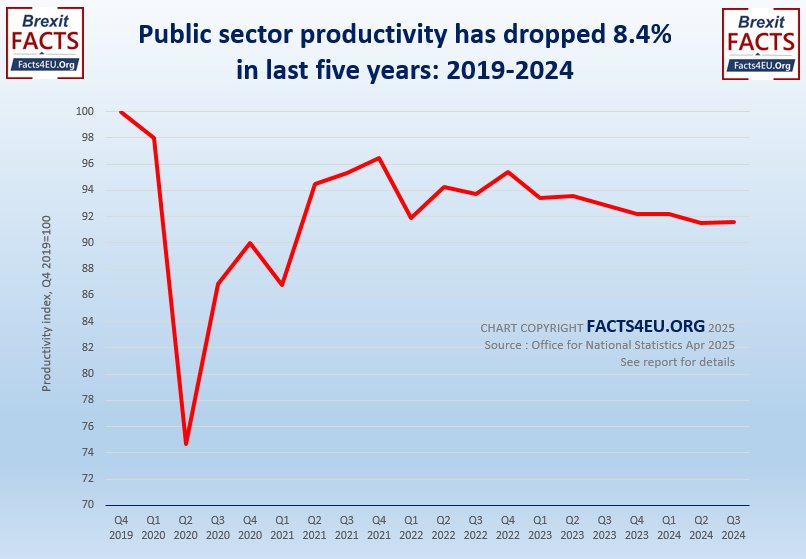
© Brexit Facts4EU.Org 2025 - click to enlarge
[Source : Office for National Statistics Apr 2025]
1b. Increase in inputs into public sector in the same time period
- Q4 2019 : 100.0
- Q3 2024 : 119.8
- Increase in inputs : +19.8%
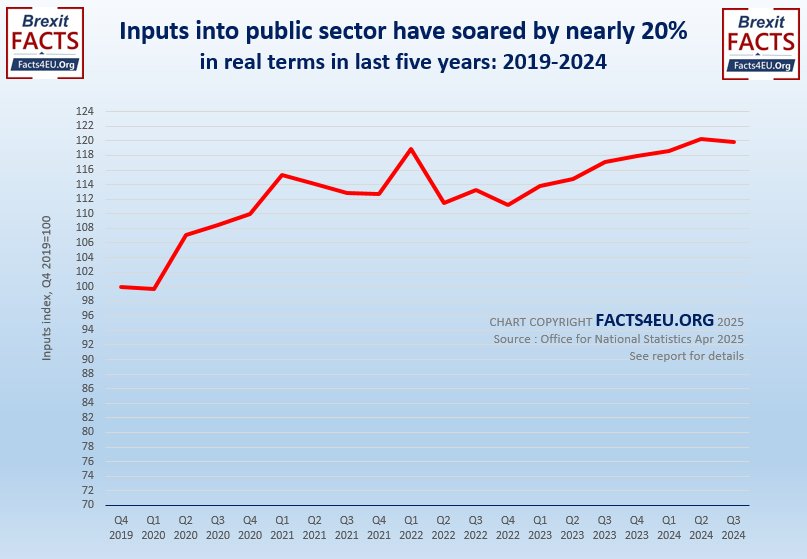
© Brexit Facts4EU.Org 2025 - click to enlarge
[Source : Office for National Statistics Apr 2025]
2a. Public health sector productivity, five years from Q4 2019 to Q3 2024
- Q4 2019 : 100.0
- Q3 2024 : 81.5
- Drop in productivity : -18.5%
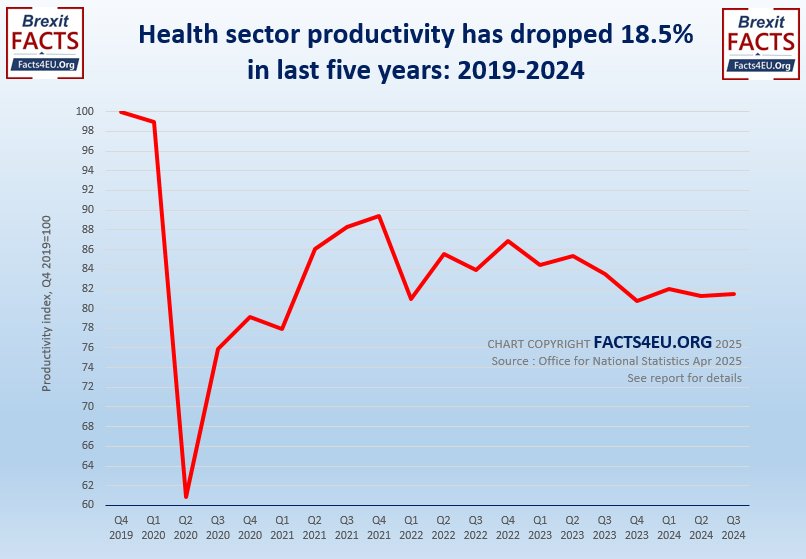
© Brexit Facts4EU.Org 2025 - click to enlarge
[Source : Office for National Statistics Apr 2025]
2b. Increase in inputs into public health sector in the same time period
- Q4 2019 : 100.0
- Q3 2024 : 130.3
- Increase in inputs : +30.3%
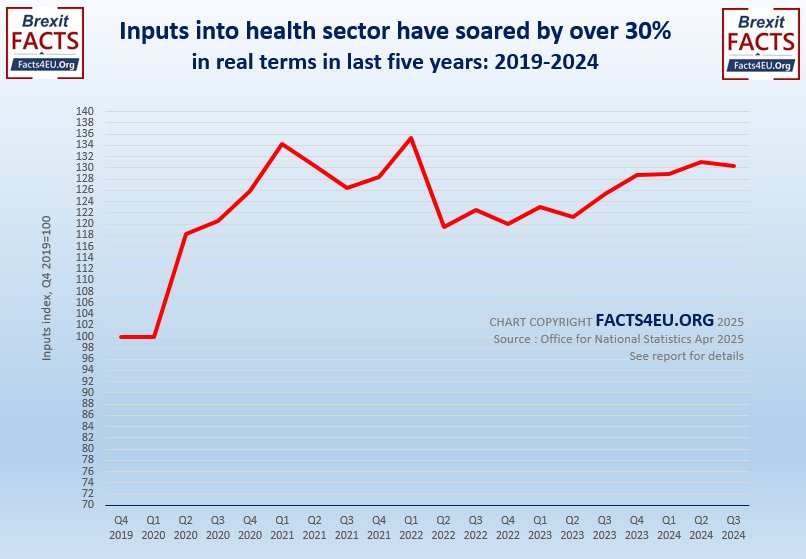
© Brexit Facts4EU.Org 2025 - click to enlarge
[Source : Office for National Statistics Apr 2025]
If nothing is done, where will we be in 33 years’ time?
If the current trends continue, with more going into the public sector each year and less being pro-rata produced by it, then by 2058 the public sector’s productivity will be only 50% of what it was immediately pre-Covid in Q4 2019.
At the same time, getting 50% of the productivity we had in 2019 will cost double the amount.
We asked an expert on these matters to review our report and comment
Here is what the Rt Hon Sir John Redwood told us
Well done Facts4EU. They are right to reveal just how much more taxpayers have to pay to get the same amount of public service as 5 years ago. The terrifying decline in productivity means the state now needs to employ more people and resources to do the same thing. No wonder spending on health and other public services has shot up. We have to pay for all the extra waste and inefficiency. Then on top there’s a further big additional charge to cover the rise in wages and prices too.

Rachel Reeves’s alleged black hole of £22 bn largely made up of her big public sector pay awards is small compared to this alarming collapse. The private sector had a big decline in productivity thanks to the Covid lockdowns as did the public sector. The private sector has restored its losses and is now more efficient than in 2019, whilst in the public sector things have got worse.
You should expect productivity to go up by say 2% a year. Many parts of the public sector employ people to process applications, licences, benefits, taxes, health appointments and the like. These are all activities where new computers and coming AI can help boost efficiency. The public sector has been spending a lot on automation but is missing out on the benefits. There has been a large recruitment of additional administrators, and a surge in the number of managers relative to other staff.
Instead of things being better managed, they are overmanaged with too many managers diverting staff time away from the central task of serving users well to pour over internal matters. The result is a disaster. The UK cannot afford all this mismanagement.
- The Rt Hon Sir John Redwood, 24 Apr 2025
What is ‘productivity’?
In these descriptions we are paraphrasing the texts used by the ONS. In calculating productivity in the public sector, the methodology of the ONS involves assessing the amount put into it (in whatever form) against the amount coming out of it (in however this can be measured). Therefore, productivity will increase when more output is being produced for each unit of inputs used. The various components of the public sector are then weighted according to overall expenditure on each to produce an overall measure for the sector as a whole.
In this summary report we have used the indices for each calculated with 2022 as being 100, showing the cumulative trend over time. The same process is also applied for a sub-sector – that of public health in all its forms – to produce productivity data purely in respect of this area, which consumes by far the largest amount of public expenditure.
What are ‘inputs’?
In a broad sense, inputs are what we invest in public services. They include labour, goods and services, social transfers in kind, and consumption of fixed capital. Expenditure data, used to estimate most inputs growth, are taken from the GDP quarterly national accounts.
What are ‘outputs’?
Output in the productivity estimates reflects total general government final consumption expenditure (GGFCE). The quarterly national accounts produce estimates of government output, based on direct measures where they are available, and indirect measures where they are not. Examples might include numbers of pupils educated at schools, numbers of patients treated in hospital, etc.
Observations
These days there are many issues which crop up which are rapidly given the status of being a 'crisis'. Whether it's the cost of living crisis, or the climate change crisis, or a sudden shortage of some desirable product, we seem to lurch from crisis to crisis in a perpetual state of anxiety.
As overusued as the word is, when it comes to the plunge in productivity in the public sector in the last five years it does seem to us appropriate to say that this is approaching crisis levels. One of the reasons for this is the massive proportion of the UK's economy which goes on paying for public services. The percentages we have shown above would be highly significant in any walk of life, but when they refer to the hundreds of billions we are spending on delivering rapidly deteriorating services overall, then the effects on us all - and on our standard of living - can easily dwarf the impacts of any other 'crisis' you care to name.
When Sir John Redwood says "The result is a disaster. The UK cannot afford all this mismanagement" he is making no exaggeration. Solving this fast should be a top priority of government.
Please, please help us to carry on our vital work in defence of independence, sovereignty, democracy and freedom by donating today. Thank you.
[ Sources: ONS Apr 2025 ] Politicians and journalists can contact us for details, as ever.
Brexit Facts4EU.Org, Thurs 24 Apr 2025
Click here to go to our news headlines
Please scroll down to COMMENT on the above article.
And don't forget actually to post your message after you have previewed it!
Since before the EU Referendum, Brexit Facts4EU.Org
has been the most prolific researcher and publisher of Brexit facts in the world.
Supported by MPs, MEPs, & other groups, our work has impact.
We think facts matter. Please donate today, so that we can continue to ensure a clean Brexit is finally delivered.
Any credit card user
Quick One-off

From £5 - £1,000
Monthly

From £3 per month
Paypal Users Only - Choose amount first
Quick One-off
Monthly
Something to say about this? Scroll down for reader comments