How the UK is defending the EU : The Royal Navy protecting the EU’s seas
Rule Britannia – Global Brexit Britain is playing a crucial role on the European stage
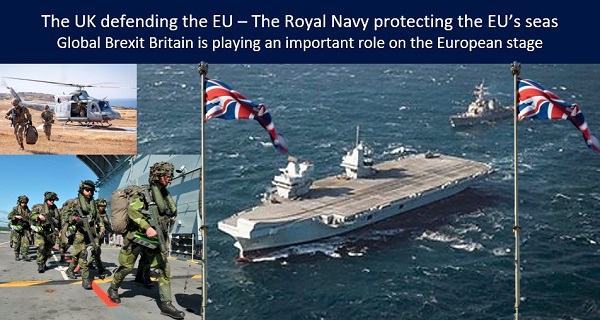
Montage © Facts4EU.Org 2022
A Facts4EU.Org summary of recent and current Royal Navy deployments around the EU
For decades the United Kingdom has invested far more in defending Europe than any EU country. This record continues to this day. As a result of Putin’s war in Ukraine some EU countries are now – belatedly – trying to catch up, but they will never be able to make up for their years of inadequate spending on defence.
In this second of our major reports on how Brexit Britain continues to defend the EU – despite having left the European Union – Facts4EU.Org focuses on the UK’s naval power. (Our first report covered the British Army defending the EU on the ground.)
From the icy Arctic to the sunny Mediterranean we give readers a glimpse into what Global Brexit Britain has been doing in and around the EU’s seas in helping them to defend themselves.
Brexit Facts4EU.Org Summary
The following deployments cover the period from 2019 to the present day
1. The icy North - Exercise Cold Response
© MoD 2022
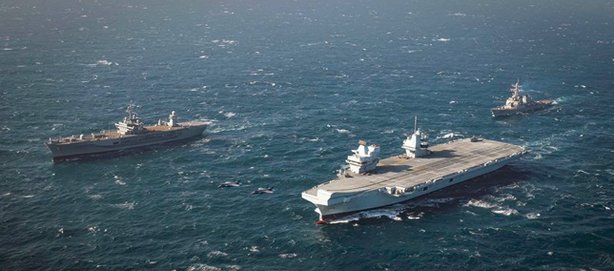
In March this year, the second of the new Royal Navy aircraft carriers, HMS Prince of Wales, took its place at the head of one of the most powerful naval task forces in the world at the start of the largest Arctic military exercise for 30 years.
Six Royal Navy ships and 2,000 UK personnel joined vessels and troops from 26 other nations for Exercise Cold Response off the shores of Norway. The naval task force of 25 ships from 11 nations was led by HMS The Prince of Wales which has been serving as NATO’s command ship.
The UK’s Arctic reach – extreme cold does not deter the British forces

© MoD 2022
One of Britain’s biggest warships sailed within 900 miles of the North Pole as the Royal Navy pushed the boundaries of aircraft carrier operations into the Arctic.
HMS Prince of Wales led a task group to 77 Degrees North in the North Atlantic to demonstrate the ability of the UK’s two 65,000-tonne Queen Elizabeth-class carriers to operate in the harshest environmental conditions. This operation – including the UK-led Joint Expeditionary Force - laid the foundations for Royal Navy carrier operations in the High North for the next half century.
Captain Steve Higham, the carrier’s Commanding Officer, said:
“HMS Prince of Wales deploying in the High North has proved our ability to operate in the Arctic. I’m very proud of our ship's company and their constant innovation in the face of extreme conditions.”
Having acted as NATO command ship throughout Cold Response, the carrier and her task group, including frigate HMS Richmond, destroyer HMS Defender, tankers RFA Tiderace and Tidesurge and a hunter-killer submarine, remained in the North Atlantic to continue their Arctic deployment/cold weather operations under the banner of UK defence’s new policy of contributing to the wider defence of the High North, announced by the Secretary of State last month.
2. Exercise Joint Warrior
Exercise Joint Warrior is the largest military exercise in Europe, bringing together the Royal Navy, the Royal Air Force and the British Army, as well as forces from other nations.
Led by the UK, Joint Warrior takes place in spring and autumn each year. The Royal Navy, Royal Air Force and British Army are joined by forces from 13 other nations, including Belgium, Canada, Denmark, France, Germany, Latvia, the Netherlands, Norway, Spain, Turkey, Japan, UAE and the US.
Taking place over two weeks, Joint Warrior includes airborne assaults, amphibious landings, evacuations and live-fire exercises. It involves 16 warships, 58 aircraft, and 3,725 personnel from 14 nations.
3. Baltic Protector
Starting in May 2019, Operation Baltic Protector marked the first deployment of the UK-led Joint Expeditionary Force (JEF) Maritime Task Group, with command of the group conducted by HMS Albion.

HMS Albion off the coast of Den Helder, Netherlands, with the small Dutch vessel Johna de Witt. © MoD 2022
A total of 3,000 military personnel and 17 vessels from nine nations contribute to the first major maritime training deployment of the UK-led Joint Expeditionary Force (JEF).
HMS Albion was joined by forces with vessels and personnel from Denmark, Estonia, Sweden, Finland, Latvia, Lithuania, Norway and the Netherlands in the western Baltic and eastern North Sea – the first of three phases making up the deployment.
“This deployment represents the largest UK-led operational deployment of a military force in Europe for decades and demonstrates our ability to react quickly and decisively to any crisis in the world.”
- Captain Peter Laughton, Commanding Officer, HMS Albion

© MoD 2022
Pictured are Yankee Company, 45 Commando Royal Marines during an aviation insertion by a Merlin Mk4 helicoper of 845 Naval Air Squadron in Denmark, 29 May 2019
4. Exercise Baltops
Hosted by Strike Force NATO, Exercise Baltops is the largest multinational exercise in the Baltic Sea. Its purpose is to improve maritime security in the region through partnership and the sharing of resources, and to enhance cooperation among the Baltic states.
Each year, the Royal Navy sends a number of vessels to take part in Exercise Baltops, including frigates, minehunters and patrol vessels.

Troops disembarking off the coast of Sweden. © MoD 2022
5. To the sunny Med - but not for a holiday...
Littoral Response Group eXperimental (LRG(X))
In September 2020, HMS Albion led a unique deployment to the Mediterranean.
Albion is a key part of the Royal Navy's amphibious fighting force. This involves carrying Royal Marines and vehicles up to and including the Challenger 2 main battle tank. She also carries landing craft and has a flight deck for helicopter operations. During the deployment Albion's personnel tested unmanned aerial drones and autonomous vehicles for logistical and intelligence gathering purposes.
6. Still on the EU’s southern flank in the Mediterranean…
Offshore Patrol Ship HMS Trent and Type 45 HMS Diamond have recently been part of Standing NATO Maritime Group 2 in the Mediterranean.
Standing NATO Maritime Group 2 is normally deployed to the Mediterranean region but is available to deploy wherever they may be required. Each task group is typically made up of between four and six destroyers and frigates from the various member states of NATO, with ships serving with the force for up to six months at a time. The Royal Navy is an essential element in this force.

Britain’s biggest warship, en route to protect the EU’s southern flank in the Mediterranean © MoD 2022
Fresh from the Arctic, Britain’s biggest warship has just left Portsmouth bound for exercises in the Atlantic and Mediterranean in her latest foray as NATO’s command ship.
HMS Prince of Wales is currently completing two weeks of preparations off the UK’s South Coast before joining warships from across NATO for training and port visits to Spain and Portugal.
The aircraft carrier is scheduled to visit Rota, on Spain’s west coast, before linking up with a multinational task group for Spain’s annual exercises, known as Flotex.
It will involve a large contingent of Spanish ships and will include NATO task groups (Standing NATO Maritime Group 2 and Standing NATO Mine Countermeasures Group 2) which are responsible for the security and prosperity of the Mediterranean.
7. Operation Commando Phoenix

A Royal Marine Commando from Operation Phoenix © MoD 2022
Last month Royal Marines Reserves carried out a mission to rescue a downed pilot at the end of two weeks of intensive exercises in Cyprus. It was the first exercise of its type for three years and was an opportunity for commandos from across the reserves to hone critical skills to keep them sharp for operations around the world.
In the sun-baked Eastern Mediterranean, Griffin helicopters from the Royal Air Force’s 84 Squadron, which operates out of RAF Akrotiri in Cyprus, dropped the commandos in behind enemy lines.

Royal Marine Commandos © MoD 2022
RMR Bristol led Exercise Commando Phoenix, but marines from across the reserves were involved, including RMR London, RMR Merseyside, RMR Scotland and their 20 satellite detachments.
The RMR is the elite amphibious element of the Maritime Reserves and is just 500 strong but must stay at the very top of their game physically and professionally to stay ready.
Observations
Britannia rules the EU's waves
In this second part in our latest defence series, Facts4EU.Org shows how shallow are the claims of those who wish to belittle our country, and who suggest the United Kingdom cannot stand alone, independently of the European Union.
The simple fact is that the Royal Navy – despite what Facts4EU.Org considers to be wholly insufficient funding – has been performing an immensely important task in defending the seas. It has done so around the United Kingdom, around the EU, and indeed as far away as the South China Sea.
From the freezing Arctic to the balmy climes of the Mediterranean, our naval forces have been in the forefront of the projection of naval power.
All of this costs a great deal of money, of course, from the capital costs of building the ships in the first place to the considerable running costs of all these deployments. In our report above we have only summarised seven examples. There are more but we hope our piece gives readers a flavour for the way in which the United Kingdom has been patrolling and defending the seas around the European Union.
Jingoism? No. Merely facts of which the British people can be proud.
It’s lucky the UK isn’t waiting for thanks from the EU Commission
As we pointed out in Part One (on the British Army’s deployments in the EU), the EU Commission has yet to register any form of appreciation for the United Kingdom’s massive contribution to the security and defence of its 27 member states.
This has been going on for decades. No matter. The EU will carry on debating and criticising, while the United Kingdom carries on defending it.
Facts4EU.Org needs you today
We are a 'not for profit' team (we make a loss) and any donation goes towards the actual work, not plush London offices, lunch or taxi expenses, or other luxuries of some organisations.
We badly need more of our thousands of readers to donate. Could this be you, today? Maybe you've been thinking about it, but just haven't got around to doing it? If so, let us reassure you. It's quick and easy and we use two highly secure payment providers. And we do NOT ask you for further donations if you donate once - we just hope that you keep supporting us. Your donation stays anonymous unless you tell us otherwise.
Please don't assume that other people will keep us going - we don't receive enough to survive and we need your help today. Could you help us?
Most of our readers are well-informed and appreciate our fact-based articles, presented in a way you won't see anywhere else. If you value reports like the one above, please help our work with a donation. We have far more to do in researching, publishing, campaigning and lobbying Parliament than we have in terms of the financial resources to fulfil these tasks. We badly need funding to continue - we rely 100% on public donations from readers like you.
If you believe in a fully-free, independent, and sovereign United Kingdom, please make a donation now. It’s quick, secure, and confidential, and you can use one of the links below or you can use our Donations page here. You will receive a personal, friendly ‘thank you’ from a member of our team within 24 hours. Thank you for reading this.
[ Sources: MoD ] Politicians and journalists can contact us for details, as ever.
Brexit Facts4EU.Org, Sat 11 June 2022
Click here to go to our news headlines
Please scroll down to COMMENT on the above article.
And don't forget to actually post your message after you have previewed it!
Since before the EU Referendum, Brexit Facts4EU.Org
has been the most prolific researcher and publisher of Brexit facts in the world.
Supported by MPs, MEPs, & other groups, our work has impact.
We think facts matter. Please donate today, so that we can continue to ensure a clean Brexit is finally delivered.
Any credit card user
Quick One-off

From £5 - £1,000
Monthly

From £3 per month
Paypal Users Only - Choose amount first
Quick One-off
Monthly
Something to say about this? Scroll down for reader comments