Academics conclude Tartan Curtain most likely if an independent Scotland joined the EU
Impartial study of what Brexit means to an independent Scotland: expect hard border with England
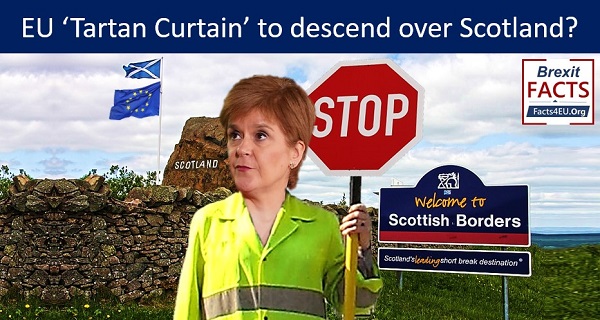
Montage © Facts4EU.Org 2022
Just as Scots want to keep the Pound so they also want an open border with England - irrespective of support for independence or not. A new study suggests a hard border is much more likely following secession.
Project Fear argued Brexit could cause Scottish independence. However the study suggests Brexit makes it less likely because a “hard border” would be required and we know this prospect is very unpopular in Scotland.
The Rt Hon Alister Jack MP, Secretary of State for Scotland
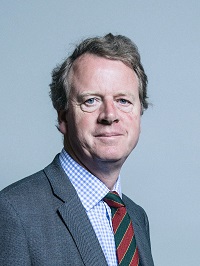
“I live close to the Scotland/England border and it’s little more than a sign that people pass daily, with no thought of moving from one country to another.
“Under the SNP, a hard border would be required with all the associated paperwork, an impediment to business and individuals. With more that unites us than divides us as people, that would be a heartbreaking situation and one most Britons want to prevent.”
Rt Hon Alister Jack MP, Strength in Union, The Case for the United Kingdom, Published by Centre for Policy Studies, 3 October 2021
Brexit Facts4EU.Org Summary
An EU Border across Britain: Scotland’s borders after independence
The report was written by Katy Hayward, Professor of Political Sociology at Queen’s University, and Nicola McEwen, Professor of Territorial Politics at the University of Edinburgh. Both are Senior Fellows with UK in a Changing Europe which is based at Kings College London and is funded by the UK’s Economic and Social Research Council. The report made the following findings:
- ”Some of the cross-border arrangements for an independent Scotland that had been envisaged in the 2014 referendum would no longer be possible as a result of the UK’s departure from the EU.” In other words Brexit has moved the goalposts – considerably.
- The report’s authors anticipate an independent Scotland would be able to obtain an opt-out of the EU’s Schengen Agreement so there would be no need for passport controls at a Scottish-English border. Facts4EU doubts this outcome but notes that little consideration is given in the report to the fact that if an independent Scotland was outside the Schengen area so it could be inside the UK-Ireland Common Travel Agreement it would then have to enforce the immigration checks of the UK at all points of entry to Scotland.
- The report concedes, however that “if Scotland joined the Schengen area, it would imply the need for passport controls between Scotland and its nearest neighbour.” We agree, passport controls would be vital to protect England’s border from illegal immigration.
- The author’s claim “Brexit negotiations resulted in a ‘hard’ Brexit, which has generated new barriers that disrupt the flow of goods, services, people and capital between the UK and the EU.” Our interpretation of this definition is that even were there to be any negotiated trade deal between Scotland and the rest of the UK (such as the EU-UK Trade & Co-operation Agreement) this must also mean a “hard border’ between Scotland and England would result.
- The report states, “The greater the regulatory divergence between England and the EU, the greater the challenge for managing the land border of an independent Scotland, because the greater the likelihood that goods crossing south to north won’t meet the necessary criteria for entry. Effective border checks and controls would then become all the more important.” Facts4EU concurs.
- The report describes the Irish border as 310 miles long “with some 208 officially-recognised crossing points”. Conversely, the roads connecting Scotland with the rest of Great Britain are the M74/M6, the A1, A68, A7 trunk roads, the non-trunk A6105 and A697 - plus just over 20 cross-border minor roads – making a total of some 26 roads. Facts4EU believes that with fewer roads than the NI-RoI Irish border a “hard border” with physical infrastructure would be a real possibility
- The report stated: If Scotland were to join the EU as a member state in its own right, “England would represent a sizeable ‘land-bridge’ to get to the main EU markets.” Facts4EU agrees.
- The report suggested regulatory standards for the whole of the UK and England alone, “may have diverged considerably from EU standards by the time an independent Scotland seeks EU membership. It is also likely that the UK will have secured more trade deals with countries that diverge from the standards set by the EU. The risks to the integrity of the EU internal market could therefore be heightened without a secure system of border management.” Facts4EU believes this would make a hard trade border irresistible to the EU.
- Finally, but not least to many, the report found that “the EU has strict requirements for owners bringing their dogs into the EU from a third country (including Great Britain), such as microchipping, certain vaccinations and vet-issued certificates.” Again, this suggests a “hard Border” to check for these requirements.
Observations
Why Brexit makes Scottish secession far less popular and far more unlikely
It was never something that John Major or Edinburgh’s most famous political son – Tony Blair – were ever prepared to admit. Indeed they claimed the exact opposite, stating on many occasions that a vote to leave the EU would make it far more likely Scots would want independence so they could then join the EU. Facts4EU has never accepted this lazy assumption.
The reality is that when polled the things that most Scots like about being British – having the British Pound Sterling and travelling with ease between Scotland and England – would both be highly unlikely if an independent Scotland wanted to join the EU. The reason for this is that the EU would not want a member that was using the currency of a country outside the EU. (At least Denmark and Sweden etc use their own currencies.) The EU would insist on a hard border between Scotland (and the EU) and England.
The Northern Ireland Protocol has shown how important that border – to protect the purity of the Single Market - is to the EU. With Ireland it ended up in the Irish Sea. With a Scotland after secession it would have to be a land border. And as the report points out, it is a lot simpler to build one between Berwick and Carlisle.
Once voters begin to realise what these details mean – and can see the realities of the Northern Ireland Protocol - then sympathies for secession will cool with many who had not worked out the consequences and hard realities. Arranging deals or a Scottish Protocol would not be able to overcome some of these hurdles.
The lesson to the UK Government is that the faster and greater the regulatory divergence of the UK (or just England) with the EU then the greater will be the need for a hard border in the event of Scottish independence. Now there’s an incentive to diverge and deregulate if ever there was one! What might be termed a Tartan Curtain would soon become a Claymore Curtain.
By calling on the EU to hold firm AGAINST the UK’s attempts to make the trusted trader scheme acceptable in Ireland and to oppose any compromise with the British Government the SNP has surely only made independence in Europe (an oxymoron) far, far harder. Just like that border would be…
Our research and campaigning does not come cost free, nor do we have the resources of the Remainers and Rejoiners…
Facts4EU.Org needs your financial support today
We are a 'not for profit' team (we make a loss) and any donation goes towards the actual work, not plush London offices, lunch or taxi expenses, or other luxuries of some organisations.
We badly need more of our thousands of readers to donate – no matter how small an amount it all helps. Could this be you, today? Maybe you've been thinking about it, but just haven't got around to doing it? If so, let us reassure you. It's quick and easy and we use two highly secure payment providers. And we do NOT ask you for further donations if you donate once - we just hope that you keep supporting us. Your donation stays anonymous unless you tell us otherwise.
Please don't assume that other people will keep us going - we don't receive enough to survive and we need your help today. Could you help us?
Most of our readers are well-informed and appreciate our fact-based articles, presented in a way you won't see anywhere else. If you value reports like the one above, please help our work with a donation. We have far more to do in researching, publishing, campaigning and lobbying Parliament than we have in terms of the financial resources to fulfil these tasks. We badly need funding to continue - we rely 100% on public donations from readers like you.
If you believe in a fully-free, independent, and sovereign United Kingdom, please make a donation now. It’s quick, secure, and confidential, and you can use one of the links below or you can use our Donations page here. You will receive a personal, friendly ‘thank you’ from a member of our team within 24 hours. Thank you for reading this.
[Sources: An EU Border across Britain: Scotland’s borders after independence – published by the UK in A Changing Europe.] Politicians and journalists can contact us for details, as ever.
Brexit Facts4EU.Org, Wednesday, 23 February, 2022
Click here to go to our news headlines
Please scroll down to COMMENT on the above article.
And don't forget to actually post your message after you have previewed it!
Since before the EU Referendum, Brexit Facts4EU.Org
has been the most prolific researcher and publisher of Brexit facts in the world.
Supported by MPs, MEPs, & other groups, our work has impact.
We think facts matter. Please donate today, so that we can continue to ensure a clean Brexit is finally delivered.
Any credit card user
Quick One-off

From £5 - £1,000
Monthly

From £3 per month
Paypal Users Only - Choose amount first
Quick One-off
Monthly
Something to say about this? Scroll down for reader comments