BBC shows its anti-Brexit bias yet again
Commons report critical of Government is turned into a report critical of Brexit
Montage © Facts4EU.Org 2022
Public Accounts Committee looks at value for money of Government – but BBC uses it for anti-Brexit headlines
Yesterday (Wed 09 Feb 2022) the House of Commons Public Accounts Committee, which has as its remit the task of establishing value for money and diligent use of public funds, published a report on “EU Exit: UK Border post transition” which was highly critical of the government’s performance to date.
On examination by Facts4EU, the report shows evidence of veering off from the Committee’s widely understood remit, and worse, of being used by the BBC in a partisan fashion as evidence of systematic Brexit failure rather than government failures.
It is also clear that the report makes little allowance for the impact of Covid-19 lockdowns and other pandemic-related restrictions on the ability of the Government and its agencies to progress the installation of processes and infrastructure.
Brexit Facts4EU.Org Summary
How a Government critique became a Brexit critique
What you see below was the main headline on the BBC News website yesterday morning
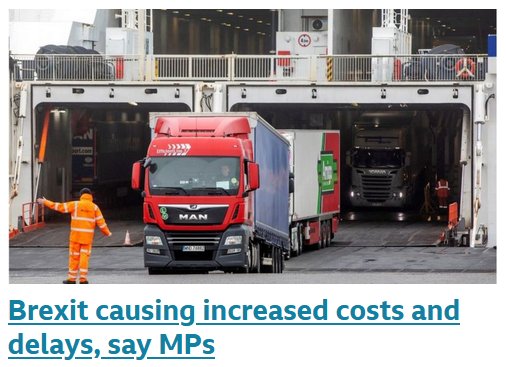
©BBC - click to enlarge
- Findings criticise lack of Government preparation
- BBC and other pro-EU media jump to blame Brexit
- Little if any allowance given for Covid-19 disruption
- No recognition of Schengen rules of the past
- No recognition of EU's inflexible application of rules, compared to UK's flexibility
- No questioning of EU's lack of “co-operation” in Trade & Co-operation Agreement
What the Public Accounts Committee said and the Facts4EU response
Conclusion #1: “The new border arrangements have yet to be tested with normal passenger volumes and may be further challenged when the EU introduces requirements for biometric passport checks.”
FACT: This has nothing to do with Brexit. Everyone on the Committee seems to have forgotten that the UK and Ireland were NOT signatories of the Schengen Agreement and as such passport checks were still required for people coming from or going to EU member states. The introduction of new biometric passport checks by the EU would therefore make no difference had there been Brexit or not, as this change would still have applied to truck drivers, passengers and others if Brexit had never happened. Blaming Brexit for possible disruption in the future – the first conclusion of the report - is therefore misplaced.
Conclusion #2: “The new controls in place over the movement of goods from the UK to the EU have created additional costs for businesses and affected international trade flows.” The Committee then goes on to say, “It is not yet clear to what extent the declines in UK trade with the EU since the end of the transition period have been caused by EU exit, or by the COVID-19 pandemic”.
FACT: The Committee cannot separate the costs of Brexit from the costs of Covid-19. It simply does not know and cannot apportion blame.
The Committee then goes on to state: “In 2019, HMRC estimated that complying just with new customs rules could cost UK and EU businesses £15 billion per year.”
FACT: The balance of goods trade is far greater coming from the EU to the UK than departing from the UK to the EU. Therefore the larger part of any extra cost will be borne by the EU companies. That said, costs for implementing the change in procedures was anticipated by the Government and support was put in place to help with adjustment. It is one thing to say it was inadequate or did not reach the right people – a function of Government performance – but it is another to say that it did not happen because of Brexit itself. FACT: HMRC said in its evidence that “there are indications that the costs to businesses will be less than that estimate.”
Conclusion #3: “More could be done by Government to ensure small and medium sized enterprises (SMEs) are prepared to face the additional costs and administration required by new border requirements.”
FACT: The Committee itself stated, “Some support was provided to SMEs, including the £20 million SME Brexit Support Fund, but narrowly defined criteria meant that many businesses could not access this support and only £6.7 million was paid out.” This is a criticism of Government, NOT Brexit. The Government has sought to protect public funds but possibly been over-zealous in its approach.
Conclusion #4: “Government intends to introduce full import controls in phases from January 2022, but much work remains to be done.”
FACT: The Committee itself stated, “The government has delayed introducing these controls three times and now intends to introduce them in phases between January 2022 and November 2022”. However it made no reference to the fact that Covid-19 has disrupted all Government changes in processes and infrastructure due to the pandemic disruptions to staff illness and lack of availability. In contrast, France and the rest of the EU, which has not had changes to make has simply carried on regardless without any allowance for the pandemic. The Covid factor and the imbalance of approach – despite the Trade and “Cooperation” Agreement - is not mentioned by the media.
Conclusion #8: “Businesses have faced challenges operating under the Northern Ireland Protocol which need to be resolved.”
FACT: The Committee has accepted there are problems “operating under the Northern Ireland protocol” including “considerable diversion of trade” and lacks support among “significant parts of the northern Ireland community”. The BBC chose not to report that the committee recognised there were challenges, nor did they report any of the evidence surrounding those challenges.
The Committee then recommended “Government should continue its efforts to resolve the challenges of the Protocol and ensure that departments are ready to put any negotiated outcome into operation, and that it has prepared for any contingencies which may be required if an agreement cannot be reached between the UK and the EU.”
FACT: The Committee backed the Government in its efforts to resolve the Protocol and did not rule out it invoking Article 16 to suspend aspects of it. None of this was reported by the BBC.
Observations
The report of the Public Accounts Committee is essentially a ‘dog bites man’ story – not ‘man bites dog’ as the BBC has portrayed it - and which would have been newsworthy. The Committee found there were problems with the necessary changes at the UK borders – and that more might yet come – but it was confused by what is a problem of Brexit and what is a failure of government to deliver change.
Notably it failed to take account of the Schengen Agreement making changes by the EU immaterial to Brexit. Secondly it failed to give appropriate significance to the impact of Covid-19 and the restrictions introduced in response to it. Such errors and its overall tone of seeing Brexit as the problem rather than the failure of Government – which is the Committee’s raison d’etre – has allowed sections of the media to cast blame on Brexit.
Readers will have woken up to news broadcasts by a number of channels interpreting the Committee’s report as vindication of criticisms of Brexit. This rather suggests those that wrote up their bulletins and online reports already had their minds made up and simply accepted the summarised Committee media release through the prism of their own prejudices. They certainly could not have read the report in any critical fashion.
This response is not meant as a defence of the Government. Indeed the Government is open to much criticism for a lack of preparation, especially given all the time that has passed since 2016. The only mitigating factor is the impact of Covid and its pandemic response.
What is also noticeable in the report and is swallowed whole by the BBC is that the Government has on three occasions provided grace periods for imports from the EU so that the exporters to the UK could become accustomed to the new arrangements and allowance could be made for lack of UK staff due to Covid restrictions. And yet at no time has the EU made any similar allowances, when it would be easier for it to do so, as it is not having to change its rules as they already exist for other “3rd countries”.
This acceptance of the uncooperative nature of the EU is revealing in itself of the attitudes of the Committee and the media.
The inflammatory and critical media reports would not count as bias so much if they were accompanied by similar and balancing enthusiasm for the many benefits of Brexit that we regularly publish on these pages. But they never are. All we have is an unrelenting stream of Bad Brexit News with any good news challenged and doubted.
It is for this reason that many members of the public no longer watch or listen to the legacy media but now have alternative sources – even English language sources from other countries that give a far more balanced view. And yet the Brexit Bashing Corporation wonders why so many people question the imposition of a tax that is punishable by a conviction and possibly a period in jail if it goes unpaid.
The public pays for a balanced news service – it has every right to expect one or to withhold its licence fee until it happens.
Our hard work in preparing these reports does not come cost free, however…
Facts4EU.Org needs your financial support today
We are a 'not for profit' team (we make a loss) and any donation goes towards the actual work, not plush London offices, lunch or taxi expenses, or other luxuries of some organisations.
We badly need more of our thousands of readers to donate – no matter how small an amount it all helps. Could this be you, today? Maybe you've been thinking about it, but just haven't got around to doing it? If so, let us reassure you. It's quick and easy and we use two highly secure payment providers. And we do NOT ask you for further donations if you donate once - we just hope that you keep supporting us. Your donation stays anonymous unless you tell us otherwise.
Please don't assume that other people will keep us going - we don't receive enough to survive and we need your help today. Could you help us?
Most of our readers are well-informed and appreciate our fact-based articles, presented in a way you won't see anywhere else. If you value reports like the one above, please help our work with a donation. We have far more to do in researching, publishing, campaigning and lobbying Parliament than we have in terms of the financial resources to fulfil these tasks. We badly need funding to continue - we rely 100% on public donations from readers like you.
If you believe in a fully-free, independent, and sovereign United Kingdom, please make a donation now. It’s quick, secure, and confidential, and you can use one of the links below or you can use our Donations page here. You will receive a personal, friendly ‘thank you’ from a member of our team within 24 hours. Thank you for reading this.
[ Sources: House of Commons Public Accounts Committee report | BBC online news reporting. ] Politicians and journalists can contact us for details, as ever.
Brexit Facts4EU.Org,Thursday, 10 February, 2022
Since before the EU Referendum, Brexit Facts4EU.Org
has been the most prolific researcher and publisher of Brexit facts in the world.
Supported by MPs, MEPs, & other groups, our work has impact.
We think facts matter. Please donate today, so that we can continue to ensure a clean Brexit is finally delivered.
Any credit card user
Quick One-off

From £5 - £1,000
Monthly

From £3 per month
Paypal Users Only - Choose amount first
Quick One-off
Monthly
Something to say about this? Scroll down for reader comments